



 Chat with AI
Exam 11: Viral Molecular Biology

Exam 1: Microbial Life: Origin and Discovery69 Questions
Exam 2: Observing the Microbial Cell69 Questions
Exam 3: Cell Structure and Function72 Questions
Exam 4: Bacterial Culture, Growth, and Development70 Questions
Exam 5: Environmental Influences and Control of Microbial Growth70 Questions
Exam 6: Viruses70 Questions
Exam 7: Genomes and Chromosomes70 Questions
Exam 8: Transcription, Translation, and Bioinformatics76 Questions
Exam 9: Gene Transfer, Mutations, and Genome Evolution72 Questions
Exam 10: Molecular Regulation73 Questions
Exam 11: Viral Molecular Biology70 Questions
Exam 12: Biotechniques and Synthetic Biology72 Questions
Exam 13: Energetics and Catabolism77 Questions
Exam 14: Electron Flow in Organotrophy, Lithotrophy, and Phototrophy70 Questions
Exam 15: Biosynthesis70 Questions
Exam 16: Food and Industrial Microbiology73 Questions
Exam 17: Origins and Evolution70 Questions
Exam 18: Bacterial Diversity71 Questions
Exam 19: Archaeal Diversity70 Questions
Exam 20: Eukaryotic Diversity70 Questions
Exam 21: Microbial Ecology70 Questions
Exam 22: Microbes in Global Elemental Cycles70 Questions
Exam 23: Human Microbiota and Innate Immunity70 Questions
Exam 24: The Adaptive Immune Response70 Questions
Exam 25: Microbial Pathogenesis70 Questions
Exam 26: Microbial Diseases69 Questions
Exam 27: Antimicrobial Therapy72 Questions
Exam 28: Clinical Microbiology and Epidemiology75 Questions
Select questions type


What is an oncolytic virus? Give an example.

Free
(Essay)
4.8/5  (92)
(92) Correct Answer: Verified
Viruses that prefer to infect tumor cells are called oncolytic and can be used in treating cancer. An engineered form of herpes simplex virus 1 has been developed and approved in the United States for viriotherapy as an alternative in the treatment of patients with inoperable tumors.
T-VEC is the commercial name of an engineered form of herpes simplex virus 1 that has been approved for viriotherapy.
T-VEC-infected tumor cells release fragments that attract cells of the immune system, which eventually destroy the tumor. Once the immune system is activated, it recognizes metastatic tumorous cells that might have spread throughout the body.
Retroelements are remains of retroviral genomes in various states of decay. Which of the following are NOT retroelements?
Free
(Multiple Choice)
4.9/5 (79)
(79) Correct Answer:Verified
VerifiedD
The genome of the influenza virus is best described as
Free
(Multiple Choice)
4.9/5 (90)
(90) Correct Answer:Verified
VerifiedA
Sequences of endogenous retroviruses (HERVs) are remnants of retroviral infections. HERVs have accumulated over millions of years and comprise about 8% of the human genome. Briefly describe the evidence for the expression of HERV-K proteins and virus-like particles in the human embryo. What are the implications of HERV-K products interacting with embryonic factors?
(Essay)
4.9/5 (84)
(84) The lambda genome is replicated by a rolling circle mechanism. What is the end result after a round of replication?
(Multiple Choice)
4.8/5 (92)
(92) What is the mechanism by which the viriotherapeutic agent T-VEC specifically kills hard-to-treat tumors?
(Essay)
4.9/5 (78)
(78) The figure below shows the structures involved in attachment of HIV to a host cell. The protein gp120 is represented by the number ________; CCR5 is indicated by ________ and CD4 by ________. 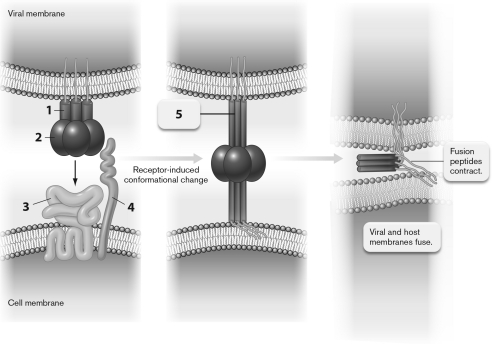
(Multiple Choice)
4.8/5 (79)
(79) Glycosylation and packaging of the HIV env proteins occur in the
(Multiple Choice)
4.9/5 (81)
(81) The HIV genome can be characterized by all of the following EXCEPT
(Multiple Choice)
4.9/5 (75)
(75) Describe the several features of lentivectors. What are their molecular sources?
(Essay)
4.9/5 (91)
(91) What is the cause for cloudy centers appearing in lambda plaques on an Escherichia coli confluent plate?
(Multiple Choice)
4.9/5 (89)
(89) Use the figure below to describe the events leading to the fusion between influenza virus A and host membranes. What structures are indicated by the numbers?
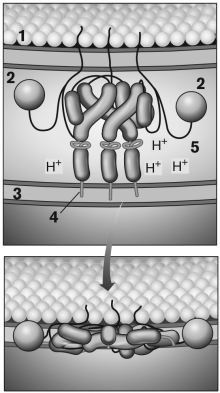
(Essay)
4.8/5 (82)
(82) The term "________" describes the mutation-caused emergence of multiple viral strains that present differing properties of replication, tissue tropism, and drug resistance within a single infected individual.
(Multiple Choice)
4.9/5 (72)
(72) RNA synthesis of influenza virus is primed by 7-methylguanine fragments of host mRNA, obtained by
(Multiple Choice)
4.8/5 (77)
(77) Control proteins Cro and CII lead to lysis or lysogeny, respectively. What environmental signal in the host contributes to regulate the amount of CII by influencing the activity of the protease HflB?
(Multiple Choice)
4.7/5 (79)
(79) Which of the following is FALSE regarding the establishment of lysogeny?
(Multiple Choice)
4.9/5 (82)
(82) Which are the main open reading frames (ORFs) present in all retroviruses, including HIV?
(Multiple Choice)
4.9/5 (91)
(91) HIV-infected cells can fuse with neighboring cells, subsequently forming a giant multinucleate cell known as a
(Multiple Choice)
4.8/5 (93)
(93) The lack of ________ in some people makes them resistant to HIV infection.
(Multiple Choice)
4.8/5 (64)
(64) Endogenous retroviruses (ERVs) express viral components, including reverse transcriptase, as part of the host cell normal functions. What role do ERVs play in mouse B-cell immune response to carbohydrate antigens?
(Essay)
4.9/5 (80)
(80) 
Filters
- Essay(0)
- Multiple Choice(0)
- Short Answer(0)
- True False(0)
- Matching(0)