



 Chat with AI
Exam 16: Food and Industrial Microbiology


Which of the following is NOT an example of a microbial enzyme used in industrial or commercial applications?

 (62)
 Verified
C
Use the figure below to describe four types of fermentation used in food preparation. Make sure to indicate what the Roman numerals indicate. Give an example of a product that is made from each type of fermentation.
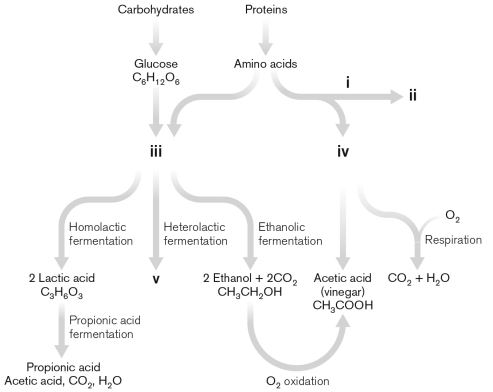
(86) VerifiedAmino acids, product of protein hydrolysis, are the substrate for alkaline fermentation [i]; ammonia, a byproduct [ii], raises pH and prevents microbial growth. An example is dawadawa, a paste of fermented beans common in West Africa. [iii] Glucose is converted to pyruvic acid, which is then converted to lactic acid. Acetyl-CoA [iv], also a product of alkaline fermentation, may be used as a respiratory substrate or converted to acetic acid, widely used in pickling. Pyruvic acid is a precursor in many types of fermentation. In lactic acid fermentation, lactic acid is produced from pyruvate, as in cheeses. Propionic acid can be formed from lactic acid by further fermentation, as in Swiss cheese. Heterolactic fermentation (v) results in the production of lactic acid, ethanol, and carbon dioxide, as in sauerkraut. Ethanolic fermentation results in the production of ethanol and carbon dioxide, as in beer.
Alcohol dehydrogenase in the ________ detoxifies alcohol produced in the intestines.
(80) VerifiedB
The following are desirable characteristics of an industrial strain, EXCEPT
(78) Brewer's yeast, Saccharomyces cerevisiae, conducts ________ fermentation of maltose, a ________, which is produced by the action of amylases on starch.
(80) Escherichia coli O157:H7 was first observed in fast-food hamburger meat. More recently, it has been associated with contamination of spinach and other vegetables. How did the spread of this strain from meat to vegetables happen?
(74) Describe the primary and secondary fermentations involved in winemaking.
(81) Microorganisms are used in the production of many small molecules, such as amino acids, vitamins, and medicines. Which of the following is NOT produced by a bacterium?
(75) An acid or base serves as an effective preservative because
(71) The ________ of milk proteins results in the formation of curds.
(69) Ethanolic fermentation of ________ was important to early civilizations because it provided a drink free of waterborne pathogens.
(82) The search for organisms with potential commercial application is called
(95) Describe how the transportation of milk products by herders led to the formation of cheeses.
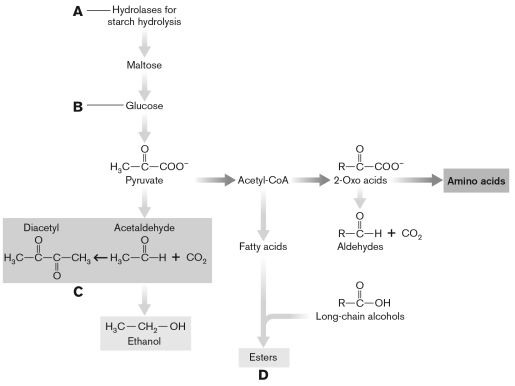
(79) In the figure below, identify the carbohydrate substrate for fermentation in the production of beer and wine. Compare and contrast the desirable flavors and off-flavors that may come about during ethanolic fermentation in both cases.
(74) The most common food-borne cause of death in the United States is
(60) What proportion of known species of mushrooms are poisonous?
(75) The ________ gene products stimulate plasmid transfer from Agrobacterium to the host plant.
(78) 
Filters
- Essay(0)
- Multiple Choice(0)
- Short Answer(0)
- True False(0)
- Matching(0)