



 Chat with AI
Exam 16: Food and Industrial Microbiology

Exam 1: Microbial Life: Origin and Discovery69 Questions
Exam 2: Observing the Microbial Cell69 Questions
Exam 3: Cell Structure and Function72 Questions
Exam 4: Bacterial Culture, Growth, and Development70 Questions
Exam 5: Environmental Influences and Control of Microbial Growth70 Questions
Exam 6: Viruses70 Questions
Exam 7: Genomes and Chromosomes70 Questions
Exam 8: Transcription, Translation, and Bioinformatics76 Questions
Exam 9: Gene Transfer, Mutations, and Genome Evolution72 Questions
Exam 10: Molecular Regulation73 Questions
Exam 11: Viral Molecular Biology70 Questions
Exam 12: Biotechniques and Synthetic Biology72 Questions
Exam 13: Energetics and Catabolism77 Questions
Exam 14: Electron Flow in Organotrophy, Lithotrophy, and Phototrophy70 Questions
Exam 15: Biosynthesis70 Questions
Exam 16: Food and Industrial Microbiology73 Questions
Exam 17: Origins and Evolution70 Questions
Exam 18: Bacterial Diversity71 Questions
Exam 19: Archaeal Diversity70 Questions
Exam 20: Eukaryotic Diversity70 Questions
Exam 21: Microbial Ecology70 Questions
Exam 22: Microbes in Global Elemental Cycles70 Questions
Exam 23: Human Microbiota and Innate Immunity70 Questions
Exam 24: The Adaptive Immune Response70 Questions
Exam 25: Microbial Pathogenesis70 Questions
Exam 26: Microbial Diseases69 Questions
Exam 27: Antimicrobial Therapy72 Questions
Exam 28: Clinical Microbiology and Epidemiology75 Questions
Select questions type


What categories of foods may be spoiled by psychrotrophs? Why are these organisms a problem with fish?
(Essay)
4.8/5  (78)
(78) Nori used as a sushi wrap is produced by growing Porphyra, a ________, in tanks.
(Multiple Choice)
4.8/5 (95)
(95) Use the figure below to discuss how molecular tools are used in the investigation of pathogen-contaminated food. What does the figure represent? What is the overall conclusion of the analysis?
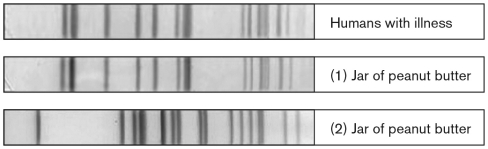
(Essay)
4.8/5 (89)
(89) Mold ripening refers to the secondary ________ stage of cheese production.
(Multiple Choice)
4.8/5 (61)
(61) Which of the following contains protein as high as 25% dry weight and are an excellent source of all the essential dietary amino acids?
(Multiple Choice)
4.9/5 (84)
(84) Until the recent invention of ________, all foods contained live microbes.
(Multiple Choice)
4.9/5 (81)
(81) Which of the following organisms or processes is NOT involved in the chocolate-making process?
(Multiple Choice)
4.9/5 (84)
(84) Which of the following products of beer making and winemaking result in off-flavors?
(Multiple Choice)
4.8/5 (95)
(95) In beer making, enzymatic activities during germination of barley produce the ________ used for fermentation.
(Multiple Choice)
4.7/5 (70)
(70) Production of traditionally fermented foods typically relies on ________ microbiota, whereas commercial fermentation generally relies on ________.
(Multiple Choice)
4.8/5 (74)
(74) Miso is a fermented Japanese condiment made primarily from ________, which is salted and fermented with ________ for two months.
(Multiple Choice)
4.7/5 (84)
(84) Within a mound of cocoa beans, ________ generates heat so that the mound temperature increases up to 50°C.
(Multiple Choice)
4.8/5 (79)
(79) Describe some of the characteristics that industrial strains of microbes must possess.
(Essay)
4.8/5 (68)
(68) Which of the following is classified as a form of single-celled protein?
(Multiple Choice)
4.8/5 (80)
(80) What are the three stages in the fermentation of cocoa beans for chocolate (in order)?
(Multiple Choice)
4.8/5 (92)
(92) Sauerkraut is primarily fermented with the bacterium ________ that uses a ________ type of fermentation.
(Multiple Choice)
4.9/5 (75)
(75) Listeria is a(n) ________ organism, which means that it readily grows at refrigeration temperatures.
(Multiple Choice)
5.0/5 (78)
(78) 
Filters
- Essay(0)
- Multiple Choice(0)
- Short Answer(0)
- True False(0)
- Matching(0)