



 Chat with AI
Exam 6: Viruses

Exam 1: Microbial Life: Origin and Discovery69 Questions
Exam 2: Observing the Microbial Cell69 Questions
Exam 3: Cell Structure and Function72 Questions
Exam 4: Bacterial Culture, Growth, and Development70 Questions
Exam 5: Environmental Influences and Control of Microbial Growth70 Questions
Exam 6: Viruses70 Questions
Exam 7: Genomes and Chromosomes70 Questions
Exam 8: Transcription, Translation, and Bioinformatics76 Questions
Exam 9: Gene Transfer, Mutations, and Genome Evolution72 Questions
Exam 10: Molecular Regulation73 Questions
Exam 11: Viral Molecular Biology70 Questions
Exam 12: Biotechniques and Synthetic Biology72 Questions
Exam 13: Energetics and Catabolism77 Questions
Exam 14: Electron Flow in Organotrophy, Lithotrophy, and Phototrophy70 Questions
Exam 15: Biosynthesis70 Questions
Exam 16: Food and Industrial Microbiology73 Questions
Exam 17: Origins and Evolution70 Questions
Exam 18: Bacterial Diversity71 Questions
Exam 19: Archaeal Diversity70 Questions
Exam 20: Eukaryotic Diversity70 Questions
Exam 21: Microbial Ecology70 Questions
Exam 22: Microbes in Global Elemental Cycles70 Questions
Exam 23: Human Microbiota and Innate Immunity70 Questions
Exam 24: The Adaptive Immune Response70 Questions
Exam 25: Microbial Pathogenesis70 Questions
Exam 26: Microbial Diseases69 Questions
Exam 27: Antimicrobial Therapy72 Questions
Exam 28: Clinical Microbiology and Epidemiology75 Questions
Select questions type


What is it necessary for bacteriophage and animal virus entry into a cell? How does that differ from plant viral entry?
(Essay)
4.8/5  (94)
(94) How is the technique displayed in the figure below used to count virions in a solution?
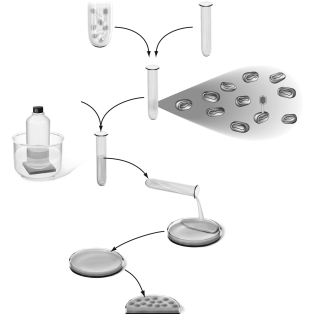
(Essay)
4.9/5 (78)
(78) When a bacterial cell is infected, the virus protection coat
(Multiple Choice)
4.8/5 (84)
(84) In contrast to animal viruses and bacteriophages, plant viruses infect cells by mechanisms that do NOT involve specific
(Multiple Choice)
4.8/5 (68)
(68) What type of diseases are unique in that they can be transmitted by an infective protein that propagates conformational change of existing molecules without synthesizing entirely new infective molecules?
(Multiple Choice)
4.9/5 (61)
(61) Who was distinguished for modifying tissue culture procedure for plaque assays?
(Multiple Choice)
4.9/5 (84)
(84) The genome of ________ ssRNA viruses can serve directly as mRNA.
(Multiple Choice)
4.8/5 (80)
(80) Within a host, receptor molecules can also determine the ________, or tendency to infect a particular tissue type.
(Multiple Choice)
4.8/5 (82)
(82) A(n) ________ phage may integrate its genome into that of the host cell.
(Multiple Choice)
4.9/5 (88)
(88) Which of the following is a term for the observable destruction of cells as a result of viral lysis?
(Multiple Choice)
4.8/5 (68)
(68) David Baltimore proposed that the primary distinction among classes of viruses was the ________ composition and the route used to express messenger RNA.
(Multiple Choice)
4.9/5 (90)
(90) Which is the period of time that is categorized by virtually undetectable virions inside the infected cell?
(Multiple Choice)
4.9/5 (76)
(76) Which filamentous virus causes a fatal disease in humans and is also related to primates?
(Multiple Choice)
4.8/5 (67)
(67) An icosahedral capsid is classified as having how many sides?
(Multiple Choice)
4.8/5 (87)
(87) What can be counted as representing individual infectious virions from a phage suspension?
(Multiple Choice)
4.8/5 (79)
(79) In bacteriophage T4, the DNA genome is contained in the head, and binding to the host is facilitated by attachment of the
(Multiple Choice)
4.8/5 (78)
(78) 
Filters
- Essay(0)
- Multiple Choice(0)
- Short Answer(0)
- True False(0)
- Matching(0)