



 Chat with AI
Exam 20: Eukaryotic Diversity

Exam 1: Microbial Life: Origin and Discovery69 Questions
Exam 2: Observing the Microbial Cell69 Questions
Exam 3: Cell Structure and Function72 Questions
Exam 4: Bacterial Culture, Growth, and Development70 Questions
Exam 5: Environmental Influences and Control of Microbial Growth70 Questions
Exam 6: Viruses70 Questions
Exam 7: Genomes and Chromosomes70 Questions
Exam 8: Transcription, Translation, and Bioinformatics76 Questions
Exam 9: Gene Transfer, Mutations, and Genome Evolution72 Questions
Exam 10: Molecular Regulation73 Questions
Exam 11: Viral Molecular Biology70 Questions
Exam 12: Biotechniques and Synthetic Biology72 Questions
Exam 13: Energetics and Catabolism77 Questions
Exam 14: Electron Flow in Organotrophy, Lithotrophy, and Phototrophy70 Questions
Exam 15: Biosynthesis70 Questions
Exam 16: Food and Industrial Microbiology73 Questions
Exam 17: Origins and Evolution70 Questions
Exam 18: Bacterial Diversity71 Questions
Exam 19: Archaeal Diversity70 Questions
Exam 20: Eukaryotic Diversity70 Questions
Exam 21: Microbial Ecology70 Questions
Exam 22: Microbes in Global Elemental Cycles70 Questions
Exam 23: Human Microbiota and Innate Immunity70 Questions
Exam 24: The Adaptive Immune Response70 Questions
Exam 25: Microbial Pathogenesis70 Questions
Exam 26: Microbial Diseases69 Questions
Exam 27: Antimicrobial Therapy72 Questions
Exam 28: Clinical Microbiology and Epidemiology75 Questions
Select questions type


What are choanoflagellates and what is their importance in evolutionary studies?
(Essay)
5.0/5  (67)
(67) Amanita phalloides makes a-amanitin, a dangerous toxin that can be used in the laboratory for studies in molecular biology. What enzyme is inhibited by a-amanitin?
(Multiple Choice)
4.8/5 (78)
(78) New and emerging drug therapy targets for Plasmodium falciparum include
(Multiple Choice)
4.7/5 (79)
(79) Encephalitozoon intestinalis is an organism classified as a Microsporidia. It is of clinical importance because it
(Multiple Choice)
4.9/5 (65)
(65) The protozoa were considered to be microscopic animals because
(Multiple Choice)
5.0/5 (76)
(76) Briefly describe the life cycle of Ascomyta and describe three ascomycetes that have been used in science or in the culinary arts.
(Essay)
4.8/5 (78)
(78) Leishmania major causes a skin infection that can then disseminate to internal organs and is transmitted to a human host by
(Multiple Choice)
4.8/5 (78)
(78) Which group has the widest range of form but the least diversity in terms of metabolism?
(Multiple Choice)
4.9/5 (62)
(62) One of the smallest eukaryotes recently discovered, the green alga Ostreococcus tauri, measures less than ________ across and its genome (8 Mb) is ________ the size of that of Escherichia coli.
(Multiple Choice)
4.7/5 (74)
(74) Why are sponges, jellyfish, worms, reptiles, humans, yeast, and microsporidia placed in the same eukaryotic clade?
(Essay)
4.9/5 (89)
(89) The following are characteristics of primary algae EXCEPT that
(Multiple Choice)
4.8/5 (79)
(79) Organisms in the ________ clade have lost their mitochondria through the process of reductive (degenerative) evolution.
(Multiple Choice)
4.9/5 (74)
(74) Which of the following statements regarding pseudopods is NOT correct?
(Multiple Choice)
5.0/5 (82)
(82) Physarum polycephalum is a type of plasmodial slime mold that can be seen as a yellow mass growing on decaying wood. This organism produces
(Multiple Choice)
5.0/5 (77)
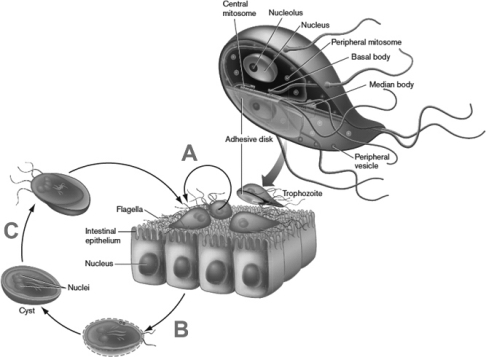
(77) In the figure below, the letters A, B, and C represent the formation of Giardia intestinalis dormant cysts from trophozoites and back. Briefly describe the structure and life cycle of G. intestinalis. What conditions lead to the formation of the cyst?
(Essay)
4.8/5 (64)
(64) What are nanoeukaryotes and how has their discovery changed our understanding of biological systems?
(Essay)
4.8/5 (82)
(82) Some rhodophyta, or red algae, appear red due to the presence of the pigment
(Multiple Choice)
4.8/5 (81)
(81) Trypanosomes are a group of organisms that share which of the following characteristics?
(Multiple Choice)
5.0/5 (85)
(85) 
Filters
- Essay(0)
- Multiple Choice(0)
- Short Answer(0)
- True False(0)
- Matching(0)