



 Chat with AI
Exam 17: Origins and Evolution

Exam 1: Microbial Life: Origin and Discovery69 Questions
Exam 2: Observing the Microbial Cell69 Questions
Exam 3: Cell Structure and Function72 Questions
Exam 4: Bacterial Culture, Growth, and Development70 Questions
Exam 5: Environmental Influences and Control of Microbial Growth70 Questions
Exam 6: Viruses70 Questions
Exam 7: Genomes and Chromosomes70 Questions
Exam 8: Transcription, Translation, and Bioinformatics76 Questions
Exam 9: Gene Transfer, Mutations, and Genome Evolution72 Questions
Exam 10: Molecular Regulation73 Questions
Exam 11: Viral Molecular Biology70 Questions
Exam 12: Biotechniques and Synthetic Biology72 Questions
Exam 13: Energetics and Catabolism77 Questions
Exam 14: Electron Flow in Organotrophy, Lithotrophy, and Phototrophy70 Questions
Exam 15: Biosynthesis70 Questions
Exam 16: Food and Industrial Microbiology73 Questions
Exam 17: Origins and Evolution70 Questions
Exam 18: Bacterial Diversity71 Questions
Exam 19: Archaeal Diversity70 Questions
Exam 20: Eukaryotic Diversity70 Questions
Exam 21: Microbial Ecology70 Questions
Exam 22: Microbes in Global Elemental Cycles70 Questions
Exam 23: Human Microbiota and Innate Immunity70 Questions
Exam 24: The Adaptive Immune Response70 Questions
Exam 25: Microbial Pathogenesis70 Questions
Exam 26: Microbial Diseases69 Questions
Exam 27: Antimicrobial Therapy72 Questions
Exam 28: Clinical Microbiology and Epidemiology75 Questions
Select questions type


Define the term "metagenomics" and explain why growth in this field has led to an increase in SSU rRNA species designations.
(Essay)
4.9/5  (68)
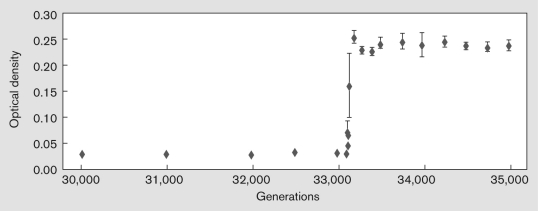
(68) During the Long-Term Evolution Experiment (LTEE), investigators found a Cit⁺ strain of Escherichia coli that allowed fast growth on citrate buffer after 33,000 generations. The ability to catabolize citrate evolved at this time through
(Multiple Choice)
4.7/5 (71)
(71) The loss of genes encoding for unselected traits is known as
(Multiple Choice)
4.9/5 (85)
(85) Human diseases caused by defective mitochondrial DNA include all of the following EXCEPT
(Multiple Choice)
4.9/5 (95)
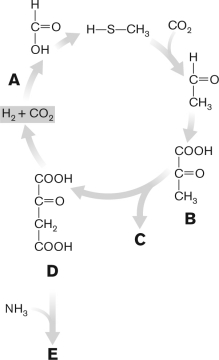
(95) The figure below depicts a metabolist model for CO₂ fixation as the basis for biosynthesis as proposed by Morowitz and Wächterhäuser. Discuss the pathway and determine what its outcome is.
(Essay)
4.8/5 (74)
(74) Which of the following is NOT correct regarding conditions for life on Earth?
(Multiple Choice)
4.8/5 (72)
(72) The following is correct about a probabilistic indicator for bacterial identification, EXCEPT that
(Multiple Choice)
4.9/5 (85)
(85) The word "symbiosis" is usually understood to mean ________, a relationship in which both partners benefit and may absolutely require each other.
(Multiple Choice)
4.9/5 (72)
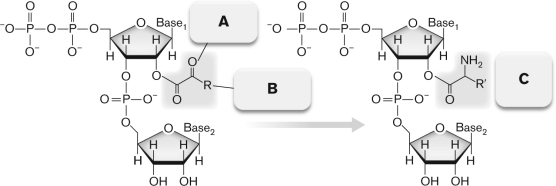
(72) Refer to the figure below and briefly discuss the possible origin of the genetic code.
(Essay)
4.9/5 (81)
(81) The Long-Term Evolution Experiment (LTEE) has been conducted by Richard Lenski at Michigan State University since 1988. The purpose of the experiment is to observe evolution in action in a laboratory environment. Use the figure below to explain what physiological adaptations allowed one of the Escherichia coli strains to grow to a much higher density after 33,000 generations.
(Essay)
4.8/5 (69)
(69) Appearance of a new trait in experimental evolution consists of which three basic stages?
(Multiple Choice)
4.9/5 (78)
(78) Cyanobacterial endosymbionts in the protist ________retain cell walls and some metabolism, thus serving as a model for cyanobacterial uptake.
(Multiple Choice)
4.8/5 (90)
(90) Spikes in ________ content often indicate that a horizontal gene transfer has occurred in the genome.
(Multiple Choice)
4.8/5 (78)
(78) Which of the following is the organizing body that sets the rules for naming a new prokaryotic species or taxa?
(Multiple Choice)
4.8/5 (78)
(78) 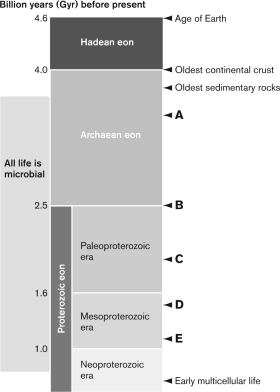
The ancestral organism that gave rise to the modern-day chloroplast was
(Multiple Choice)
4.7/5 (73)
(73) Explain how studying the evolutionary rate of RNA viruses in comparison to DNA viruses can help explain the evolutionary rate in early Earth.
(Essay)
4.9/5 (78)
(78) 
Filters
- Essay(0)
- Multiple Choice(0)
- Short Answer(0)
- True False(0)
- Matching(0)