



 Chat with AI
Exam 13: Crisis and Renaissance, 1340-1492

Exam 1: Early Western Civilization, 400,000-1000 B.C.E65 Questions
Exam 2: Near East Empires and the Reemergence of Civilization in Greece, 1000-500 B.C.E64 Questions
Exam 3: The Greek Golden Age, C 500-C 400 B.C.E65 Questions
Exam 4: From the Classical to the Hellenistic World, 400-30 B.C.E65 Questions
Exam 5: The Rise of Rome and Its Republic, 753-44 B.C.E64 Questions
Exam 6: The Creation of the Roman Empire, 44 B.C.E-284 C.E65 Questions
Exam 7: The Transformation of the Roman Empire, 284-600 C.E64 Questions
Exam 8: The Heirs of Rome: Islam, Byzantium, and Europe, 600-75065 Questions
Exam 9: From Centralization to Fragmentation, 750-105065 Questions
Exam 10: Commercial Quickening and Religious Reform, 1050-115065 Questions
Exam 11: The Flowering of the Middle Ages, 1150-121565 Questions
Exam 12: The Medieval Synthesis and Its Cracks, 1215-134065 Questions
Exam 13: Crisis and Renaissance, 1340-149265 Questions
Exam 14: Global Encounters and the Shock of the Reformation, 1492-156065 Questions
Exam 15: Wars of Religion and the Clash of Worldviews, 1560-164865 Questions
Exam 16: Absolutism, Constitutionalism, and the Search for Order, 1640-170065 Questions
Exam 17: The Atlantic System and Its Consequences, 1700-175065 Questions
Exam 18: The Promise of Enlightenment, 1750-178965 Questions
Exam 19: The Cataclysm of Revolution, 1789-179965 Questions
Exam 20: Napoleon and the Revolutionary Legacy, 1800-183065 Questions
Exam 21: Industrialization and Social Ferment, 1830-185064 Questions
Exam 22: Politics and Culture of the Nation-State, 1850-187065 Questions
Exam 23: Empire, Industry, and Everyday Life, 1870-189065 Questions
Exam 24: Modernity and the Road to War, 1890-191465 Questions
Exam 25: World War I and Its Aftermath, 1914-192965 Questions
Exam 26: The Great Depression and World War II, 1929-194565 Questions
Exam 27: The Cold War and the Remaking of Europe, 1945-1960s64 Questions
Exam 28: Postindustrial Society and the End of the Cold War Order, 1960s-198965 Questions
Exam 29: A New Globalism, 1989 to the Present65 Questions
Select questions type


What state filled the territorial gap between France and Germany but was, unlike most other European states, an artificial creation whose existence depended entirely on skillful rulers?
(Multiple Choice)
4.8/5  (77)
(77) Why is the mid-fourteenth century regarded as an era of crisis in the West?
(Multiple Choice)
5.0/5 (81)
(81) Which of the following did the Peace of Lodi (1454) accomplish?
(Multiple Choice)
4.9/5 (79)
(79) How and why did the centralizing Spanish monarchy become an agent of intolerance with regard to its religious minorities?
(Essay)
4.7/5 (74)
(74) How did the leading Renaissance musicians and composers support themselves in their artistic endeavors?
(Multiple Choice)
4.9/5 (78)
(78) Which of the following was part of the Holy Roman Empire by about 1492?
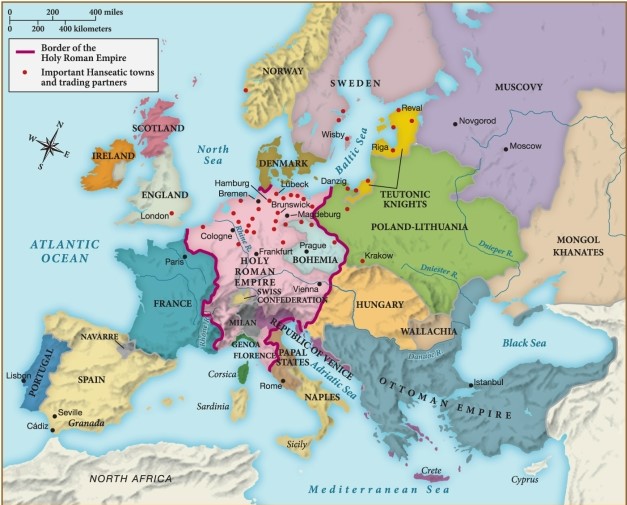
(Multiple Choice)
4.8/5 (85)
(85) This map shows that during the fourteenth and fifteenth centuries, the Ottoman Empire
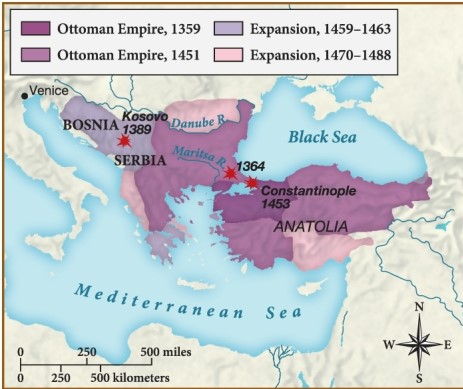
(Multiple Choice)
4.8/5 (87)
(87) Which of the following statements about the Swiss Confederation is true?
(Multiple Choice)
4.8/5 (85)
(85) In the year 1492, Ferdinand and Isabella succeeded in reunifying Spain by conquering what kingdom on the Iberian peninsula?
(Multiple Choice)
4.7/5 (82)
(82) Describe how the Ottoman Turks were finally able to conquer Constantinople in 1453. What significance did this event have for Europe?
(Essay)
4.8/5 (81)
(81) What is historians' highest estimate for the percentage of the European population that perished from the plague between 1348 and 1400?
(Multiple Choice)
4.9/5 (72)
(72) Sandro Botticelli and other Renaissance painters mined the ancient world for new subjects, such as
(Multiple Choice)
4.8/5 (73)
(73) Which of the following initially precipitated the Hundred Years' War (1337-1453)?
(Multiple Choice)
4.7/5 (82)
(82) Describe the causes and the political, military, and social impact of the Hundred Years' War in western Europe.
(Essay)
5.0/5 (72)
(72) 
Filters
- Essay(0)
- Multiple Choice(0)
- Short Answer(0)
- True False(0)
- Matching(0)