



 Chat with AI
Exam 20: Napoleon and the Revolutionary Legacy, 1800-1830

Exam 1: Early Western Civilization, 400,000-1000 B.C.E65 Questions
Exam 2: Near East Empires and the Reemergence of Civilization in Greece, 1000-500 B.C.E64 Questions
Exam 3: The Greek Golden Age, C 500-C 400 B.C.E65 Questions
Exam 4: From the Classical to the Hellenistic World, 400-30 B.C.E65 Questions
Exam 5: The Rise of Rome and Its Republic, 753-44 B.C.E64 Questions
Exam 6: The Creation of the Roman Empire, 44 B.C.E-284 C.E65 Questions
Exam 7: The Transformation of the Roman Empire, 284-600 C.E64 Questions
Exam 8: The Heirs of Rome: Islam, Byzantium, and Europe, 600-75065 Questions
Exam 9: From Centralization to Fragmentation, 750-105065 Questions
Exam 10: Commercial Quickening and Religious Reform, 1050-115065 Questions
Exam 11: The Flowering of the Middle Ages, 1150-121565 Questions
Exam 12: The Medieval Synthesis and Its Cracks, 1215-134065 Questions
Exam 13: Crisis and Renaissance, 1340-149265 Questions
Exam 14: Global Encounters and the Shock of the Reformation, 1492-156065 Questions
Exam 15: Wars of Religion and the Clash of Worldviews, 1560-164865 Questions
Exam 16: Absolutism, Constitutionalism, and the Search for Order, 1640-170065 Questions
Exam 17: The Atlantic System and Its Consequences, 1700-175065 Questions
Exam 18: The Promise of Enlightenment, 1750-178965 Questions
Exam 19: The Cataclysm of Revolution, 1789-179965 Questions
Exam 20: Napoleon and the Revolutionary Legacy, 1800-183065 Questions
Exam 21: Industrialization and Social Ferment, 1830-185064 Questions
Exam 22: Politics and Culture of the Nation-State, 1850-187065 Questions
Exam 23: Empire, Industry, and Everyday Life, 1870-189065 Questions
Exam 24: Modernity and the Road to War, 1890-191465 Questions
Exam 25: World War I and Its Aftermath, 1914-192965 Questions
Exam 26: The Great Depression and World War II, 1929-194565 Questions
Exam 27: The Cold War and the Remaking of Europe, 1945-1960s64 Questions
Exam 28: Postindustrial Society and the End of the Cold War Order, 1960s-198965 Questions
Exam 29: A New Globalism, 1989 to the Present65 Questions
Select questions type


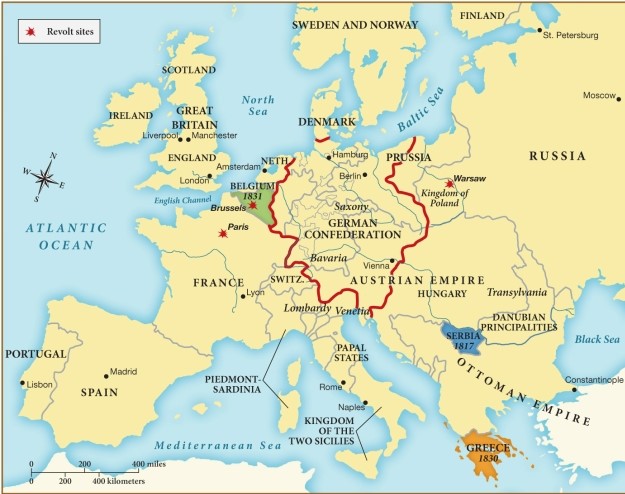
According to this map, which of the following European countries experienced revolt during the 1830s?
(Multiple Choice)
4.7/5  (80)
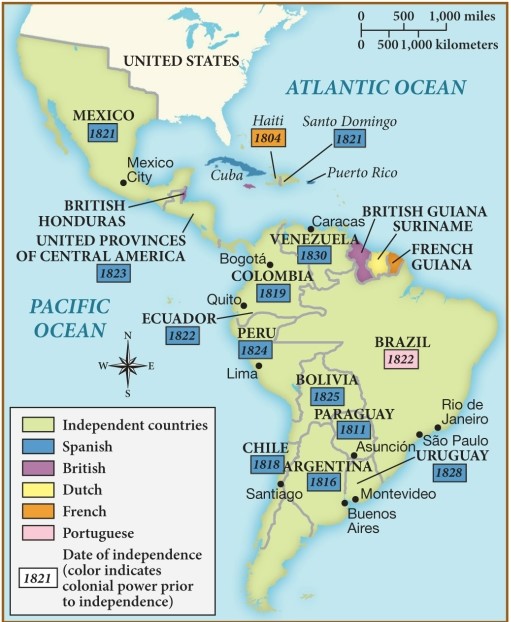
(80) Napoleon's occupation of Spain significantly weakened the country during the early 1800s. How is that reflected in this map?
(Multiple Choice)
4.9/5 (73)
(73) After Prussia was defeated and humiliated by the French in 1806, Frederick William III undertook major domestic reforms. What did he do, and why did he take this course of action?
(Essay)
4.8/5 (75)
(75) In the early 1820s, rebellions against the monarchies in Spain and Russia were led by army officers because these men
(Multiple Choice)
4.8/5 (71)
(71) Explain which government came to power after Napoleon's downfall and how that regime fared.
(Essay)
5.0/5 (78)
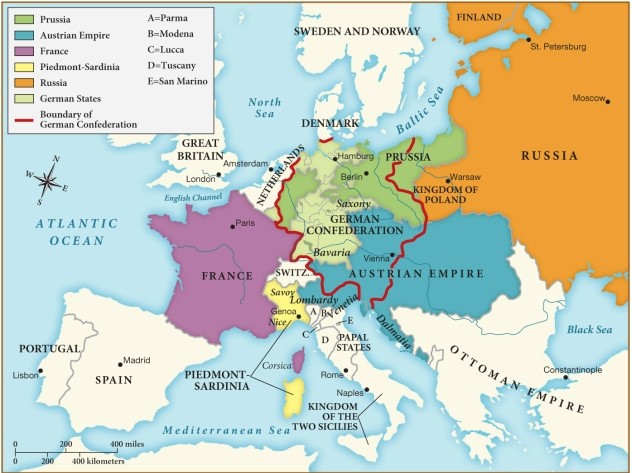
(78) What impact did the Congress of Vienna have on Europe by 1815?
(Multiple Choice)
4.9/5 (88)
(88) During the Congress of Vienna (1814-1815) and beyond, British prime minister Robert Castlereagh (1769-1822) had which of the following goals?
(Multiple Choice)
4.9/5 (71)
(71) Following the battle of Borodino in September 1812, Napoleon
(Multiple Choice)
4.8/5 (71)
(71) How was the British Reform Bill of 1832 both moderate and precedent setting?
(Essay)
4.8/5 (73)
(73) Nineteenth-century poets and writers who collected old legends and folktales that expressed a shared cultural and linguistic heritage stretching back to the Middle Ages embraced what ideology?
(Multiple Choice)
4.9/5 (88)
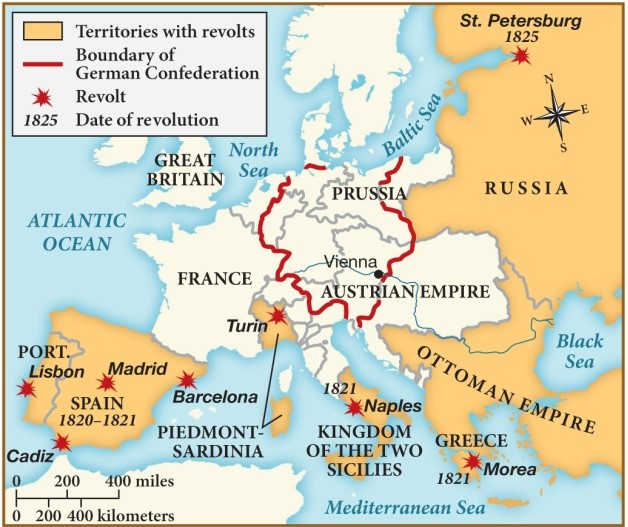
(88) According to this map, which European state was the first to experience an attempted revolution during the 1820s?
(Multiple Choice)
4.8/5 (85)
(85) Which of the following is true of Ferdinand VII after his restoration to the Spanish throne in 1814?
(Multiple Choice)
4.8/5 (76)
(76) Between 1807 and 1812, which European nations demonstrated the strongest resistance against French rule?
(Multiple Choice)
4.8/5 (80)
(80) After Napoleon defeated the Russians at Friedland in 1807, the ensuing Treaties of Tilsit
(Multiple Choice)
4.7/5 (69)
(69) How were the settlement of the Congress of Vienna and the period of "restoration" emblematic of the new political doctrine of conservatism that emerged in Europe after 1815? How did conservatives justify their belief in the necessity for a return to a pre-1789 social order?
(Essay)
4.8/5 (78)
(78) Napoleon's founding of the Legion of Honor in 1802 was part of his campaign to
(Multiple Choice)
4.7/5 (86)
(86) Which of the following characterizes Napoleon's approach to war?
(Multiple Choice)
4.8/5 (72)
(72) 
Filters
- Essay(0)
- Multiple Choice(0)
- Short Answer(0)
- True False(0)
- Matching(0)