



 Chat with AI
Exam 20: Napoleon and the Revolutionary Legacy, 1800-1830

Exam 1: Early Western Civilization, 400,000-1000 B.C.E65 Questions
Exam 2: Near East Empires and the Reemergence of Civilization in Greece, 1000-500 B.C.E64 Questions
Exam 3: The Greek Golden Age, C 500-C 400 B.C.E65 Questions
Exam 4: From the Classical to the Hellenistic World, 400-30 B.C.E65 Questions
Exam 5: The Rise of Rome and Its Republic, 753-44 B.C.E64 Questions
Exam 6: The Creation of the Roman Empire, 44 B.C.E-284 C.E65 Questions
Exam 7: The Transformation of the Roman Empire, 284-600 C.E64 Questions
Exam 8: The Heirs of Rome: Islam, Byzantium, and Europe, 600-75065 Questions
Exam 9: From Centralization to Fragmentation, 750-105065 Questions
Exam 10: Commercial Quickening and Religious Reform, 1050-115065 Questions
Exam 11: The Flowering of the Middle Ages, 1150-121565 Questions
Exam 12: The Medieval Synthesis and Its Cracks, 1215-134065 Questions
Exam 13: Crisis and Renaissance, 1340-149265 Questions
Exam 14: Global Encounters and the Shock of the Reformation, 1492-156065 Questions
Exam 15: Wars of Religion and the Clash of Worldviews, 1560-164865 Questions
Exam 16: Absolutism, Constitutionalism, and the Search for Order, 1640-170065 Questions
Exam 17: The Atlantic System and Its Consequences, 1700-175065 Questions
Exam 18: The Promise of Enlightenment, 1750-178965 Questions
Exam 19: The Cataclysm of Revolution, 1789-179965 Questions
Exam 20: Napoleon and the Revolutionary Legacy, 1800-183065 Questions
Exam 21: Industrialization and Social Ferment, 1830-185064 Questions
Exam 22: Politics and Culture of the Nation-State, 1850-187065 Questions
Exam 23: Empire, Industry, and Everyday Life, 1870-189065 Questions
Exam 24: Modernity and the Road to War, 1890-191465 Questions
Exam 25: World War I and Its Aftermath, 1914-192965 Questions
Exam 26: The Great Depression and World War II, 1929-194565 Questions
Exam 27: The Cold War and the Remaking of Europe, 1945-1960s64 Questions
Exam 28: Postindustrial Society and the End of the Cold War Order, 1960s-198965 Questions
Exam 29: A New Globalism, 1989 to the Present65 Questions
Select questions type


Who benefited the most from Napoleon's introduction of a hierarchy of noble titles?
(Multiple Choice)
5.0/5  (82)
(82) What measures did Napoleon impose on the colonized populations in the annexed territories and satellite kingdoms of France?
(Multiple Choice)
4.8/5 (88)
(88) In what sense can Methodism be seen as undermining established authority?
(Essay)
4.9/5 (75)
(75) How did the revolutionary movements of the 1830s demonstrate the general discontent with the Vienna settlement of 1815 and the ideology of conservatism? In your answer consider what the revolts were attempting to accomplish and whether they were a response to new problems or a recurring outbreak of a deeper revolutionary impulse.
(Essay)
4.8/5 (86)
(86) Which nation was allied with Napoleon's empire in 1812?
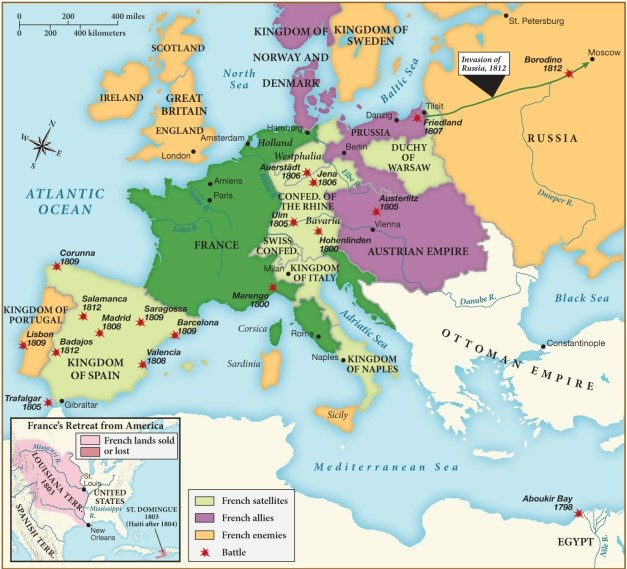
(Multiple Choice)
4.9/5 (86)
(86) In what way did the Civil Code limit political and social liberties?
(Multiple Choice)
4.9/5 (81)
(81) How did romanticism address the political problems of the age and encourage nationalism?
(Essay)
4.8/5 (74)
(74) Which of the following actions did Napoleon undertake in 1804 with the pope's blessing?
(Multiple Choice)
4.9/5 (86)
(86) Napoleon's decisive defeat at the battle of Waterloo in 1815 came at the hands of
(Multiple Choice)
4.9/5 (77)
(77) Which of the following provided a major test for the theory of conservatism in the post-Napoleonic order?
(Multiple Choice)
4.8/5 (77)
(77) Which of the following ideologies argued for the restoration of social and religious hierarchies in the years after the Napoleonic wars?
(Multiple Choice)
5.0/5 (95)
(95) In what manner did Napoleon build on the legacy of previous French rulers to demonstrate his power?
(Multiple Choice)
4.7/5 (74)
(74) How did Napoleon's tactics for achieving order differ from those used during the French Revolution?
(Multiple Choice)
4.8/5 (78)
(78) Conservative European states agreed to Belgium's independence in 1831 under the condition that
(Multiple Choice)
4.8/5 (84)
(84) Although Napoleon instituted a number of reforms throughout Europe that were based on Enlightenment ideas of reason and order, in at least one respect he was a conservative: he believed that people should follow the orders of their superiors without question. Explain how he attempted to promote this belief in France, using laws to regulate family structure, work relationships, public welfare programs, and religion.
(Essay)
4.7/5 (74)
(74) When an adviser to Frederick William III of Prussia (r. 1797-1840) wrote, "We must do from above what the French have done from below," to what was he referring?
(Multiple Choice)
5.0/5 (79)
(79) How did the Congress of Vienna (1814-1815) set the parameters for future relations between European states?
(Multiple Choice)
4.9/5 (90)
(90) How did Napoleon help to create nationalism in Germany and Italy, and how did this undermine his rule of these countries? What other factors contributed to nationalism in countries conquered or dominated by Napoleonic France?
(Essay)
4.7/5 (65)
(65) Which of the following was part of Metternich's campaign to suppress dissent within the states of the German Confederation?
(Multiple Choice)
4.8/5 (85)
(85) 
Filters
- Essay(0)
- Multiple Choice(0)
- Short Answer(0)
- True False(0)
- Matching(0)