



 Chat with AI
Exam 24: Modernity and the Road to War, 1890-1914

Exam 1: Early Western Civilization, 400,000-1000 B.C.E65 Questions
Exam 2: Near East Empires and the Reemergence of Civilization in Greece, 1000-500 B.C.E64 Questions
Exam 3: The Greek Golden Age, C 500-C 400 B.C.E65 Questions
Exam 4: From the Classical to the Hellenistic World, 400-30 B.C.E65 Questions
Exam 5: The Rise of Rome and Its Republic, 753-44 B.C.E64 Questions
Exam 6: The Creation of the Roman Empire, 44 B.C.E-284 C.E65 Questions
Exam 7: The Transformation of the Roman Empire, 284-600 C.E64 Questions
Exam 8: The Heirs of Rome: Islam, Byzantium, and Europe, 600-75065 Questions
Exam 9: From Centralization to Fragmentation, 750-105065 Questions
Exam 10: Commercial Quickening and Religious Reform, 1050-115065 Questions
Exam 11: The Flowering of the Middle Ages, 1150-121565 Questions
Exam 12: The Medieval Synthesis and Its Cracks, 1215-134065 Questions
Exam 13: Crisis and Renaissance, 1340-149265 Questions
Exam 14: Global Encounters and the Shock of the Reformation, 1492-156065 Questions
Exam 15: Wars of Religion and the Clash of Worldviews, 1560-164865 Questions
Exam 16: Absolutism, Constitutionalism, and the Search for Order, 1640-170065 Questions
Exam 17: The Atlantic System and Its Consequences, 1700-175065 Questions
Exam 18: The Promise of Enlightenment, 1750-178965 Questions
Exam 19: The Cataclysm of Revolution, 1789-179965 Questions
Exam 20: Napoleon and the Revolutionary Legacy, 1800-183065 Questions
Exam 21: Industrialization and Social Ferment, 1830-185064 Questions
Exam 22: Politics and Culture of the Nation-State, 1850-187065 Questions
Exam 23: Empire, Industry, and Everyday Life, 1870-189065 Questions
Exam 24: Modernity and the Road to War, 1890-191465 Questions
Exam 25: World War I and Its Aftermath, 1914-192965 Questions
Exam 26: The Great Depression and World War II, 1929-194565 Questions
Exam 27: The Cold War and the Remaking of Europe, 1945-1960s64 Questions
Exam 28: Postindustrial Society and the End of the Cold War Order, 1960s-198965 Questions
Exam 29: A New Globalism, 1989 to the Present65 Questions
Select questions type


What was the name given to the growing number of women who challenged accepted views of women's dependence and seclusion in the home at the beginning of the twentieth century?
(Multiple Choice)
4.9/5  (69)
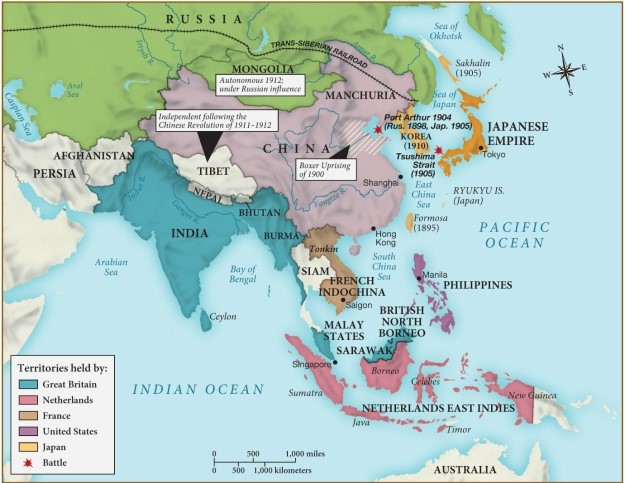
(69) According to this map, Great Britain controlled which of the following territories during the late nineteenth and early twentieth centuries?
(Multiple Choice)
4.8/5 (63)
(63) How would you characterize the imperialist policies of European nations and the United States in the early twentieth century? How did those being colonized react to these policies? Provide examples to support your answer.
(Essay)
4.7/5 (75)
(75) Explain the ways in which technology, bureaucracies, economics, and ideologies shaped the military forces of European nations by the early twentieth century. How were armies changing? In what ways were they more powerful? How might these changes in themselves have increased the possibility of war?
(Essay)
4.8/5 (70)
(70) Which of the following marriage reforms did Europeans propose in the late nineteenth century?
(Multiple Choice)
4.9/5 (69)
(69) How did V. I. Lenin (1870-1924) come to prominence in Russian Marxist circles?
(Multiple Choice)
4.9/5 (84)
(84) Why are denunciations of Jews and socialists by right-wing and nationalist groups in Germany at the turn of the twentieth century considered a departure from rational debate, and what consequences did such politics have?
(Essay)
4.8/5 (81)
(81) Many educated Europeans at the turn of the twentieth century believed in a set of ideas called eugenics, which argued that
(Multiple Choice)
4.9/5 (90)
(90) In France, anti-Semitism became a hotly contested political issue with the 1894 arrest of Alfred Dreyfus, a Jewish army officer, for espionage, particularly after
(Multiple Choice)
4.8/5 (98)
(98) Which of the following is an example of the power of European working classes at the turn of the century?
(Multiple Choice)
4.9/5 (71)
(71) How did the Italian prime minister Giovanni Giolitti respond to the urban working classes and rural laborers who demanded political change in the years before World War I?
(Multiple Choice)
4.8/5 (69)
(69) What reforms did the Russian prime minister Pyotr Stolypin introduce in order to end peasant unrest, and why did they fail to achieve their purpose?
(Essay)
4.9/5 (72)
(72) Why did nationalist and anti-Semitic politics flourish in late-nineteenth-century Germany?
(Multiple Choice)
4.9/5 (75)
(75) How and why did private life become a public affair in the late nineteenth and early twentieth centuries? How did population pressures affect debates about Europeans' private lives? In what ways did governments intervene in the private lives of European men and women?
(Essay)
4.8/5 (81)
(81) Which of the following did politicians and social theorists in the late nineteenth century blame for what they feared was a marked decline in fertility?
(Multiple Choice)
4.8/5 (67)
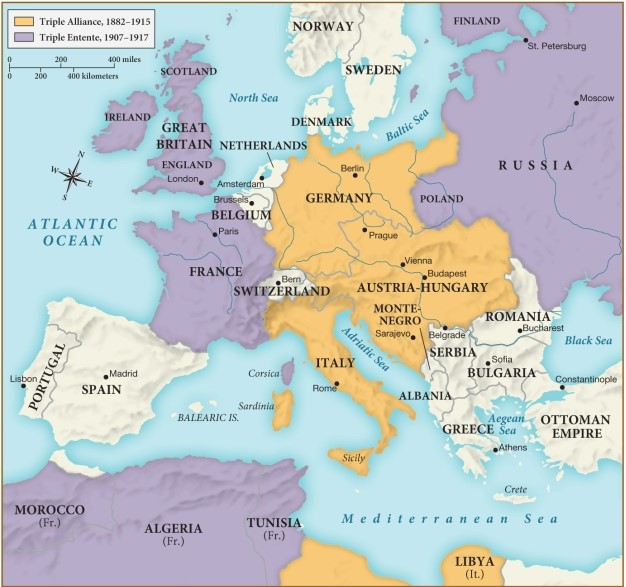
(67) According to this map, which of the following nations was part of the Triple Alliance from 1882 through 1915?
(Multiple Choice)
4.9/5 (85)
(85) How did the relationship between science and society evolve in the late nineteenth century?
(Essay)
5.0/5 (84)
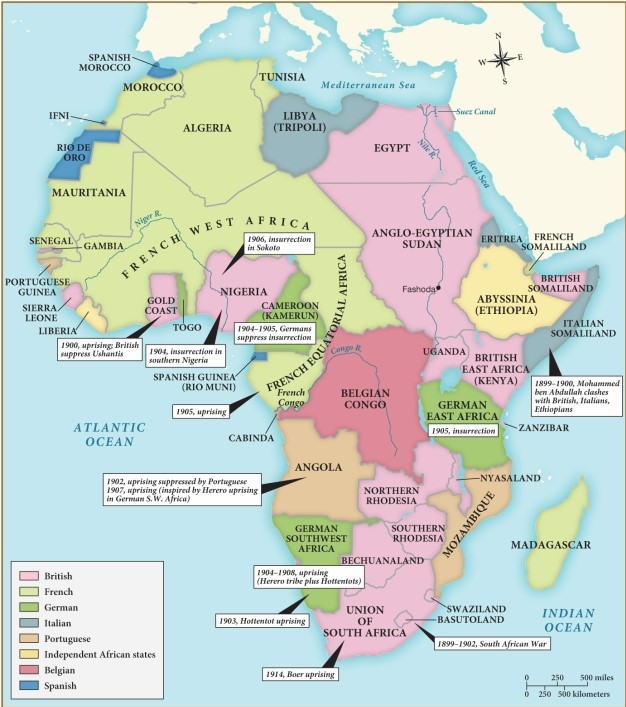
(84) This map of Africa in 1914 justifies which of the following statements?
(Multiple Choice)
4.9/5 (74)
(74) How did audiences react to the Paris premiere of Igor Stravinsky's ballet The Rite of Spring and to premieres of musical works by Arnold Schoenberg, and what caused this reaction? How were this style of dance and Schoenberg's music representative of the changes gripping modern music and dance?
(Essay)
4.8/5 (90)
(90) 
Filters
- Essay(0)
- Multiple Choice(0)
- Short Answer(0)
- True False(0)
- Matching(0)