



 Chat with AI
Exam 24: Modernity and the Road to War, 1890-1914

Exam 1: Early Western Civilization, 400,000-1000 B.C.E65 Questions
Exam 2: Near East Empires and the Reemergence of Civilization in Greece, 1000-500 B.C.E64 Questions
Exam 3: The Greek Golden Age, C 500-C 400 B.C.E65 Questions
Exam 4: From the Classical to the Hellenistic World, 400-30 B.C.E65 Questions
Exam 5: The Rise of Rome and Its Republic, 753-44 B.C.E64 Questions
Exam 6: The Creation of the Roman Empire, 44 B.C.E-284 C.E65 Questions
Exam 7: The Transformation of the Roman Empire, 284-600 C.E64 Questions
Exam 8: The Heirs of Rome: Islam, Byzantium, and Europe, 600-75065 Questions
Exam 9: From Centralization to Fragmentation, 750-105065 Questions
Exam 10: Commercial Quickening and Religious Reform, 1050-115065 Questions
Exam 11: The Flowering of the Middle Ages, 1150-121565 Questions
Exam 12: The Medieval Synthesis and Its Cracks, 1215-134065 Questions
Exam 13: Crisis and Renaissance, 1340-149265 Questions
Exam 14: Global Encounters and the Shock of the Reformation, 1492-156065 Questions
Exam 15: Wars of Religion and the Clash of Worldviews, 1560-164865 Questions
Exam 16: Absolutism, Constitutionalism, and the Search for Order, 1640-170065 Questions
Exam 17: The Atlantic System and Its Consequences, 1700-175065 Questions
Exam 18: The Promise of Enlightenment, 1750-178965 Questions
Exam 19: The Cataclysm of Revolution, 1789-179965 Questions
Exam 20: Napoleon and the Revolutionary Legacy, 1800-183065 Questions
Exam 21: Industrialization and Social Ferment, 1830-185064 Questions
Exam 22: Politics and Culture of the Nation-State, 1850-187065 Questions
Exam 23: Empire, Industry, and Everyday Life, 1870-189065 Questions
Exam 24: Modernity and the Road to War, 1890-191465 Questions
Exam 25: World War I and Its Aftermath, 1914-192965 Questions
Exam 26: The Great Depression and World War II, 1929-194565 Questions
Exam 27: The Cold War and the Remaking of Europe, 1945-1960s64 Questions
Exam 28: Postindustrial Society and the End of the Cold War Order, 1960s-198965 Questions
Exam 29: A New Globalism, 1989 to the Present65 Questions
Select questions type


Which of the following issues became a hotly debated talking point among European politicians at the beginning of the twentieth century?
(Multiple Choice)
4.8/5  (78)
(78) By the 1890s, workers, women, and oppressed ethnic groups who had limited rights and political power in nineteenth-century Europe were organizing to demand full civil rights, increased political participation, greater economic leverage, and even national independence. Provide a basic summary of the goals of these groups and the methods they used to achieve them. Assess the response of conservatives and nationalists to these demands.
(Essay)
4.8/5 (99)
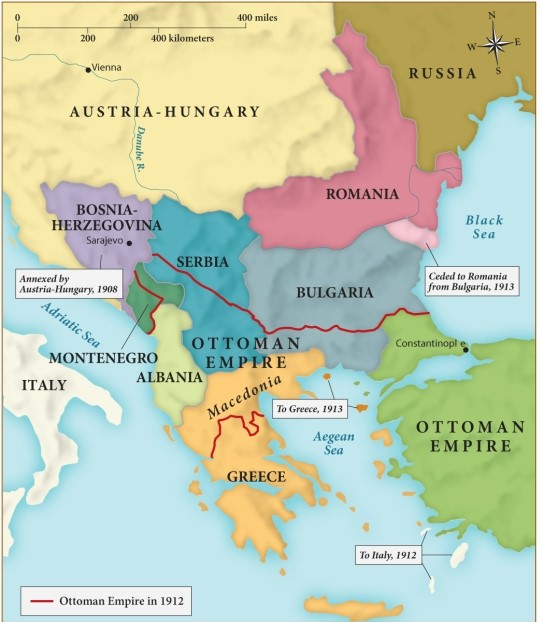
(99) Which of the following statements about the Balkans during the early twentieth century is supported by this map?
(Multiple Choice)
4.8/5 (66)
(66) What was the name of the ultranationalist, anti-Semitic leader of Austria's Christian Social Party who was elected mayor of Vienna in 1895?
(Multiple Choice)
4.8/5 (86)
(86) Why did the German philosopher Friedrich Nietzsche announce, "God is dead, we have killed him"?
(Multiple Choice)
4.7/5 (76)
(76) What was the primary goal of Sinn Féin, which was founded in 1905?
(Multiple Choice)
4.8/5 (72)
(72) Who were the Young Turks? How were their goals turned against them once they seized power in 1908, and what was their response?
(Essay)
4.9/5 (71)
(71) The British theorist Havelock Ellis emerged as a practitioner of the new field of
(Multiple Choice)
4.8/5 (65)
(65) What is one way in which Albert Einstein's special theory of relativity challenged mainstream scientific principles?
(Multiple Choice)
4.9/5 (80)
(80) What belief about marriage became increasingly common among middle- and upper-class Europeans by the beginning of the twentieth century?
(Multiple Choice)
4.8/5 (84)
(84) The South African War (or Boer War), which ended with Britain's defeat of the Boers in 1902, began when
(Multiple Choice)
4.9/5 (92)
(92) Like other expressionist art of the period, the Norwegian artist Edvard Munch's painting The Scream (1893) conveyed
(Multiple Choice)
4.8/5 (81)
(81) What factors contributed to the massive increase in the European population at the turn of the twentieth century?
(Multiple Choice)
4.9/5 (88)
(88) In 1911, Liberals in Britain initiated a new social policy funded by new taxes on the wealthy that was known as the
(Multiple Choice)
4.9/5 (76)
(76) Why was Japan's decisive defeat of Russia in 1905 so troubling for European nations that might otherwise have been pleased at a check to the tsar's power?
(Essay)
4.9/5 (79)
(79) In 1896, a Hungarian-born Jew named Theodor Herzl published a book that called for the creation of a Jewish nation-state, which was the goal of what major movement?
(Multiple Choice)
4.9/5 (72)
(72) Despite the fact that the overall population in the West was growing at the end of the nineteenth century,
(Multiple Choice)
4.8/5 (85)
(85) How did Russia respond to the rise of Japanese imperialism in the late nineteenth century?
(Multiple Choice)
4.8/5 (88)
(88) How did Hungarian nationalists justify their claims for greater Hungarian influence (or Magyarization) in Austria-Hungary?
(Multiple Choice)
4.8/5 (75)
(75) In 1905 and 1911, Germany risked conflict with France by attempting to assert its strength in
(Multiple Choice)
4.9/5 (74)
(74) 
Filters
- Essay(0)
- Multiple Choice(0)
- Short Answer(0)
- True False(0)
- Matching(0)