



 Chat with AI
Exam 26: The Great Depression and World War II, 1929-1945

Exam 1: Early Western Civilization, 400,000-1000 B.C.E65 Questions
Exam 2: Near East Empires and the Reemergence of Civilization in Greece, 1000-500 B.C.E64 Questions
Exam 3: The Greek Golden Age, C 500-C 400 B.C.E65 Questions
Exam 4: From the Classical to the Hellenistic World, 400-30 B.C.E65 Questions
Exam 5: The Rise of Rome and Its Republic, 753-44 B.C.E64 Questions
Exam 6: The Creation of the Roman Empire, 44 B.C.E-284 C.E65 Questions
Exam 7: The Transformation of the Roman Empire, 284-600 C.E64 Questions
Exam 8: The Heirs of Rome: Islam, Byzantium, and Europe, 600-75065 Questions
Exam 9: From Centralization to Fragmentation, 750-105065 Questions
Exam 10: Commercial Quickening and Religious Reform, 1050-115065 Questions
Exam 11: The Flowering of the Middle Ages, 1150-121565 Questions
Exam 12: The Medieval Synthesis and Its Cracks, 1215-134065 Questions
Exam 13: Crisis and Renaissance, 1340-149265 Questions
Exam 14: Global Encounters and the Shock of the Reformation, 1492-156065 Questions
Exam 15: Wars of Religion and the Clash of Worldviews, 1560-164865 Questions
Exam 16: Absolutism, Constitutionalism, and the Search for Order, 1640-170065 Questions
Exam 17: The Atlantic System and Its Consequences, 1700-175065 Questions
Exam 18: The Promise of Enlightenment, 1750-178965 Questions
Exam 19: The Cataclysm of Revolution, 1789-179965 Questions
Exam 20: Napoleon and the Revolutionary Legacy, 1800-183065 Questions
Exam 21: Industrialization and Social Ferment, 1830-185064 Questions
Exam 22: Politics and Culture of the Nation-State, 1850-187065 Questions
Exam 23: Empire, Industry, and Everyday Life, 1870-189065 Questions
Exam 24: Modernity and the Road to War, 1890-191465 Questions
Exam 25: World War I and Its Aftermath, 1914-192965 Questions
Exam 26: The Great Depression and World War II, 1929-194565 Questions
Exam 27: The Cold War and the Remaking of Europe, 1945-1960s64 Questions
Exam 28: Postindustrial Society and the End of the Cold War Order, 1960s-198965 Questions
Exam 29: A New Globalism, 1989 to the Present65 Questions
Select questions type


How did Mustafa Kemal dramatically change Turkish society in the 1920s?
(Multiple Choice)
4.7/5  (75)
(75) How did housewives and other women participate in the resistance to the Nazis?
(Essay)
4.9/5 (92)
(92) Based on this map, the first major battle that helped to kick off World War II occurred in
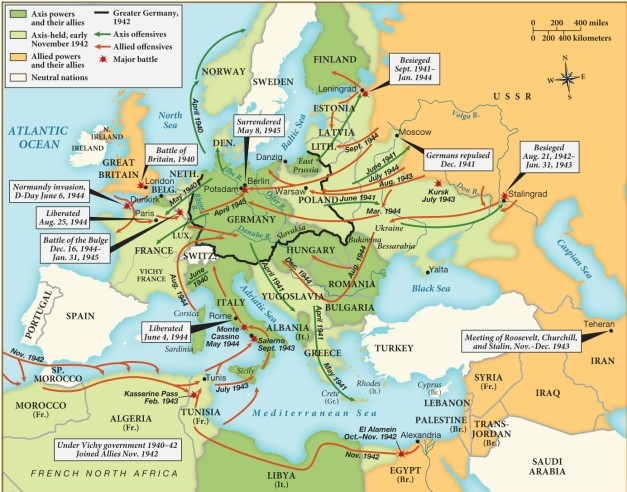
(Multiple Choice)
4.8/5 (84)
(84) Although Ramsay MacDonald, Britain's prime minister at the time the Great Depression began, was the leader of the Labour Party, at least two of his government's early efforts to deal with the financial crisis suggested that the working people's welfare was not the British government's top priority. Explain.
(Essay)
4.9/5 (76)
(76) Which of the following was an indication of the prevalence of racial thinking in the United States during World War II?
(Multiple Choice)
4.8/5 (67)
(67) What did the Germans call their strategy of capturing Poland by launching an overpowering, concentrated attack using airplanes, tanks, and motorized infantry?
(Multiple Choice)
4.9/5 (68)
(68) Which statement about the Final Solution is justified by this map?
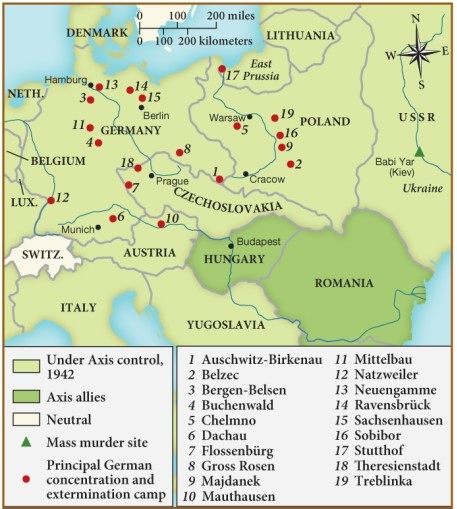
(Multiple Choice)
4.8/5 (82)
(82) How did Stalin respond to economic failures such as the drop in grain harvest that resulted from the failure of the collectivization of agriculture?
(Multiple Choice)
4.8/5 (80)
(80) Why did the U.S. stock market crash lead to a global economic depression?
(Multiple Choice)
4.9/5 (86)
(86) How did parliamentary leader Alva Myrdal address the problem of the population decline in Sweden?
(Multiple Choice)
4.9/5 (70)
(70) In the face of total military defeat by late 1944, Hitler continued to beseech the Germans to fight on, believing that
(Multiple Choice)
4.7/5 (83)
(83) What was the name given to the extensive system of Soviet prison camps that stretched from Moscow to Siberia and housed millions of political prisoners in harsh conditions?
(Multiple Choice)
4.9/5 (75)
(75) Why did the results of Churchill's meeting with Stalin in October 1944 on the postwar distribution of territories disturb Roosevelt?
(Multiple Choice)
4.9/5 (85)
(85) When did the "Final Solution"-the Nazis' plan to systematically murder all the Jews of Europe-begin?
(Multiple Choice)
4.9/5 (84)
(84) Why were literate civilians in the conquered areas of eastern Europe the most vulnerable?
(Multiple Choice)
4.8/5 (75)
(75) What were the Soviet purges of the 1930s, and how did they change society?
(Essay)
4.8/5 (89)
(89) Why would an antifascist coalition government such as the French Popular Front have been impossible in democratic countries before 1936?
(Multiple Choice)
4.9/5 (80)
(80) What was the subject of Pope Pius XI's address to the world in 1931, and how was it both similar to and different from the theology of Karl Barth?
(Essay)
4.8/5 (96)
(96) Which of the following factors contributed to the growth in public support for the Nazi Party among the German population in the early 1930s?
(Multiple Choice)
4.8/5 (90)
(90) 
Filters
- Essay(0)
- Multiple Choice(0)
- Short Answer(0)
- True False(0)
- Matching(0)