



 Chat with AI
Exam 26: The Great Depression and World War II, 1929-1945

Exam 1: Early Western Civilization, 400,000-1000 B.C.E65 Questions
Exam 2: Near East Empires and the Reemergence of Civilization in Greece, 1000-500 B.C.E64 Questions
Exam 3: The Greek Golden Age, C 500-C 400 B.C.E65 Questions
Exam 4: From the Classical to the Hellenistic World, 400-30 B.C.E65 Questions
Exam 5: The Rise of Rome and Its Republic, 753-44 B.C.E64 Questions
Exam 6: The Creation of the Roman Empire, 44 B.C.E-284 C.E65 Questions
Exam 7: The Transformation of the Roman Empire, 284-600 C.E64 Questions
Exam 8: The Heirs of Rome: Islam, Byzantium, and Europe, 600-75065 Questions
Exam 9: From Centralization to Fragmentation, 750-105065 Questions
Exam 10: Commercial Quickening and Religious Reform, 1050-115065 Questions
Exam 11: The Flowering of the Middle Ages, 1150-121565 Questions
Exam 12: The Medieval Synthesis and Its Cracks, 1215-134065 Questions
Exam 13: Crisis and Renaissance, 1340-149265 Questions
Exam 14: Global Encounters and the Shock of the Reformation, 1492-156065 Questions
Exam 15: Wars of Religion and the Clash of Worldviews, 1560-164865 Questions
Exam 16: Absolutism, Constitutionalism, and the Search for Order, 1640-170065 Questions
Exam 17: The Atlantic System and Its Consequences, 1700-175065 Questions
Exam 18: The Promise of Enlightenment, 1750-178965 Questions
Exam 19: The Cataclysm of Revolution, 1789-179965 Questions
Exam 20: Napoleon and the Revolutionary Legacy, 1800-183065 Questions
Exam 21: Industrialization and Social Ferment, 1830-185064 Questions
Exam 22: Politics and Culture of the Nation-State, 1850-187065 Questions
Exam 23: Empire, Industry, and Everyday Life, 1870-189065 Questions
Exam 24: Modernity and the Road to War, 1890-191465 Questions
Exam 25: World War I and Its Aftermath, 1914-192965 Questions
Exam 26: The Great Depression and World War II, 1929-194565 Questions
Exam 27: The Cold War and the Remaking of Europe, 1945-1960s64 Questions
Exam 28: Postindustrial Society and the End of the Cold War Order, 1960s-198965 Questions
Exam 29: A New Globalism, 1989 to the Present65 Questions
Select questions type


Which of the following European nations experienced the lowest percentage of population loss by the end of World War II in 1945?
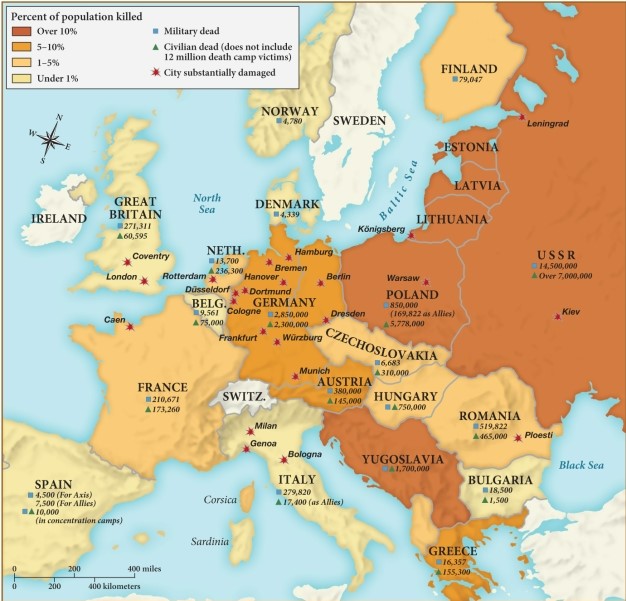
(Multiple Choice)
4.8/5  (85)
(85) Which of the following was a 1938 event in which the Nazis publicly persecuted Jews in Germany by burning synagogues, destroying Jewish property, and imprisoning Jews in retaliation for the murder of a German official by a Jewish teenager?
(Multiple Choice)
4.9/5 (88)
(88) The Japanese justified their expansionist practices in Asia by claiming they were
(Multiple Choice)
4.9/5 (60)
(60) In what ways was World War II a global war? What ties did Japan have to the other Axis powers? What role did the colonies play in the war?
(Essay)
4.8/5 (89)
(89) Why were Allied governments more successful in mobilizing civilian women than the Axis powers were?
(Multiple Choice)
4.9/5 (98)
(98) How did the civil war in Spain start, and why did many people from a variety of countries go to Spain to fight for the republican cause?
(Essay)
4.8/5 (77)
(77) The relentless German bombing of British cities in the summer of 1940 is known as the
(Multiple Choice)
4.8/5 (72)
(72) Although every age group and class of people supported Hitler, what demographic did the Nazi Party especially attract?
(Multiple Choice)
4.9/5 (94)
(94) In 1929, Joseph Stalin implemented what ambitious industrial expansion program intended to end the Soviet Union's backwardness?
(Multiple Choice)
4.8/5 (64)
(64) What effects did the economic depression have on Europe's overseas empires?
(Multiple Choice)
4.9/5 (97)
(97) Hitler's order for the assassination of Ernst Roehm, which also resulted in the deaths of hundreds of SA leaders and innocent civilians, is known as the
(Multiple Choice)
4.8/5 (72)
(72) Why did the Nazi-Soviet Pact signed on August 23, 1939, stun the Western world?
(Multiple Choice)
4.9/5 (84)
(84) How did Western leaders respond to Japanese aggression in China in 1931-1937?
(Multiple Choice)
4.8/5 (90)
(90) How did culture, science, and religion respond to the conditions of the early twentieth century, as economies around the world suffered and international tensions escalated into global warfare?
(Essay)
4.9/5 (68)
(68) What term was used for Hitler's annexation of (or merger with) Austria?
(Multiple Choice)
4.8/5 (86)
(86) According to this map, which of the following regions was annexed by Germany in 1939?
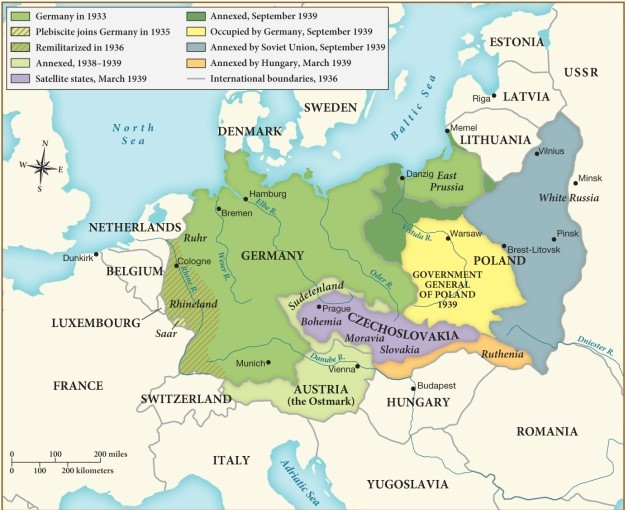
(Multiple Choice)
5.0/5 (80)
(80) Why did the republican forces lose the Spanish Civil War despite the popular outpouring of support for the cause of democracy from around the globe?
(Multiple Choice)
4.8/5 (93)
(93) Why have many historians criticized the Munich Pact of 1938?
(Multiple Choice)
5.0/5 (77)
(77) How did government actions to resolve the financial crisis that began in 1929 actually make conditions worse and extend the depression?
(Essay)
4.8/5 (68)
(68) 
Filters
- Essay(0)
- Multiple Choice(0)
- Short Answer(0)
- True False(0)
- Matching(0)