



 Chat with AI
Exam 28: Postindustrial Society and the End of the Cold War Order, 1960s-1989

Exam 1: Early Western Civilization, 400,000-1000 B.C.E65 Questions
Exam 2: Near East Empires and the Reemergence of Civilization in Greece, 1000-500 B.C.E64 Questions
Exam 3: The Greek Golden Age, C 500-C 400 B.C.E65 Questions
Exam 4: From the Classical to the Hellenistic World, 400-30 B.C.E65 Questions
Exam 5: The Rise of Rome and Its Republic, 753-44 B.C.E64 Questions
Exam 6: The Creation of the Roman Empire, 44 B.C.E-284 C.E65 Questions
Exam 7: The Transformation of the Roman Empire, 284-600 C.E64 Questions
Exam 8: The Heirs of Rome: Islam, Byzantium, and Europe, 600-75065 Questions
Exam 9: From Centralization to Fragmentation, 750-105065 Questions
Exam 10: Commercial Quickening and Religious Reform, 1050-115065 Questions
Exam 11: The Flowering of the Middle Ages, 1150-121565 Questions
Exam 12: The Medieval Synthesis and Its Cracks, 1215-134065 Questions
Exam 13: Crisis and Renaissance, 1340-149265 Questions
Exam 14: Global Encounters and the Shock of the Reformation, 1492-156065 Questions
Exam 15: Wars of Religion and the Clash of Worldviews, 1560-164865 Questions
Exam 16: Absolutism, Constitutionalism, and the Search for Order, 1640-170065 Questions
Exam 17: The Atlantic System and Its Consequences, 1700-175065 Questions
Exam 18: The Promise of Enlightenment, 1750-178965 Questions
Exam 19: The Cataclysm of Revolution, 1789-179965 Questions
Exam 20: Napoleon and the Revolutionary Legacy, 1800-183065 Questions
Exam 21: Industrialization and Social Ferment, 1830-185064 Questions
Exam 22: Politics and Culture of the Nation-State, 1850-187065 Questions
Exam 23: Empire, Industry, and Everyday Life, 1870-189065 Questions
Exam 24: Modernity and the Road to War, 1890-191465 Questions
Exam 25: World War I and Its Aftermath, 1914-192965 Questions
Exam 26: The Great Depression and World War II, 1929-194565 Questions
Exam 27: The Cold War and the Remaking of Europe, 1945-1960s64 Questions
Exam 28: Postindustrial Society and the End of the Cold War Order, 1960s-198965 Questions
Exam 29: A New Globalism, 1989 to the Present65 Questions
Select questions type


Explain how the idea of the cold war as a struggle between Western democracies and international communism for world domination was weakened by events of the 1970s.
(Essay)
4.9/5  (79)
(79) Which of the following was a system through which government-banned literature was secretly published and distributed in the Soviet Union?
(Multiple Choice)
5.0/5 (71)
(71) The 1968 film 2001: A Space Odyssey not only reflected the enormous popular interest in space but also showed that science fiction was increasingly
(Multiple Choice)
4.9/5 (85)
(85) Intelsat I, the first commercial communications satellite, was launched in 1965 and was an example of
(Multiple Choice)
4.9/5 (93)
(93) What was the main approach to foreign policy followed by Ronald Reagan?
(Essay)
4.8/5 (93)
(93) Ronald Reagan was U.S. president from 1981 until 1989. During this time, he addressed economic crises as well as foreign policy concerns surrounding the Soviet Union and the cold war. Explain how President Reagan approached the economic crisis in the United States during this time and what influenced his economic policies. Then describe Reagan's approach to foreign policy, particularly when it came to the cold war and relations with the Soviet Union.
(Essay)
4.9/5 (78)
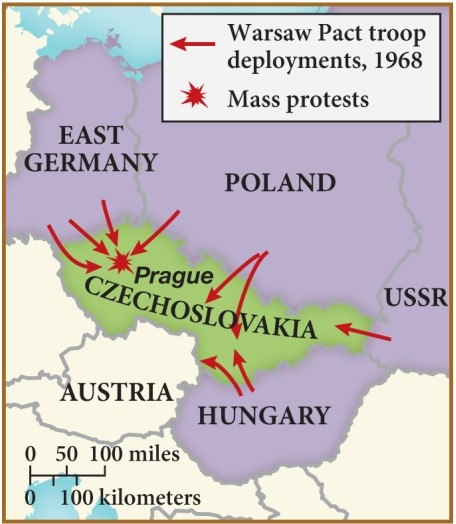
(78) According to this map, who mobilized to Czechoslovakia in 1968 during the Prague Spring?
(Multiple Choice)
4.9/5 (66)
(66) The West German foreign minister Willy Brandt's anti-cold war policy of opening up trade with Communist East Germany in the late 1960s was known as what?
(Multiple Choice)
4.8/5 (72)
(72) How did the development of multinational corporations change the global economy?
(Essay)
4.9/5 (86)
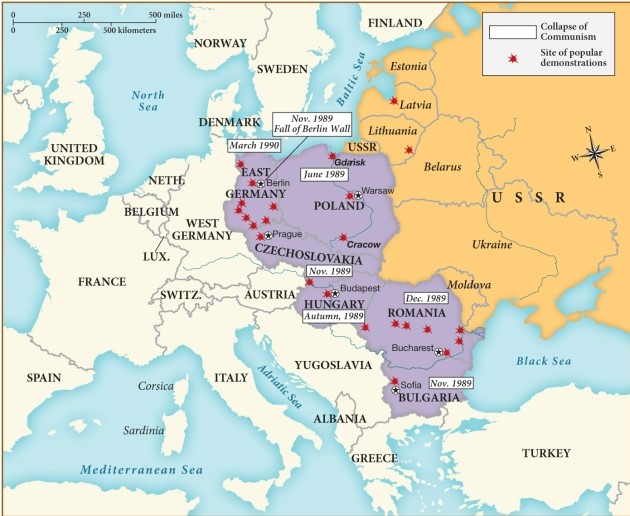
(86) Which of the following nations was the first to become free from communism?
(Multiple Choice)
4.7/5 (66)
(66) In 1952, scientists Francis Crick and James Watson made which of the following discoveries?
(Multiple Choice)
4.8/5 (62)
(62) How did the new working class in postindustrial society undermine old socioeconomic distinctions?
(Multiple Choice)
4.9/5 (69)
(69) Which of the following measures did French president Charles de Gaulle undertake in an effort to assert French independence in a world increasingly dominated by superpower rivalry?
(Multiple Choice)
4.8/5 (76)
(76) Which of the following was a technological advancement of the 1960s?
(Multiple Choice)
4.7/5 (74)
(74) What was the consequence of the negotiations that produced SALT I?
(Multiple Choice)
4.7/5 (83)
(83) What Polish labor movement led by Lech Walesa and Anna Walentynowicz, workers at the shipyards of Gdańsk, Poland, helped bring down Soviet communism?
(Multiple Choice)
4.9/5 (84)
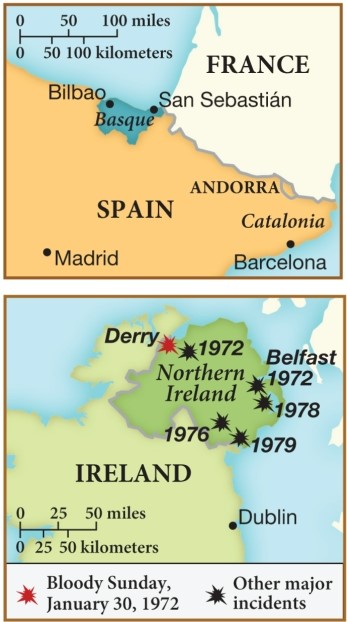
(84) The two maps reproduced here collectively exemplify the emergence of what in 1970s Europe?
(Multiple Choice)
4.7/5 (78)
(78) In what country did British troops fire on nationalists and civil rights demonstrators in a 1972 event known as "Bloody Sunday"?
(Multiple Choice)
4.9/5 (83)
(83) Mikhail Gorbachev's program of economic "restructuring," intended to increase productivity and gradually introduce market-based incentives, was called
(Multiple Choice)
4.9/5 (78)
(78) What was distinctive about the 1968 revolt in Czechoslovakia, also known as the Prague Spring?
(Multiple Choice)
4.9/5 (77)
(77) 
Filters
- Essay(0)
- Multiple Choice(0)
- Short Answer(0)
- True False(0)
- Matching(0)