



 Chat with AI
Exam 28: Postindustrial Society and the End of the Cold War Order, 1960s-1989

Exam 1: Early Western Civilization, 400,000-1000 B.C.E65 Questions
Exam 2: Near East Empires and the Reemergence of Civilization in Greece, 1000-500 B.C.E64 Questions
Exam 3: The Greek Golden Age, C 500-C 400 B.C.E65 Questions
Exam 4: From the Classical to the Hellenistic World, 400-30 B.C.E65 Questions
Exam 5: The Rise of Rome and Its Republic, 753-44 B.C.E64 Questions
Exam 6: The Creation of the Roman Empire, 44 B.C.E-284 C.E65 Questions
Exam 7: The Transformation of the Roman Empire, 284-600 C.E64 Questions
Exam 8: The Heirs of Rome: Islam, Byzantium, and Europe, 600-75065 Questions
Exam 9: From Centralization to Fragmentation, 750-105065 Questions
Exam 10: Commercial Quickening and Religious Reform, 1050-115065 Questions
Exam 11: The Flowering of the Middle Ages, 1150-121565 Questions
Exam 12: The Medieval Synthesis and Its Cracks, 1215-134065 Questions
Exam 13: Crisis and Renaissance, 1340-149265 Questions
Exam 14: Global Encounters and the Shock of the Reformation, 1492-156065 Questions
Exam 15: Wars of Religion and the Clash of Worldviews, 1560-164865 Questions
Exam 16: Absolutism, Constitutionalism, and the Search for Order, 1640-170065 Questions
Exam 17: The Atlantic System and Its Consequences, 1700-175065 Questions
Exam 18: The Promise of Enlightenment, 1750-178965 Questions
Exam 19: The Cataclysm of Revolution, 1789-179965 Questions
Exam 20: Napoleon and the Revolutionary Legacy, 1800-183065 Questions
Exam 21: Industrialization and Social Ferment, 1830-185064 Questions
Exam 22: Politics and Culture of the Nation-State, 1850-187065 Questions
Exam 23: Empire, Industry, and Everyday Life, 1870-189065 Questions
Exam 24: Modernity and the Road to War, 1890-191465 Questions
Exam 25: World War I and Its Aftermath, 1914-192965 Questions
Exam 26: The Great Depression and World War II, 1929-194565 Questions
Exam 27: The Cold War and the Remaking of Europe, 1945-1960s64 Questions
Exam 28: Postindustrial Society and the End of the Cold War Order, 1960s-198965 Questions
Exam 29: A New Globalism, 1989 to the Present65 Questions
Select questions type


U.S. president Richard M. Nixon's 1972 visit to what country helped to speed up the process of détente between the United States and the Soviet Union?
(Multiple Choice)
4.8/5  (89)
(89) What were some of the policies enacted by Lyndon B. Johnson that prompted the Black novelist Ralph Ellison to call him "the greatest American president for the poor and the Negroes"?
(Essay)
4.9/5 (90)
(90) Describe how Margaret Thatcher reshaped the West's political and economic ideas in the 1980s. What impact did her policies have on Europe? What were the consequences of her economic and political policies?
(Essay)
4.8/5 (78)
(78) Which of the following is an example of how postindustrial life in the Soviet bloc differed from life in the West?
(Multiple Choice)
4.8/5 (75)
(75) Describe the groups who were most active in protests beginning in the 1960s. To what extent might the prosperity of society have contributed to their anger?
(Essay)
4.9/5 (91)
(91) As neoliberalism took hold in the 1980s and 1990s and European governments began cutting the welfare state, which country maintained a full array of social programs?
(Multiple Choice)
4.9/5 (64)
(64) What was the title of Aleksandr Solzhenitsyn's book that detailed life in Soviet forced-labor camps and brought about his expulsion from the USSR?
(Multiple Choice)
4.9/5 (63)
(63) Historians have observed that, whereas early modern families focused their efforts on independent subsistence production and the teaching of craft skills to younger generations, postindustrial families
(Multiple Choice)
4.8/5 (76)
(76) Richard Nixon won election as president of the United States in 1968 partly because of what campaign promise?
(Multiple Choice)
4.8/5 (83)
(83) Why did European governments in the postwar era fund both radio and television broadcasting with tax dollars?
(Multiple Choice)
5.0/5 (83)
(83) Why did Soviet-bloc nations often have great difficulty applying their achievements in science to commercial applications?
(Multiple Choice)
4.9/5 (82)
(82) What was the climactic moment of the "space race" between the United States and the Soviet Union?
(Multiple Choice)
4.9/5 (70)
(70) Which of the following nations experienced the greatest concentration of popular demonstrations against communism from 1989 through 1990?
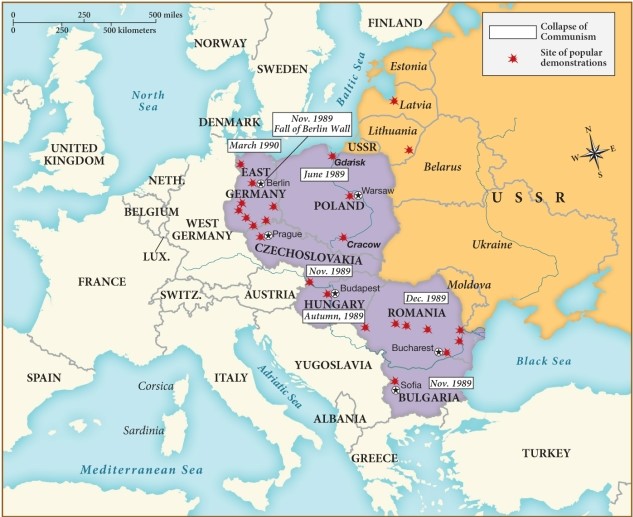
(Multiple Choice)
4.7/5 (77)
(77) The combination of economic conditions-rising prices, rising interest rates, and high unemployment-that hit the oil-dependent Western nations as a result of the OPEC oil embargo became known as what?
(Multiple Choice)
4.8/5 (83)
(83) What did one philosopher mean when, in the last third of the twentieth century, she proclaimed that people had become cyborgs?
(Multiple Choice)
4.9/5 (76)
(76) The Black Panthers compared their struggle in the United States to
(Multiple Choice)
4.8/5 (76)
(76) In what ways could protests by European students in the 1960s be characterized as an expression of individualism, and how did they show this in their lifestyles and attire?
(Essay)
4.8/5 (91)
(91) In what ways was the study of anthropology, and the work of Claude Lévi-Strauss in particular, influenced by the ways in which Western societies were ordered and run?
(Essay)
4.9/5 (84)
(84) 
Filters
- Essay(0)
- Multiple Choice(0)
- Short Answer(0)
- True False(0)
- Matching(0)