



 Chat with AI
Exam 5: The Rise of Rome and Its Republic, 753-44 B.C.E

Exam 1: Early Western Civilization, 400,000-1000 B.C.E65 Questions
Exam 2: Near East Empires and the Reemergence of Civilization in Greece, 1000-500 B.C.E64 Questions
Exam 3: The Greek Golden Age, C 500-C 400 B.C.E65 Questions
Exam 4: From the Classical to the Hellenistic World, 400-30 B.C.E65 Questions
Exam 5: The Rise of Rome and Its Republic, 753-44 B.C.E64 Questions
Exam 6: The Creation of the Roman Empire, 44 B.C.E-284 C.E65 Questions
Exam 7: The Transformation of the Roman Empire, 284-600 C.E64 Questions
Exam 8: The Heirs of Rome: Islam, Byzantium, and Europe, 600-75065 Questions
Exam 9: From Centralization to Fragmentation, 750-105065 Questions
Exam 10: Commercial Quickening and Religious Reform, 1050-115065 Questions
Exam 11: The Flowering of the Middle Ages, 1150-121565 Questions
Exam 12: The Medieval Synthesis and Its Cracks, 1215-134065 Questions
Exam 13: Crisis and Renaissance, 1340-149265 Questions
Exam 14: Global Encounters and the Shock of the Reformation, 1492-156065 Questions
Exam 15: Wars of Religion and the Clash of Worldviews, 1560-164865 Questions
Exam 16: Absolutism, Constitutionalism, and the Search for Order, 1640-170065 Questions
Exam 17: The Atlantic System and Its Consequences, 1700-175065 Questions
Exam 18: The Promise of Enlightenment, 1750-178965 Questions
Exam 19: The Cataclysm of Revolution, 1789-179965 Questions
Exam 20: Napoleon and the Revolutionary Legacy, 1800-183065 Questions
Exam 21: Industrialization and Social Ferment, 1830-185064 Questions
Exam 22: Politics and Culture of the Nation-State, 1850-187065 Questions
Exam 23: Empire, Industry, and Everyday Life, 1870-189065 Questions
Exam 24: Modernity and the Road to War, 1890-191465 Questions
Exam 25: World War I and Its Aftermath, 1914-192965 Questions
Exam 26: The Great Depression and World War II, 1929-194565 Questions
Exam 27: The Cold War and the Remaking of Europe, 1945-1960s64 Questions
Exam 28: Postindustrial Society and the End of the Cold War Order, 1960s-198965 Questions
Exam 29: A New Globalism, 1989 to the Present65 Questions
Select questions type


What specific function did the Roman Senate fulfill during the years of the Roman republic?
(Multiple Choice)
4.8/5  (75)
(75) How did the Roman republican system ensure that consuls would have sufficient experience to fulfill their duties?
(Essay)
4.8/5 (84)
(84) Gaius Marius (c. 157-86 B.C.E.) changed Roman history when he reformed the army entrance requirements. Explain Marius's rise to power and the influence of his reform on the nature of the Roman army.
(Essay)
4.9/5 (76)
(76) What was the cause of the Social War that took place between 91 and 87 B.C.E.?
(Multiple Choice)
4.8/5 (66)
(66) Freed slaves in the Roman republic could not hold elective office or serve in the army,
(Multiple Choice)
4.8/5 (77)
(77) How were the violent deaths of Tiberius and Gaius Gracchus a turning point in the history of the Roman republic?
(Multiple Choice)
4.8/5 (78)
(78) How did the Roman elites who profited from Rome's expansion undermine traditional Roman values?
(Multiple Choice)
4.9/5 (74)
(74) What factor enabled Julius Caesar to triumph in the civil war that lasted from 49 to 45 B.C.E.?
(Multiple Choice)
4.7/5 (88)
(88) Why was Rome's geography perfect for territorial expansion?
(Multiple Choice)
4.8/5 (79)
(79) How did Rome convince many of their vanquished foes in Italy to willingly accept Roman domination?
(Essay)
5.0/5 (73)
(73) The Roman concept of authority was based on the belief that
(Multiple Choice)
5.0/5 (80)
(80) What Roman woman of the second century B.C.E. gained fame for having turned down a marriage offer from King Ptolemy VIII of Egypt and giving birth to two leading politicians, Tiberius and Gaius Gracchus?
(Multiple Choice)
4.7/5 (86)
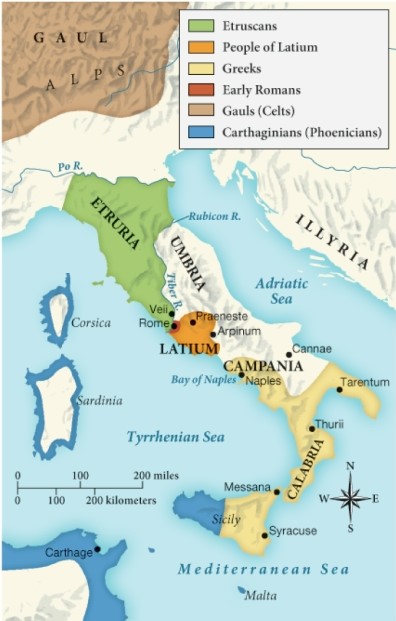
(86) Which of the following statements is supported by this map?
(Multiple Choice)
4.7/5 (88)
(88) Although the Romans finally won the Punic Wars, why were the hard-won victories ultimately disastrous for the soldiers and their families?
(Essay)
4.9/5 (65)
(65) In the Roman republic, the highest officials were known as consuls. Consuls were elected each year and were expected to command the army. How did the Romans ensure that the elected consuls would be sufficiently experienced to carry out such an important task? Explain in detail.
(Essay)
4.9/5 (76)
(76) How did the general and politician Gnaeus Pompey shatter Roman tradition?
(Multiple Choice)
4.8/5 (75)
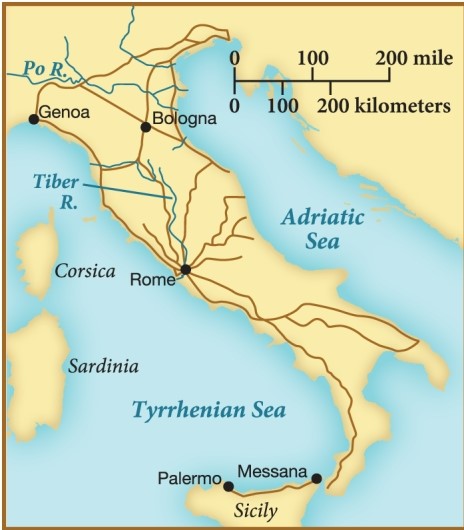
(75) This map of the Roman roads demonstrates what about the Roman republic around 110 B.C.E.?
(Multiple Choice)
4.8/5 (80)
(80) The expansion of Rome increased the disparity between rich and poor because the elites gained wealth and increased their estates through the spoils of war, while the soldiers, all of whom were small landholders, were unable to maintain their farms while they were away at war and often lost their land altogether. How did the Gracchus brothers and Gaius Marius try to remedy this situation?
(Essay)
4.8/5 (82)
(82) What was the most common reason for men to seek public office in the early Roman republic?
(Multiple Choice)
4.9/5 (90)
(90) What was the main tactic used by the plebeians to force the patricians to make political and economic concessions?
(Multiple Choice)
4.9/5 (73)
(73) 
Filters
- Essay(0)
- Multiple Choice(0)
- Short Answer(0)
- True False(0)
- Matching(0)