



 Chat with AI
Exam 5: The Rise of Rome and Its Republic, 753-44 B.C.E

Exam 1: Early Western Civilization, 400,000-1000 B.C.E65 Questions
Exam 2: Near East Empires and the Reemergence of Civilization in Greece, 1000-500 B.C.E64 Questions
Exam 3: The Greek Golden Age, C 500-C 400 B.C.E65 Questions
Exam 4: From the Classical to the Hellenistic World, 400-30 B.C.E65 Questions
Exam 5: The Rise of Rome and Its Republic, 753-44 B.C.E64 Questions
Exam 6: The Creation of the Roman Empire, 44 B.C.E-284 C.E65 Questions
Exam 7: The Transformation of the Roman Empire, 284-600 C.E64 Questions
Exam 8: The Heirs of Rome: Islam, Byzantium, and Europe, 600-75065 Questions
Exam 9: From Centralization to Fragmentation, 750-105065 Questions
Exam 10: Commercial Quickening and Religious Reform, 1050-115065 Questions
Exam 11: The Flowering of the Middle Ages, 1150-121565 Questions
Exam 12: The Medieval Synthesis and Its Cracks, 1215-134065 Questions
Exam 13: Crisis and Renaissance, 1340-149265 Questions
Exam 14: Global Encounters and the Shock of the Reformation, 1492-156065 Questions
Exam 15: Wars of Religion and the Clash of Worldviews, 1560-164865 Questions
Exam 16: Absolutism, Constitutionalism, and the Search for Order, 1640-170065 Questions
Exam 17: The Atlantic System and Its Consequences, 1700-175065 Questions
Exam 18: The Promise of Enlightenment, 1750-178965 Questions
Exam 19: The Cataclysm of Revolution, 1789-179965 Questions
Exam 20: Napoleon and the Revolutionary Legacy, 1800-183065 Questions
Exam 21: Industrialization and Social Ferment, 1830-185064 Questions
Exam 22: Politics and Culture of the Nation-State, 1850-187065 Questions
Exam 23: Empire, Industry, and Everyday Life, 1870-189065 Questions
Exam 24: Modernity and the Road to War, 1890-191465 Questions
Exam 25: World War I and Its Aftermath, 1914-192965 Questions
Exam 26: The Great Depression and World War II, 1929-194565 Questions
Exam 27: The Cold War and the Remaking of Europe, 1945-1960s64 Questions
Exam 28: Postindustrial Society and the End of the Cold War Order, 1960s-198965 Questions
Exam 29: A New Globalism, 1989 to the Present65 Questions
Select questions type


Which of the following territories only came under Roman control between 133 B.C.E. and the death of Julius Caesar?
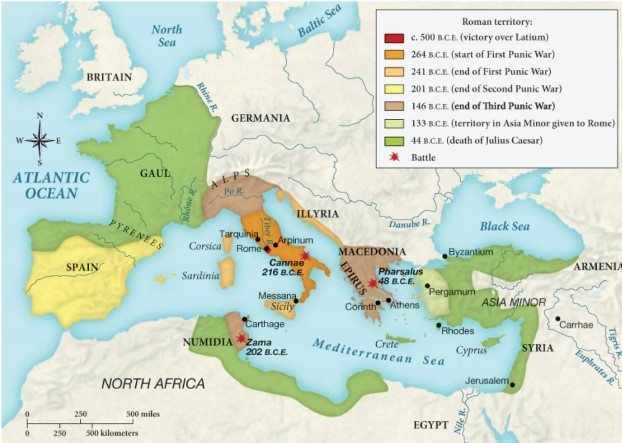
(Multiple Choice)
4.8/5  (83)
(83) Why did the Romans expand nearly continuously throughout the Mediterranean world until the first century B.C.E.? What factors enabled this expansion? Please detail the stages of Roman expansion in your response.
(Essay)
4.8/5 (84)
(84) Patria potestas referred to the right of the father to hold formal power over which of the following?
(Multiple Choice)
4.9/5 (83)
(83) To consolidate its power on the Italian peninsula, republican Rome often required conquered neighboring peoples to
(Multiple Choice)
4.9/5 (84)
(84) What did the Roman generals Sulla (c. 138-78 B.C.E.), Pompey (106-48 B.C.E.), and Julius Caesar (100-44 B.C.E.) have in common?
(Multiple Choice)
4.7/5 (78)
(78) Why did so many farmers sink into debt or lose their land in the latter years of the Roman republic?
(Multiple Choice)
4.9/5 (74)
(74) Which of the following subjects was considered most important for an elite Roman boy's education and preparation for adulthood?
(Multiple Choice)
4.8/5 (82)
(82) How did many of the landless poor in the Roman countryside seek to better their condition in the second century B.C.E.?
(Multiple Choice)
4.8/5 (88)
(88) How did a Hellenistic king increase Roman power in 133 B.C.E.?
(Multiple Choice)
4.9/5 (84)
(84) Why did the Roman aristocrats create a republican system of government and not a monarchy?
(Multiple Choice)
4.9/5 (66)
(66) Which of the following traits were highly esteemed in the early Roman republic (509-287 B.C.E.)?
(Multiple Choice)
4.9/5 (69)
(69) What was the primary function of the gods in Roman religion?
(Multiple Choice)
4.9/5 (77)
(77) How did Gaius Marius's military conquests and election as consul represent a turning point in the Roman republic?
(Multiple Choice)
4.8/5 (90)
(90) With regard to the Second Punic War, and the outcome at Cannae in particular, one could call Hannibal the general who won the battle but lost the war. Explain.
(Essay)
5.0/5 (75)
(75) Concerns about national security and a desire for wealth led the Romans to
(Multiple Choice)
4.9/5 (72)
(72) What was the most important of the Roman assemblies, in which plebeians outnumbered patricians?
(Multiple Choice)
4.8/5 (86)
(86) Why did Romans such as Cato in the second century B.C.E. distrust the influence of Greek ideas and culture on Rome?
(Multiple Choice)
4.9/5 (80)
(80) 
Filters
- Essay(0)
- Multiple Choice(0)
- Short Answer(0)
- True False(0)
- Matching(0)