



 Chat with AI
Exam 12: Neurons

Exam 1: Animals and Environments: Function on the Ecological Stage66 Questions
Exam 2: Molecules and Cells in Animal Physiology65 Questions
Exam 3: Genomics, Proteomics, and Related Approaches to Physiology64 Questions
Exam 4: Physiological Development and Epigenetics59 Questions
Exam 5: Transport of Solutes and Water67 Questions
Exam 6: Nutrition, Feeding, and Digestion77 Questions
Exam 7: Energy Metabolism68 Questions
Exam 8: Aerobic and Anaerobic Forms of Metabolism75 Questions
Exam 9: The Energetics of Aerobic Activity72 Questions
Exam 10: Thermal Relations84 Questions
Exam 11: Food, Energy, and Temperature at Work: The Lives of Mammals in Frigid Places76 Questions
Exam 12: Neurons59 Questions
Exam 13: Synapses58 Questions
Exam 14: Sensory Processes67 Questions
Exam 15: Nervous System Organization and Biological Clocks59 Questions
Exam 16: Endocrine and Neuroendocrine Physiology69 Questions
Exam 17: Reproduction68 Questions
Exam 18: Integrating Systems at Work: Animal Navigation61 Questions
Exam 19: Control of Movement71 Questions
Exam 20: Muscle78 Questions
Exam 21: Movement and Muscle at Work: Plasticity in Response to Use and Disuse67 Questions
Exam 22: Introduction to Oxygen and Carbon Dioxide in Physiology65 Questions
Exam 23: External Respiration: the Physiology of Breathing70 Questions
Exam 24: Transport of Oxygen and Carbon Dioxide in Body Fluids With an Introduction to Acid- Base Physiology68 Questions
Exam 25: Circulation72 Questions
Exam 26: Oxygen, Carbon Dioxide, and Internal Transport at Work: Diving by Marine Mammals63 Questions
Exam 27: Water and Salt Physiology: Introduction and Mechanisms72 Questions
Exam 29: Kidneys and Excretion With Notes on Nitrogen Excretion89 Questions
Exam 30: Water, Salts, and Excretion at Work: Mammals of Deserts and Dry Savannas64 Questions
Exam 28: Water and Salt Physiology of Animals in Their Environments87 Questions
Select questions type


Explain in mechanistic terms why the action potential can travel a great distance along an axon without degrading.
(Essay)
4.9/5  (80)
(80) The absolute refractory period of the action potential is best explained by
(Multiple Choice)
4.9/5 (87)
(87) Refer to the figure shown.
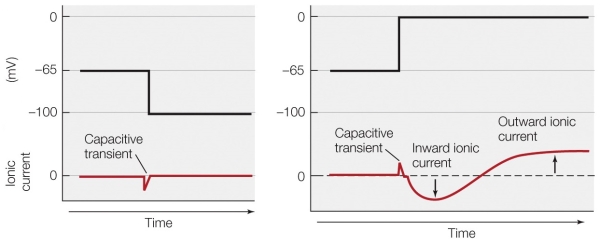 How would the trace on the right look if the neuron was soaking in tetraethylammonium (TEA)?
 (Multiple Choice)
4.8/5 (84)
(84) Suppose there is a small patch of membrane from a mammalian muscle fiber, with a small volume of adjacent cytoplasm and extracellular fluid. Assume that the membrane is most permeable to K+. There are 110,000 cations and 110,000 anions in each fluid compartment. In the center of the cell
(Multiple Choice)
4.9/5 (82)
(82) According to the Nernst equation, which change will depolarize Vm, the membrane potential?
(Multiple Choice)
4.8/5 (76)
(76) The separation of positive and negative charges constitutes
(Multiple Choice)
4.8/5 (86)
(86) Refer to the figure shown.
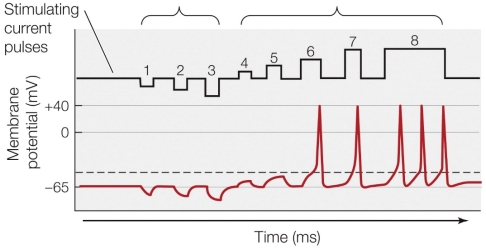 How many separate current pulses cause the membrane potential to reach the threshold?
 (Multiple Choice)
4.8/5 (75)
(75) Suppose there is a small patch of membrane from a mammalian muscle fiber, with a small volume of adjacent cytoplasm and extracellular fluid. Assume that the membrane is most permeable to K+. There are 110,000 cations and 110,000 anions in each fluid compartment. The membrane potential results from
(Multiple Choice)
4.9/5 (82)
(82) For a hormone to elicit a specific response from a cell, the cell must possess
(Multiple Choice)
4.9/5 (79)
(79) _______ prevents bidirectional propagation of action potentials.
(Multiple Choice)
4.8/5 (75)
(75) Refer to the figure shown.
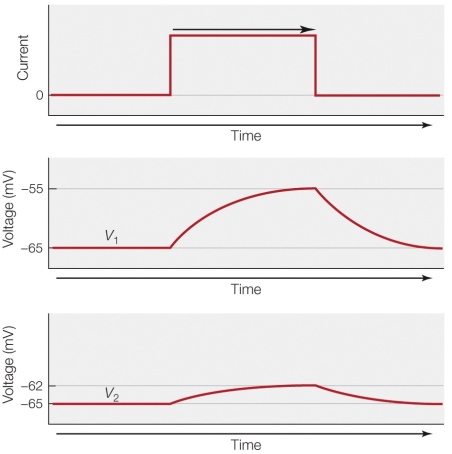 Which statement offers the best explanation for the difference between the middle panel and the lower panel?
 (Multiple Choice)
4.8/5 (75)
(75) Refer to the figure shown.
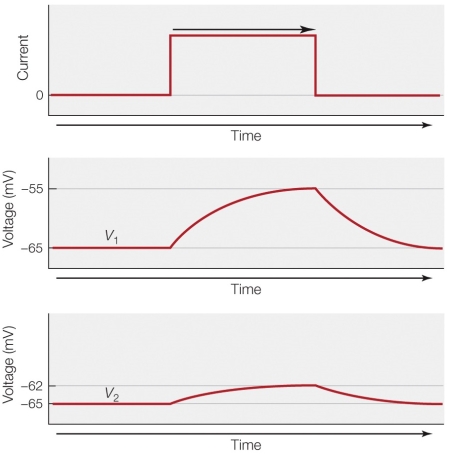 In the figure, the _______ decreases with distance.
 (Multiple Choice)
4.9/5 (80)
(80) Which structure is most responsible for the all-or-none property of the action potential?
(Multiple Choice)
4.7/5 (66)
(66) Refer to the figure shown.
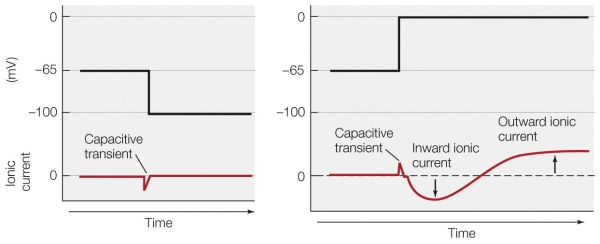 Which technique was used to collect the data shown in the figure?
 (Multiple Choice)
4.9/5 (86)
(86) Which statement regarding the structure of the voltage-gated Na+ channels is false?
(Multiple Choice)
4.7/5 (80)
(80) Refer to the figure shown.
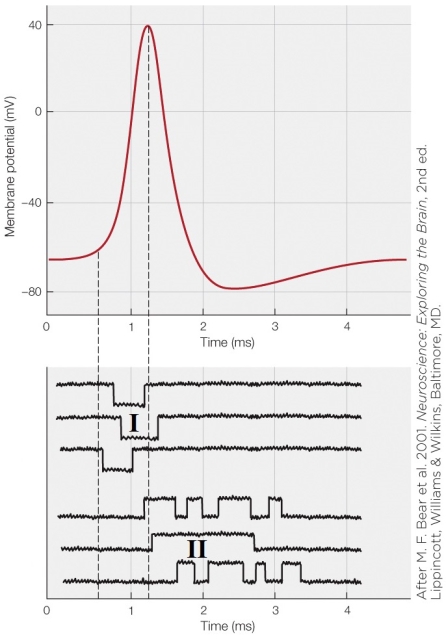 Why do the channels at II on the figure stay open longer than those at I?
 (Multiple Choice)
5.0/5 (65)
(65) Which statement about the startle response of the cockroach is true?
(Multiple Choice)
4.8/5 (85)
(85) Compare and contrast the techniques of patch clamping and voltage clamping.
(Essay)
5.0/5 (77)
(77) 
Filters
- Essay(0)
- Multiple Choice(0)
- Short Answer(0)
- True False(0)
- Matching(0)