



 Chat with AI
Exam 15: DNA Technology and Genomics

Exam 1: A View of Life72 Questions
Exam 2: Atoms and Molecules: the Chemical Basis of Life75 Questions
Exam 3: The Chemistry of Life: Organic Compounds75 Questions
Exam 4: Organization of the Cell76 Questions
Exam 5: Biological Membranes73 Questions
Exam 6: Cell Communication73 Questions
Exam 7: Energy and Metabolism73 Questions
Exam 8: How Cells Make Atp: Energy-Releasing Pathways75 Questions
Exam 9: Photosynthesis: Capturing Light Energy79 Questions
Exam 10: Chromosomes, Mitosis, and Meiosis78 Questions
Exam 11: The Basic Principles of Heredity87 Questions
Exam 12: DNA: The Carrier of Genetic Information83 Questions
Exam 13: Gene Expression92 Questions
Exam 14: Gene Regulation86 Questions
Exam 15: DNA Technology and Genomics98 Questions
Exam 16: Human Genetics and the Human Genome82 Questions
Exam 17: Developmental Genetics90 Questions
Exam 18: Introduction to Darwinian Evolution66 Questions
Exam 19: Evolutionary Change in Populations72 Questions
Exam 20: Speciation and Macroevolution72 Questions
Exam 21: The Origin and Evolutionary History of Life71 Questions
Exam 22: The Evolution of Primates73 Questions
Exam 23: Understanding Diversity: Systematics70 Questions
Exam 24: Viruses and Subviral Agents55 Questions
Exam 25: Bacteria and Archaea63 Questions
Exam 26: Protists76 Questions
Exam 27: Seedless Plants76 Questions
Exam 28: Seed Plants76 Questions
Exam 29: The Fungi78 Questions
Exam 30: An Introduction to Animal Diversity71 Questions
Exam 31: Sponges, Cnidarians, Ctenophores, and Protostomes114 Questions
Exam 32: The Deuterostomes79 Questions
Exam 33: Plant Structure, Growth, and Development94 Questions
Exam 34: Leaf Structure and Function90 Questions
Exam 35: Stem Structure and Transport91 Questions
Exam 36: Roots and Mineral Nutrition105 Questions
Exam 37: Reproduction in Flowering Plants107 Questions
Exam 38: Plant Developmental Responses to External and Internal Signals113 Questions
Exam 39: Animal Structure and Function: an Introduction106 Questions
Exam 40: Protection, Support, and Movement75 Questions
Exam 41: Neural Signaling76 Questions
Exam 42: Neural Regulation81 Questions
Exam 43: Sensory Systems83 Questions
Exam 44: Internal Transport119 Questions
Exam 45: The Immune System: Internal Defense93 Questions
Exam 46: Gas Exchange123 Questions
Exam 47: Processing Food and Nutrition127 Questions
Exam 48: Osmoregulation and Disposal of Metabolic Wastes111 Questions
Exam 49: Endocrine Regulation87 Questions
Exam 50: Reproduction121 Questions
Exam 51: Animal Development117 Questions
Exam 52: Animal Behavior91 Questions
Exam 53: Introduction to Ecology: Population Ecology99 Questions
Exam 54: Community Ecology91 Questions
Exam 55: Ecosystems and the Biosphere101 Questions
Exam 56: Ecology and the Geography of Life99 Questions
Exam 57: Biological Diversity and Conservation Biology82 Questions
Select questions type


Determine whether each scenario describes an advantage or disadvantage of transgenic organisms.
Premises:
All transgenic salmon are sterile females; therefore, they cannot breed with wild salmon populations.
Responses:
Disadvantage
Advantage
Correct Answer: Verified
Premises:
Responses:
(Matching)
4.7/5  (86)
(86) An organism in which foreign genes have been incorporated is called a:
(Multiple Choice)
4.9/5 (78)
(78) Two common methods for obtaining large quantities of a DNA fragment or gene of interest is by PCR or by DNA cloning (e.g., construction of a DNA library). Explain one advantage of using PCR and one advantage of using DNA cloning in a living cell.
(Essay)
5.0/5 (95)
(95) Identify two important proteins that are produced using genetic engineering techniques. Briefly discuss why the genetic engineering techniques used are preferred over the other methods of producing each of the proteins that you identified.
(Essay)
4.9/5 (88)
(88) Determine whether each scenario describes an advantage or disadvantage of transgenic organisms.
Premises:
Transgenic pest-resistant crops may affect nontarget pests.
Responses:
Advantage
Disadvantage
Correct Answer:Verified
VerifiedPremises:
Responses:
(Matching)
4.9/5 (77)
(77) Why is insulin produced by genetically engineered E. coli cells superior to insulin obtained from animal sources?
(Multiple Choice)
4.9/5 (82)
(82) Determine whether each scenario describes an advantage or disadvantage of transgenic organisms.
Premises:
Transgenic animals, such as sheep and cows, produce medicinal proteins in their milk. This creates a larger and cheaper supply of some human drugs.
Responses:
Disadvantage
Advantage
Correct Answer:Verified
VerifiedPremises:
Responses:
(Matching)
4.9/5 (88)
(88) Match the technique with the experimental scenario.
Premises:
gene expression; single mRNA transcripts
Responses:
DNA chip
Southern blot
bioinformatics
Correct Answer:Verified
VerifiedPremises:
Responses:
(Matching)
4.7/5 (84)
(84) In producing a genomic library, human DNA and plasmid DNA must first be treated with:
(Multiple Choice)
4.8/5 (79)
(79) A plant virus is destroying corn crops. Scientists have determined a mutation that prevents the virus from attaching to the plant cells (and thus preventing infection) without altering the function of the protein or the corn. How would a CRISPR-based gene drive allow scientists to insert this gene into the yet-to-be-planted corn crops.
(Essay)
4.7/5 (70)
(70) Reverse transcriptase catalyzes the production of _____ from ____.
(Multiple Choice)
5.0/5 (92)
(92) Match the sequence of the steps for the Southern Blot assay.
Premises:
Step 5
Responses:
Visualize the DNA fragments using UV light.
Load the DNA fragments on the gel and separate by electrophoresis.
The blotting buffer transfers DNA fragments to DNA binding filter.
Correct Answer:Verified
VerifiedPremises:
Responses:
(Matching)
4.8/5 (88)
(88) Splicing together DNA from two different organisms is known as:
(Multiple Choice)
4.8/5 (82)
(82) Figure 15-3
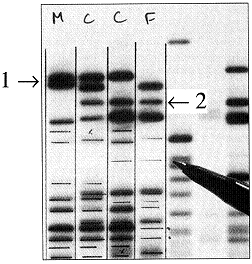 The columns in the accompanying figure represent F (for female), C (for children), and M (for male). The presence of the band marked with arrow #2, shows that:
 (Multiple Choice)
4.9/5 (87)
(87) Figure 15-1
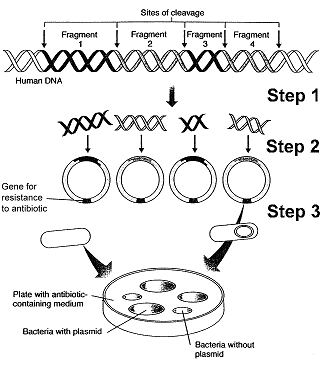 Refer to the accompanying figure. The use of antibiotic medium at the end of this process:
 (Multiple Choice)
4.9/5 (78)
(78) Each individual bacterial colony contains ____ recombinant plasmid as/than the other colonies on the plate, and the DNA sequence of the recombinant plasmid present in any given colony can be identified using a ____.
(Multiple Choice)
4.9/5 (81)
(81) A(n) ____ is produced by introducing a gene for a viral surface protein into a nonpathogenic vector.
(Multiple Choice)
4.7/5 (80)
(80) To produce a genomic library DNA, DNA fragments are incorporated into plasmids that are introduced into bacteria.
(True/False)
4.8/5 (83)
(83) 
Filters
- Essay(0)
- Multiple Choice(0)
- Short Answer(0)
- True False(0)
- Matching(0)