



 Chat with AI
Exam 10: Molecular Regulation

Exam 1: Microbial Life: Origin and Discovery70 Questions
Exam 2: Observing the Microbial Cell69 Questions
Exam 3: Cell Structure and Function72 Questions
Exam 4: Bacterial Culture, Growth, and Development70 Questions
Exam 5: Environmental Influences and Control of Microbial Growth70 Questions
Exam 6: Viruses70 Questions
Exam 7: Genomes and Chromosomes70 Questions
Exam 8: Transcription, Translation, and Bioinformatics76 Questions
Exam 9: Gene Transfer, Mutations, and Genome Evolution72 Questions
Exam 10: Molecular Regulation73 Questions
Exam 11: Viral Molecular Biology70 Questions
Exam 12: Biotechniques and Synthetic Biology72 Questions
Exam 13: Energetics and Catabolism77 Questions
Exam 14: Electron Flow in Organotrophy, Lithotrophy, and Phototrophy73 Questions
Exam 15: Biosynthesis73 Questions
Exam 16: Food and Industrial Microbiology73 Questions
Exam 17: Origins and Evolution70 Questions
Exam 18: Bacterial Diversity71 Questions
Exam 19: Archaeal Diversity70 Questions
Exam 20: Eukaryotic Diversity69 Questions
Exam 21: Microbial Ecology70 Questions
Exam 22: Microbes in Global Elemental Cycles70 Questions
Exam 23: Human Microbiota and Innate Immunity70 Questions
Exam 24: The Adaptive Immune Response70 Questions
Exam 25: Microbial Pathogenesis70 Questions
Exam 26: Microbial Diseases69 Questions
Exam 27: Antimicrobial Therapy72 Questions
Exam 28: Clinical Microbiology and Epidemiology75 Questions
Select questions type


Describe what happens to the lac operon in the presence of both lactose and glucose.
(Essay)
4.9/5  (79)
(79) Transcriptional attenuation is a common regulatory strategy used to control many operons that code for
(Multiple Choice)
4.9/5 (72)
(72) How is sigma H degradation controlled by temperature, and why is this important to the cell?
(Essay)
4.9/5 (75)
(75) Which of the following is the favored carbon source of Escherichia coli?
(Multiple Choice)
4.9/5 (86)
(86) A bacterial growth curve is presented below. The curve represents ________ growth, which is caused by the ________. 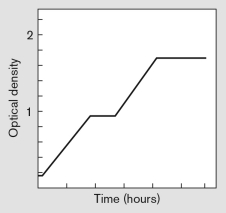
(Multiple Choice)
4.8/5 (65)
(65) With respect to quorum sensing, all of the following are true EXCEPT that it
(Multiple Choice)
4.8/5 (68)
(68) If the newly synthesized DNA strand slips back relative to the template strand, one copy of the repeated unit is ________ the growing strand.
(Multiple Choice)
4.8/5 (99)
(99) How does the AraC regulatory protein turn on transcription in the presence of arabinose?
(Multiple Choice)
4.9/5 (76)
(76) In a two-component signal transduction system, a ________ is transferred from a sensor kinase to a ________ in response to an environmental signal.
(Multiple Choice)
4.7/5 (81)
(81) Which of the following is a technique used in studying the proteome of an organism?
(Multiple Choice)
4.9/5 (69)
(69) The stringent response downregulates rRNA synthesis. Does it similarly downregulate ribosomal protein synthesis?
(Essay)
4.9/5 (81)
(81) During the process of endospore formation, different sigma factors are active in the mother cell and forespore. How is this possible, and why is it important?
(Essay)
4.8/5 (75)
(75) The value of studying a transcriptome rather than a genome is that
(Multiple Choice)
4.9/5 (82)
(82) Quorum sensing plays a role in interspecies communications. Describe the relationship between green seaweed Enteromorpha and Vibrio anguillarum bacterial cells in biofilms, and explain how Escherichia coli was used to understand this interaction.
(Essay)
4.8/5 (82)
(82) In some, but not all, instances, ________ molecules bind RNA transcripts and help or hinder degradation.
(Multiple Choice)
4.9/5 (76)
(76) All the cell's expressed RNAs are collectively referred to as the cell's
(Multiple Choice)
5.0/5 (81)
(81) Explain the process of attenuation in regulating transcription of the tryptophan operon.
(Essay)
4.9/5 (74)
(74) A transmembrane sensor kinase protein senses an environmental condition outside ________ bacteria or in the periplasm of a(n) ________ bacteria.
(Multiple Choice)
4.9/5 (84)
(84) 
Filters
- Essay(0)
- Multiple Choice(0)
- Short Answer(0)
- True False(0)
- Matching(0)