



 Chat with AI
Exam 4: Bacterial Culture, Growth, and Development

Exam 1: Microbial Life: Origin and Discovery70 Questions
Exam 2: Observing the Microbial Cell69 Questions
Exam 3: Cell Structure and Function72 Questions
Exam 4: Bacterial Culture, Growth, and Development70 Questions
Exam 5: Environmental Influences and Control of Microbial Growth70 Questions
Exam 6: Viruses70 Questions
Exam 7: Genomes and Chromosomes70 Questions
Exam 8: Transcription, Translation, and Bioinformatics76 Questions
Exam 9: Gene Transfer, Mutations, and Genome Evolution72 Questions
Exam 10: Molecular Regulation73 Questions
Exam 11: Viral Molecular Biology70 Questions
Exam 12: Biotechniques and Synthetic Biology72 Questions
Exam 13: Energetics and Catabolism77 Questions
Exam 14: Electron Flow in Organotrophy, Lithotrophy, and Phototrophy73 Questions
Exam 15: Biosynthesis73 Questions
Exam 16: Food and Industrial Microbiology73 Questions
Exam 17: Origins and Evolution70 Questions
Exam 18: Bacterial Diversity71 Questions
Exam 19: Archaeal Diversity70 Questions
Exam 20: Eukaryotic Diversity69 Questions
Exam 21: Microbial Ecology70 Questions
Exam 22: Microbes in Global Elemental Cycles70 Questions
Exam 23: Human Microbiota and Innate Immunity70 Questions
Exam 24: The Adaptive Immune Response70 Questions
Exam 25: Microbial Pathogenesis70 Questions
Exam 26: Microbial Diseases69 Questions
Exam 27: Antimicrobial Therapy72 Questions
Exam 28: Clinical Microbiology and Epidemiology75 Questions
Select questions type


Which of the following is the best technique for counting only viable cells?
(Multiple Choice)
4.9/5  (92)
(92) During which stage of bacterial growth is the culture growing exponentially? 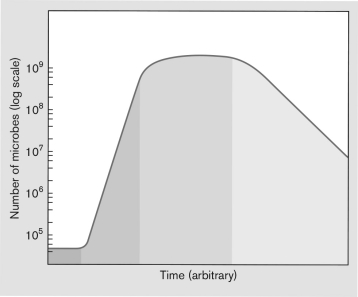
(Multiple Choice)
4.9/5 (73)
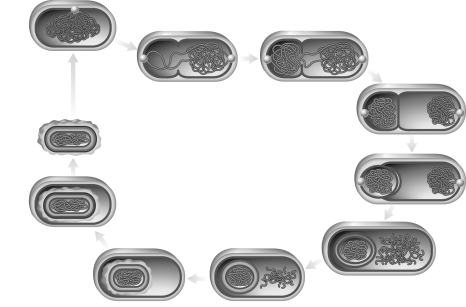
(73) 
Why do some members of a biofilm community live deep within the biofilm?
(Multiple Choice)
4.7/5 (71)
(71) How does Anabaena overcome the challenge of performing both photosynthesis and nitrogen fixation?
(Essay)
4.7/5 (85)
(85) A problem with ________ of cell number is that dead cells also scatter light.
(Multiple Choice)
5.0/5 (78)
(78) Why does a microbe's growth rate in its natural environment vary greatly from that in the laboratory? Give at least two reasons for this.
(Essay)
4.9/5 (64)
(64) Why is iron so often a limiting nutrient, when it seems to be so abundant in the environment, and how can organisms overcome this problem?
(Essay)
4.9/5 (82)
(82) Which of the following can consume glucose and, in the absence of oxygen, break it down into ethanol and carbon dioxide gas?
(Multiple Choice)
4.9/5 (68)
(68) A cafeteria worker who fails to wash his hands thoroughly and fails to wear gloves inoculates a quiche with 4 E. coli cells when he uses his finger to test whether it is done. By the time you purchase the quiche, there are 128 E. coli cells in it. How many generations did the cells go through?
(Multiple Choice)
4.9/5 (89)
(89) During biofilm formation, as more and more cells bind to the surface, they begin sending signals to each other in a process called
(Multiple Choice)
4.9/5 (76)
(76) Define the terms "viable" and "viable but unculturable." Why are so many environmental organisms believed to be viable but unculturable?
(Essay)
4.8/5 (85)
(85) The majority of nitrogen in soil and marine environments is fixed by
(Multiple Choice)
4.8/5 (73)
(73) When the intracellular iron concentration is low, iron-scavenging molecules called ________ are produced.
(Multiple Choice)
4.7/5 (87)
(87) Why can't most organisms use the nitrogen gas that is so prevalent in the atmosphere? How do these organisms acquire a usable form of nitrogen?
(Essay)
4.8/5 (83)
(83) 
Filters
- Essay(0)
- Multiple Choice(0)
- Short Answer(0)
- True False(0)
- Matching(0)