



 Chat with AI
Exam 17: The Origin of Species

Exam 1: An Introduction to Life on Earth85 Questions
Exam 2: Atoms, Molecules, and Life90 Questions
Exam 3: Biological Molecules98 Questions
Exam 4: Cell Structure and Function90 Questions
Exam 5: Cell Membrane Structure and Function95 Questions
Exam 6: Energy Flow in the Life of a Cell90 Questions
Exam 7: Capturing Solar Energy: Photosynthesis102 Questions
Exam 8: Harvesting Energy: Glycolysis and Cellular Respiration97 Questions
Exam 9: Cellular Reproduction133 Questions
Exam 10: Meiosis: the Basis of Sexual Reproduction103 Questions
Exam 11: Patterns of Inheritance98 Questions
Exam 12: Dna: the Molecule of Heredity97 Questions
Exam 13: Gene Expression and Regulation93 Questions
Exam 14: Biotechnology91 Questions
Exam 15: Principles of Evolution97 Questions
Exam 16: How Populations Evolve109 Questions
Exam 17: The Origin of Species89 Questions
Exam 18: The History of Life125 Questions
Exam 19: Systematics: Seeking Order Amid Diversity90 Questions
Exam 20: The Diversity of Prokaryotes and Viruses97 Questions
Exam 21: The Diversity of Protists102 Questions
Exam 22: The Diversity of Plants115 Questions
Exam 23: The Diversity of Fungi107 Questions
Exam 24: Animal Diversity I: Invertebrates101 Questions
Exam 25: Animal Diversity II: Vertebrates118 Questions
Exam 26: Animal Behavior116 Questions
Exam 27: Population Growth and Regulation114 Questions
Exam 28: Community Interactions125 Questions
Exam 29: Energy Flow and Nutrient Cycling in Ecosystems122 Questions
Exam 30: Earths Diverse Ecosystems126 Questions
Exam 31: Conserving Earths Biodiversity109 Questions
Exam 32: Homeostasis and the Organization of the Animal Body95 Questions
Exam 33: Circulation89 Questions
Exam 34: Respiration92 Questions
Exam 35: Nutrition and Digestion91 Questions
Exam 36: The Urinary System99 Questions
Exam 37: Defenses Against Disease104 Questions
Exam 38: Chemical Control of the Animal Body: the Endocrine System133 Questions
Exam 39: The Nervous System118 Questions
Exam 40: The Senses94 Questions
Exam 41: Action and Support: the Muscles and Skeleton90 Questions
Exam 42: Animal Reproduction120 Questions
Exam 43: Animal Development122 Questions
Exam 44: Plant Anatomy and Nutrient Transport95 Questions
Exam 45: Plant Reproduction and Development90 Questions
Exam 46: Plant Responses to the Environment87 Questions
Select questions type


Which statement best describes how overspecialization can affect a species?
(Multiple Choice)
4.9/5  (79)
(79) In many species of fireflies, males flash light from their abdomens to attract females. Each species has a different flashing pattern. This is an example of
(Multiple Choice)
4.9/5 (72)
(72) When a species invades a new habitat and evolves rapidly into several new species to better exploit new resources, what has occurred?
(Multiple Choice)
4.8/5 (93)
(93) All members of the golden hamster species known today are descendants of a single litter collected in Syria in 1939. Its diploid chromosome number is 44. Two other species of hamster, each with a diploid number of 22, overlap geographically in Syria. The golden hamster is thought to be a new species from the mating of a male and female of the two other hamster species. What mechanism might explain this recent event of speciation?
(Multiple Choice)
4.9/5 (64)
(64) Two populations of plants found in the same meadow look identical but are fertilized by different pollinators- one by a night- flying hummingbird moth, the other by honeybees that fly by day. This is an example of
(Multiple Choice)
4.8/5 (74)
(74) A group of an interbreeding natural population that is reproductively isolated from other such groups is called a
(Multiple Choice)
4.7/5 (81)
(81) In the late 1700s, two populations of minnows became isolated when an earthquake altered the path of a river. Now the populations can no longer successfully breed with each other even when they are both moved to the same pond. These organisms have undergone speciation.
(Short Answer)
4.9/5 (84)
(84) The introduction of a few individuals into a new habitat that is unoccupied by other members of the species is a(n)
(Multiple Choice)
4.7/5 (65)
(65) In what type of habitat, or under what types of environmental conditions, would you expect adaptive radiation to occur?
(Essay)
4.8/5 (77)
(77) 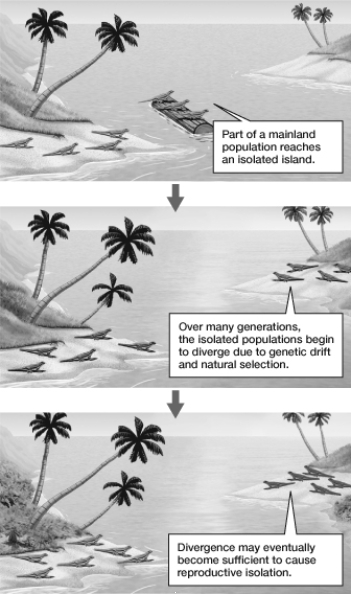
Two species of snails are physically unable to mate. This is an example of
(Multiple Choice)
4.8/5 (89)
(89) A horse has a diploid number (2n) of 64 and a donkey has 2n = 62. The hybrid of these two species, mules, have 2n = 63 and are sterile. Why are mules sterile?
(Multiple Choice)
4.9/5 (77)
(77) Fruit fly species all look similar to one another. If you have a male and a female fruit fly, how can you prove that they are the same species, according to the biological species concept?
(Multiple Choice)
4.9/5 (85)
(85) Premating isolation mechanisms occur when two species have different and incompatible mating behaviors.
(True/False)
4.8/5 (85)
(85) Two different species of pine release their pollen at different times of the year. This is an example of
(Multiple Choice)
4.7/5 (83)
(83) Two species of garter snakes live in the same geographic area. One lives mainly in water and the other mainly on land; therefore, they rarely encounter each other and do not interbreed. What type of isolation is this?
(Multiple Choice)
4.9/5 (80)
(80) When offspring are infertile after breeding occurs between individuals of different species, the genetic identities of the two populations are protected by
(Multiple Choice)
4.8/5 (77)
(77) Two species of squirrels live on either side of the Grand Canyon. It is believed that a long time ago, before being separated by the canyon, they were the same species. This is an example of
(Multiple Choice)
4.8/5 (95)
(95) 
Filters
- Essay(0)
- Multiple Choice(0)
- Short Answer(0)
- True False(0)
- Matching(0)