



 Chat with AI
Exam 17: The Origin of Species

Exam 1: An Introduction to Life on Earth85 Questions
Exam 2: Atoms, Molecules, and Life90 Questions
Exam 3: Biological Molecules98 Questions
Exam 4: Cell Structure and Function90 Questions
Exam 5: Cell Membrane Structure and Function95 Questions
Exam 6: Energy Flow in the Life of a Cell90 Questions
Exam 7: Capturing Solar Energy: Photosynthesis102 Questions
Exam 8: Harvesting Energy: Glycolysis and Cellular Respiration97 Questions
Exam 9: Cellular Reproduction133 Questions
Exam 10: Meiosis: the Basis of Sexual Reproduction103 Questions
Exam 11: Patterns of Inheritance98 Questions
Exam 12: Dna: the Molecule of Heredity97 Questions
Exam 13: Gene Expression and Regulation93 Questions
Exam 14: Biotechnology91 Questions
Exam 15: Principles of Evolution97 Questions
Exam 16: How Populations Evolve109 Questions
Exam 17: The Origin of Species89 Questions
Exam 18: The History of Life125 Questions
Exam 19: Systematics: Seeking Order Amid Diversity90 Questions
Exam 20: The Diversity of Prokaryotes and Viruses97 Questions
Exam 21: The Diversity of Protists102 Questions
Exam 22: The Diversity of Plants115 Questions
Exam 23: The Diversity of Fungi107 Questions
Exam 24: Animal Diversity I: Invertebrates101 Questions
Exam 25: Animal Diversity II: Vertebrates118 Questions
Exam 26: Animal Behavior116 Questions
Exam 27: Population Growth and Regulation114 Questions
Exam 28: Community Interactions125 Questions
Exam 29: Energy Flow and Nutrient Cycling in Ecosystems122 Questions
Exam 30: Earths Diverse Ecosystems126 Questions
Exam 31: Conserving Earths Biodiversity109 Questions
Exam 32: Homeostasis and the Organization of the Animal Body95 Questions
Exam 33: Circulation89 Questions
Exam 34: Respiration92 Questions
Exam 35: Nutrition and Digestion91 Questions
Exam 36: The Urinary System99 Questions
Exam 37: Defenses Against Disease104 Questions
Exam 38: Chemical Control of the Animal Body: the Endocrine System133 Questions
Exam 39: The Nervous System118 Questions
Exam 40: The Senses94 Questions
Exam 41: Action and Support: the Muscles and Skeleton90 Questions
Exam 42: Animal Reproduction120 Questions
Exam 43: Animal Development122 Questions
Exam 44: Plant Anatomy and Nutrient Transport95 Questions
Exam 45: Plant Reproduction and Development90 Questions
Exam 46: Plant Responses to the Environment87 Questions
Select questions type


Eastern and Western meadowlarks look almost identical and sometimes inhabit the same areas of prairies. These birds recognize members of their own species by distinctive songs and thus do not breed with each other. This is an example of
(Multiple Choice)
4.8/5  (79)
(79) Store- bought hybrid tomatoes are very popular with consumers. Suppose you buy a tomato from the grocery store, collect seeds from it, and plant the seeds. If the seeds do not germinate, the seedlings fail to thrive, or the plants die quickly after sprouting, what reproductive isolating mechanism might be responsible?
(Short Answer)
4.7/5 (77)
(77) How do premating isolation mechanisms differ from postmating isolation mechanisms?
(Essay)
4.8/5 (82)
(82) A European species of marsh grass called Spartina maritima has a diploid number (2n) of 60. A similar species native to North America, S. alterniflora, has 2n = 62. In 1835, the North American species was found growing near the European species in Southampton, England, after being accidentally imported. Occasional sterile hybrids were noted. In 1895 a new species, S. anglica, was first identified at Southampton and subsequently became common. The new species has been identified as a fertile hybrid of the original two species. What is the 2n chromosome number of the hybrids that formed from the original two species S. maritima and S. alterniflora?
(Multiple Choice)
4.9/5 (78)
(78) Researchers believe that at least % of the species that have lived on Earth have become extinct.
(Short Answer)
5.0/5 (83)
(83) If a hybrid is unable to produce sperm because meiosis does not proceed correctly, gene flow between the species is restricted by
(Multiple Choice)
4.9/5 (75)
(75) One species of fish feeds in the muddy bottom of a lake. A second species eats insects that land on the water surface. This is an example of
(Multiple Choice)
4.9/5 (68)
(68) The biological species concept is based on the idea that individuals in one group are be unable to breed with individuals outside their group. This phenomenon is referred to as .
(Short Answer)
4.9/5 (70)
(70) Female blue- footed boobies of the Galápagos Islands will mate only after a specific courtship display on the part of the male. The male high- steps to advertise his bright blue feet. What mechanism describes why the females do not mate with other species of boobies?
(Multiple Choice)
4.7/5 (88)
(88) From an evolutionary perspective, explain how three species of large, flightless birds (ostriches, rheas, and emus) came to occupy the widely separated landmasses of Africa, South America, and Australia.
(Essay)
4.9/5 (71)
(71) Where would a researcher most likely find examples of allopatric speciation?
(Multiple Choice)
4.9/5 (77)
(77) Hybrid inviability is an example of a(n) _ isolating mechanism.
(Short Answer)
4.9/5 (80)
(80) Strong courtship displays like the one in the figure below can lead to 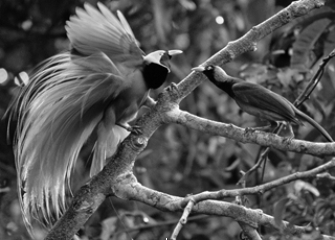
(Multiple Choice)
4.8/5 (86)
(86) The elaborate courtship rituals of many bird species help to preserve their genetic isolation through
(Multiple Choice)
4.9/5 (75)
(75) The origins of 300 or more species of cichlid fish in Lake Malawi can best be explained by
(Multiple Choice)
4.9/5 (67)
(67) Explain why naming and describing species based only on their appearance can be problematic.
(Essay)
4.7/5 (91)
(91) Before the modern era of science, organisms were assigned to species on the basis of
(Multiple Choice)
4.7/5 (62)
(62) The organisms most likely to undergo sympatric speciation by polyploidy are
(Multiple Choice)
4.8/5 (68)
(68) When two organisms reach sexual maturity at different times, it is an example of
(Multiple Choice)
4.8/5 (73)
(73) 
Filters
- Essay(0)
- Multiple Choice(0)
- Short Answer(0)
- True False(0)
- Matching(0)