



 Chat with AI
Exam 45: Plant Reproduction and Development

Exam 1: An Introduction to Life on Earth85 Questions
Exam 2: Atoms, Molecules, and Life90 Questions
Exam 3: Biological Molecules98 Questions
Exam 4: Cell Structure and Function90 Questions
Exam 5: Cell Membrane Structure and Function95 Questions
Exam 6: Energy Flow in the Life of a Cell90 Questions
Exam 7: Capturing Solar Energy: Photosynthesis102 Questions
Exam 8: Harvesting Energy: Glycolysis and Cellular Respiration97 Questions
Exam 9: Cellular Reproduction133 Questions
Exam 10: Meiosis: the Basis of Sexual Reproduction103 Questions
Exam 11: Patterns of Inheritance98 Questions
Exam 12: Dna: the Molecule of Heredity97 Questions
Exam 13: Gene Expression and Regulation93 Questions
Exam 14: Biotechnology91 Questions
Exam 15: Principles of Evolution97 Questions
Exam 16: How Populations Evolve109 Questions
Exam 17: The Origin of Species89 Questions
Exam 18: The History of Life125 Questions
Exam 19: Systematics: Seeking Order Amid Diversity90 Questions
Exam 20: The Diversity of Prokaryotes and Viruses97 Questions
Exam 21: The Diversity of Protists102 Questions
Exam 22: The Diversity of Plants115 Questions
Exam 23: The Diversity of Fungi107 Questions
Exam 24: Animal Diversity I: Invertebrates101 Questions
Exam 25: Animal Diversity II: Vertebrates118 Questions
Exam 26: Animal Behavior116 Questions
Exam 27: Population Growth and Regulation114 Questions
Exam 28: Community Interactions125 Questions
Exam 29: Energy Flow and Nutrient Cycling in Ecosystems122 Questions
Exam 30: Earths Diverse Ecosystems126 Questions
Exam 31: Conserving Earths Biodiversity109 Questions
Exam 32: Homeostasis and the Organization of the Animal Body95 Questions
Exam 33: Circulation89 Questions
Exam 34: Respiration92 Questions
Exam 35: Nutrition and Digestion91 Questions
Exam 36: The Urinary System99 Questions
Exam 37: Defenses Against Disease104 Questions
Exam 38: Chemical Control of the Animal Body: the Endocrine System133 Questions
Exam 39: The Nervous System118 Questions
Exam 40: The Senses94 Questions
Exam 41: Action and Support: the Muscles and Skeleton90 Questions
Exam 42: Animal Reproduction120 Questions
Exam 43: Animal Development122 Questions
Exam 44: Plant Anatomy and Nutrient Transport95 Questions
Exam 45: Plant Reproduction and Development90 Questions
Exam 46: Plant Responses to the Environment87 Questions
Select questions type


Endosperm has allowed the angiosperms to become the most numerous and diverse plant group. What is the role of the endosperm?
(Multiple Choice)
4.8/5  (79)
(79) Commercials on TV use food and sex as their most effective selling points. Explain how flowers use the same two points to "sell" their pollen to animals.
(Essay)
4.9/5 (61)
(61) The first leaves produced by an embryo while still inside the seed are
(Multiple Choice)
4.8/5 (70)
(70) The sexual life cycle of plants is described as alternation of generations because it alternates between
(Multiple Choice)
4.9/5 (68)
(68) In the ovule, which two cells (with a total of three nuclei) are fertilized?
(Essay)
4.9/5 (86)
(86) When a seed germinates, what usually emerges from the seed coat first? Why?
(Essay)
4.8/5 (82)
(82) In flowering plants, the sperm does not have to swim to the egg. The sperm reaches the eggs by
(Multiple Choice)
4.7/5 (84)
(84) During a late- summer walk through a park, you notice a tree that has remnants of many flowers but no fruits or seeds developing. There are no other trees like this one in the area. What could explain this occurrence?
(Multiple Choice)
5.0/5 (89)
(89) Based on the figure, the must have contained two nuclei before fertilization. 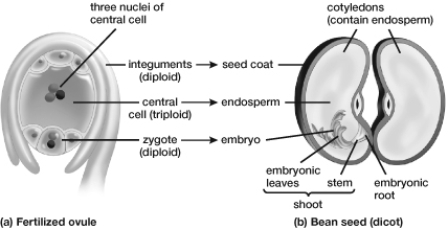
(Multiple Choice)
4.8/5 (86)
(86) Cotyledons and endosperm both provide nutrition. What is the difference between them?
(Multiple Choice)
4.8/5 (80)
(80) In temperate deciduous forests, most of the small flowers that grow on the forest floor must complete their life cycle quickly before tree leaves shade out most of the light. Many of these plants reproduce asexually by runners. What advantages does this have for such plants?
(Essay)
4.8/5 (81)
(81) While walking along a riverbank after a swim, you step on a sharp fruit. When you pick it up, you notice that it rattles, which indicates there is an air pocket around the seeds. How is this fruit most likely dispersed?
(Multiple Choice)
4.9/5 (85)
(85) 
Filters
- Essay(0)
- Multiple Choice(0)
- Short Answer(0)
- True False(0)
- Matching(0)