



 Chat with AI
Exam 45: Plant Reproduction and Development

Exam 1: An Introduction to Life on Earth85 Questions
Exam 2: Atoms, Molecules, and Life90 Questions
Exam 3: Biological Molecules98 Questions
Exam 4: Cell Structure and Function90 Questions
Exam 5: Cell Membrane Structure and Function95 Questions
Exam 6: Energy Flow in the Life of a Cell90 Questions
Exam 7: Capturing Solar Energy: Photosynthesis102 Questions
Exam 8: Harvesting Energy: Glycolysis and Cellular Respiration97 Questions
Exam 9: Cellular Reproduction133 Questions
Exam 10: Meiosis: the Basis of Sexual Reproduction103 Questions
Exam 11: Patterns of Inheritance98 Questions
Exam 12: Dna: the Molecule of Heredity97 Questions
Exam 13: Gene Expression and Regulation93 Questions
Exam 14: Biotechnology91 Questions
Exam 15: Principles of Evolution97 Questions
Exam 16: How Populations Evolve109 Questions
Exam 17: The Origin of Species89 Questions
Exam 18: The History of Life125 Questions
Exam 19: Systematics: Seeking Order Amid Diversity90 Questions
Exam 20: The Diversity of Prokaryotes and Viruses97 Questions
Exam 21: The Diversity of Protists102 Questions
Exam 22: The Diversity of Plants115 Questions
Exam 23: The Diversity of Fungi107 Questions
Exam 24: Animal Diversity I: Invertebrates101 Questions
Exam 25: Animal Diversity II: Vertebrates118 Questions
Exam 26: Animal Behavior116 Questions
Exam 27: Population Growth and Regulation114 Questions
Exam 28: Community Interactions125 Questions
Exam 29: Energy Flow and Nutrient Cycling in Ecosystems122 Questions
Exam 30: Earths Diverse Ecosystems126 Questions
Exam 31: Conserving Earths Biodiversity109 Questions
Exam 32: Homeostasis and the Organization of the Animal Body95 Questions
Exam 33: Circulation89 Questions
Exam 34: Respiration92 Questions
Exam 35: Nutrition and Digestion91 Questions
Exam 36: The Urinary System99 Questions
Exam 37: Defenses Against Disease104 Questions
Exam 38: Chemical Control of the Animal Body: the Endocrine System133 Questions
Exam 39: The Nervous System118 Questions
Exam 40: The Senses94 Questions
Exam 41: Action and Support: the Muscles and Skeleton90 Questions
Exam 42: Animal Reproduction120 Questions
Exam 43: Animal Development122 Questions
Exam 44: Plant Anatomy and Nutrient Transport95 Questions
Exam 45: Plant Reproduction and Development90 Questions
Exam 46: Plant Responses to the Environment87 Questions
Select questions type


Based on the leaflike sepals in the flower shown in the figure and on the other visible characteristics, this flower is a(n) 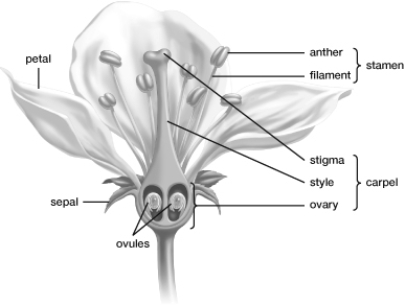
(Multiple Choice)
4.7/5  (78)
(78) What are the typical shape, color, and nectar content of a flower that is pollinated by a hummingbird? What are the traits of a bee- pollinated flower?
(Essay)
4.8/5 (79)
(79) When you eat a cherry, you know that the fruit was derived from the and the seed was derived from the .
(Short Answer)
4.9/5 (80)
(80) Some very showy desert flowers avoid desiccation of delicate floral tissues by blooming at night. They are pollinated by
(Multiple Choice)
4.9/5 (78)
(78) The female gametophyte of angiosperms is made up of eight diploid cells and one haploid egg cell.
(True/False)
4.8/5 (78)
(78) In the alternation of generations, what is formed when a spore germinates?
(Multiple Choice)
4.9/5 (65)
(65) In the development of a plant's ovule, the result is a gametophyte made up of
(Multiple Choice)
4.9/5 (62)
(62) The American holly tree requires a "male" tree and a "female" tree to produce red berries in the winter, which indicates that the male flowers lack and the female flowers lack .
(Multiple Choice)
4.8/5 (90)
(90) Conifers do not have flowers to attract pollinators. Instead, fertilization occurs
(Multiple Choice)
4.8/5 (78)
(78) Which of the following pollinators would likely visit a flower that is relatively simple in design and smells like rotting carrion?
(Multiple Choice)
5.0/5 (83)
(83) In many dicots, the first pair of leaves to emerge from the soil after seed germination is completely unlike all the rest of the leaves that form on that plant. In such plants, these leaves are
(Multiple Choice)
4.8/5 (73)
(73) All of the following are true of the relationship between the yucca and the yucca moth EXCEPT
(Multiple Choice)
4.9/5 (86)
(86) The aptly named dead horse arum has a heat- producing flower. What advantage does this heat provide?
(Multiple Choice)
4.8/5 (66)
(66) are modified leaves that are often green and surround the flower bud.
(Multiple Choice)
4.7/5 (75)
(75) 
Filters
- Essay(0)
- Multiple Choice(0)
- Short Answer(0)
- True False(0)
- Matching(0)