



 Chat with AI
Exam 10: Externalities

Exam 1: Ten Principles of Economics455 Questions
Exam 2: Thinking Like an Economist643 Questions
Exam 3: Interdependence and the Gains From Trade547 Questions
Exam 4: The Market Forces of Supply and Demand693 Questions
Exam 5: Elasticity and Its Application626 Questions
Exam 6: Supply, Demand, and Government Policies668 Questions
Exam 7: Consumers, Producers, and the Efficiency of Markets547 Questions
Exam 8: Applications: the Costs of Taxation509 Questions
Exam 9: Application: International Trade521 Questions
Exam 10: Externalities543 Questions
Exam 11: Public Goods and Common Resources452 Questions
Exam 12: The Design of the Tax System664 Questions
Exam 13: The Costs of Production649 Questions
Exam 14: Firms in Competitive Markets604 Questions
Exam 15: Monopoly662 Questions
Exam 16: Monopolistic Competition649 Questions
Exam 17: Oligopoly522 Questions
Exam 18: The Markets for the Factors of Production592 Questions
Exam 19: Earnings and Discrimination511 Questions
Exam 20: Income Inequality and Poverty478 Questions
Exam 21: The Theory of Consumer Choice570 Questions
Exam 22: Frontiers in Microeconomics461 Questions
Exam 23: Measuring a Nation S Income547 Questions
Exam 24: Measuring the Cost of Living565 Questions
Exam 25: Production and Growth527 Questions
Exam 26: Saving, Investment, and the Financial System637 Questions
Exam 27: Tools of Finance534 Questions
Exam 28: Unemployment and Its Natural Rate701 Questions
Exam 29: The Monetary System540 Questions
Exam 30: Money Growth and Inflation504 Questions
Exam 31: Open-Economy Macroeconomics: Basic Concepts540 Questions
Exam 32: A Macroeconomic Theory of the Open Economy511 Questions
Exam 33: Aggregate Demand and Aggregate Supply572 Questions
Exam 34: The Influence of Monetary and Fiscal Policy on Aggregate Demand523 Questions
Exam 35: The Short-Run Tradeoff Between Inflation and Unemployment536 Questions
Exam 36: Six Debates Over Macroeconomic Policy354 Questions
Select questions type


Table 10-1
The following table shows the private value, private cost, and external cost for various quantities of output in a market. 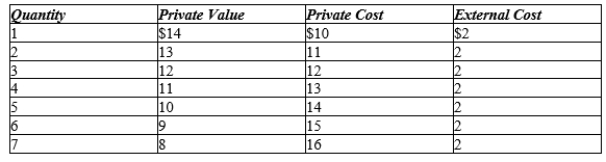 -Refer to Table 10-1. What is the socially-optimal quantity of output in this market?
 (Multiple Choice)
4.9/5  (76)
(76) Figure 10-1 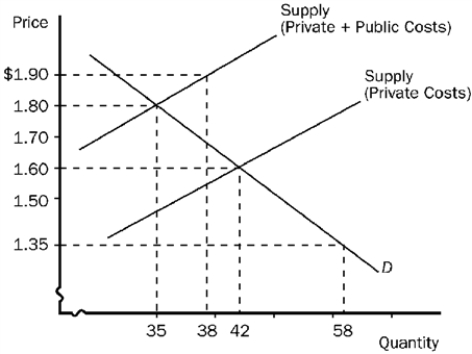 -Refer to Figure 10-1. This graph represents the tobacco industry. The socially optimal price and quantity are
 (Multiple Choice)
5.0/5 (77)
(77) According to the Coase Theorem, individuals can always work out a mutually beneficial agreement to solve the problems of externalities even when high transaction costs are involved.
(True/False)
5.0/5 (85)
(85) Scenario 10-2
The demand curve for restored historic buildings slopes downward and the supply curve for restored historic buildings slopes upward. The production of the 50th restored historic building entails the following:
• a private cost of $800,000;
• a private value of $650,000;
• a social value of $800,000.
-Refer to Scenario 10-2. Is there an external cost associated with the restoration of the 50th historic building, or is there an external benefit? What is the amount of that external cost or external benefit?
(Essay)
4.9/5 (72)
(72) When Monique drives to work every morning, she drives on a congested highway. What Monique does not realize is that when she enters the highway each morning she increases the travel time of all other drivers on the highway. In this case, the external cost of Monique's highway trip
(Multiple Choice)
4.9/5 (76)
(76) When the government intervenes in markets with externalities, it does so in order to
(Multiple Choice)
4.9/5 (81)
(81) To enhance the well-being of society, a social planner will encourage firms to increase production when
(Multiple Choice)
4.8/5 (75)
(75) Figure 10-12 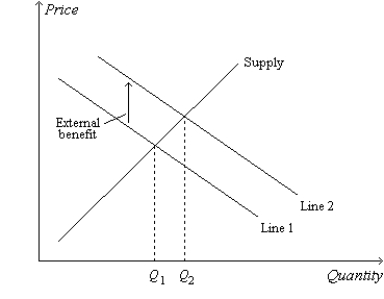 -Refer to Figure 10-12. The graph, as drawn, could apply to the market for
 (Multiple Choice)
4.8/5 (75)
(75) Which of the following is a problem that keeps people from privately solving externality problems?
(Multiple Choice)
4.9/5 (83)
(83) In recent years, the Canadian province of British Columbia has increased its carbon tax. Which of the following statements is correct?
(Multiple Choice)
4.7/5 (89)
(89) Scenario 10-4
The demand curve for fire extinguishers slopes downward and the supply curve for fire extinguishers slopes upward. The production of the 500th fire extinguisher entails the following:
• a private cost of $10;
• an external cost of $0;
• a private value of $9;
• an external benefit of $3.
-Refer to Scenario 10-4. Does the production of fire extinguishers convey a positive externality, a negative externality, or neither?
(Essay)
4.8/5 (71)
(71) Suppose the Environmental Protection Agency uses a corrective tax to set a price for pollution. Under this policy, is the supply curve for pollution rights vertical or is it horizontal?
(Short Answer)
4.8/5 (73)
(73) Figure 10-18. The graph represents a corrective tax to reduce pollution. On the axes, Q denotes the quantity of pollution and P represents the price of pollution. 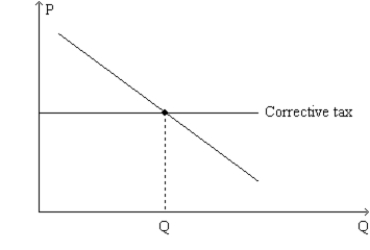 -Refer to Figure 10-18. What is the appropriate label for the downward-sloping line on the graph?
 (Multiple Choice)
4.7/5 (77)
(77) Scenario 10-4
The demand curve for fire extinguishers slopes downward and the supply curve for fire extinguishers slopes upward. The production of the 500th fire extinguisher entails the following:
• a private cost of $10;
• an external cost of $0;
• a private value of $9;
• an external benefit of $3.
-Refer to Scenario 10-4. In order to reach the social optimum, should fire extinguishers be taxed or subsidized? What is the appropriate amount of the tax or subsidy on each fire extinguisher?
(Essay)
4.7/5 (76)
(76) If an aluminum manufacturer does not bear the entire cost of the smoke it emits, it will
(Multiple Choice)
4.9/5 (76)
(76) Figure 10-6 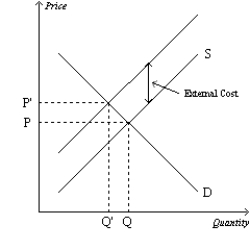 -Refer to Figure 10-6. Which price represents the equilibrium price of the product in this market?
 (Multiple Choice)
4.9/5 (69)
(69) 
Filters
- Essay(0)
- Multiple Choice(0)
- Short Answer(0)
- True False(0)
- Matching(0)