



 Chat with AI
Exam 10: Externalities

Exam 1: Ten Principles of Economics455 Questions
Exam 2: Thinking Like an Economist643 Questions
Exam 3: Interdependence and the Gains From Trade547 Questions
Exam 4: The Market Forces of Supply and Demand693 Questions
Exam 5: Elasticity and Its Application626 Questions
Exam 6: Supply, Demand, and Government Policies668 Questions
Exam 7: Consumers, Producers, and the Efficiency of Markets547 Questions
Exam 8: Applications: the Costs of Taxation509 Questions
Exam 9: Application: International Trade521 Questions
Exam 10: Externalities543 Questions
Exam 11: Public Goods and Common Resources452 Questions
Exam 12: The Design of the Tax System664 Questions
Exam 13: The Costs of Production649 Questions
Exam 14: Firms in Competitive Markets604 Questions
Exam 15: Monopoly662 Questions
Exam 16: Monopolistic Competition649 Questions
Exam 17: Oligopoly522 Questions
Exam 18: The Markets for the Factors of Production592 Questions
Exam 19: Earnings and Discrimination511 Questions
Exam 20: Income Inequality and Poverty478 Questions
Exam 21: The Theory of Consumer Choice570 Questions
Exam 22: Frontiers in Microeconomics461 Questions
Exam 23: Measuring a Nation S Income547 Questions
Exam 24: Measuring the Cost of Living565 Questions
Exam 25: Production and Growth527 Questions
Exam 26: Saving, Investment, and the Financial System637 Questions
Exam 27: Tools of Finance534 Questions
Exam 28: Unemployment and Its Natural Rate701 Questions
Exam 29: The Monetary System540 Questions
Exam 30: Money Growth and Inflation504 Questions
Exam 31: Open-Economy Macroeconomics: Basic Concepts540 Questions
Exam 32: A Macroeconomic Theory of the Open Economy511 Questions
Exam 33: Aggregate Demand and Aggregate Supply572 Questions
Exam 34: The Influence of Monetary and Fiscal Policy on Aggregate Demand523 Questions
Exam 35: The Short-Run Tradeoff Between Inflation and Unemployment536 Questions
Exam 36: Six Debates Over Macroeconomic Policy354 Questions
Select questions type


If an objective of public policy is to allocate pollution to those factories that face the highest cost of reducing it, then that objective could be achieved by
(Multiple Choice)
4.8/5  (74)
(74) According to the Coase theorem, private parties can solve the problem of externalities if
(Multiple Choice)
5.0/5 (78)
(78) The requirement that a minimum volume of ethanol is blended into the U.S. fuel supply is an example of
(Multiple Choice)
4.8/5 (86)
(86) Figure 10-16 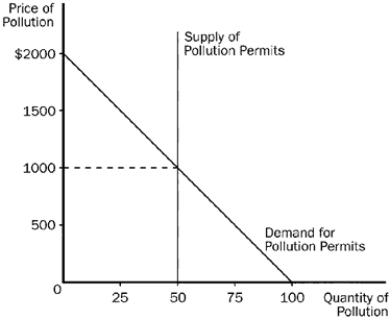 -Refer to Figure 10-16. This graph shows the market for pollution when permits are issued to firms and traded in the marketplace. The equilibrium price of pollution is
 (Multiple Choice)
4.9/5 (86)
(86) Most economists prefer corrective taxes to regulation as a way to correct the problem of pollution because
(Multiple Choice)
4.8/5 (79)
(79) Many charities like the Sierra Club are established to deal with externalities.
(True/False)
4.8/5 (77)
(77) In summarizing the research on the externalities associated with driving cars, a 2007 Journal of Economic Literature article concluded that the optimal corrective tax on gasoline in the United States, in 2015 dollars, would be about
(Multiple Choice)
4.9/5 (85)
(85) Table 10-2
The following table shows the private value, private cost, and social value for a market with a positive externality. 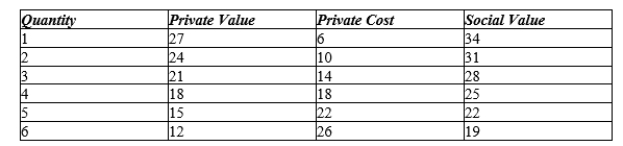 -Refer to Table 10-2. What is the socially-optimal level of output in this market?
 (Multiple Choice)
4.9/5 (77)
(77) Figure 10-11 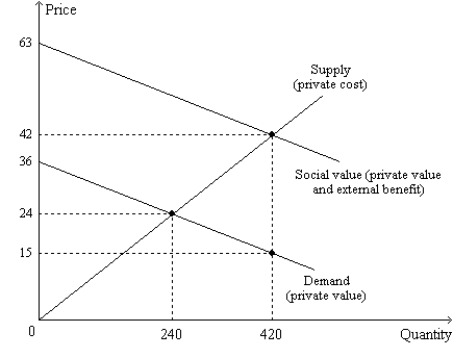 -Refer to Figure 10-11. "The social value of the last unit produced exceeds the private cost of the last unit produced by $13.50." This statement is correct at which quantity of output?
 (Multiple Choice)
5.0/5 (65)
(65) According to the Coase theorem, in the presence of externalities
(Multiple Choice)
4.8/5 (87)
(87) A rain barrel is a container that captures and stores rainwater for landscape and garden use during dry periods. As a result, rain barrels benefit the community through water conservation. If homeowners do not consider this external benefit of rain barrels, then
(Multiple Choice)
4.8/5 (90)
(90) Table 10-4 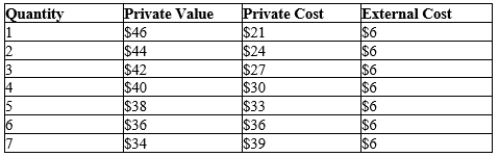 -Refer to Table 10-4. The market equilibrium quantity of output is
 (Multiple Choice)
4.9/5 (71)
(71) Figure 10-9 

 -Refer to Figure 10-9. Which graph represents a market with a negative externality?
 (Multiple Choice)
4.9/5 (79)
(79) The business activities of Firm A confer positive externalities on Firm B, and the business activities of Firm B confer positive externalities on Firm A. If the two firms merged, then
(Multiple Choice)
4.9/5 (65)
(65) Barking dogs cannot be considered an externality because externalities must be associated with some form of market exchange.
(True/False)
4.8/5 (77)
(77) Which of the following is a way to address an externality problem?
(Multiple Choice)
5.0/5 (78)
(78) 
Filters
- Essay(0)
- Multiple Choice(0)
- Short Answer(0)
- True False(0)
- Matching(0)