



 Chat with AI
Exam 10: Externalities

Exam 1: Ten Principles of Economics455 Questions
Exam 2: Thinking Like an Economist643 Questions
Exam 3: Interdependence and the Gains From Trade547 Questions
Exam 4: The Market Forces of Supply and Demand693 Questions
Exam 5: Elasticity and Its Application626 Questions
Exam 6: Supply, Demand, and Government Policies668 Questions
Exam 7: Consumers, Producers, and the Efficiency of Markets547 Questions
Exam 8: Applications: the Costs of Taxation509 Questions
Exam 9: Application: International Trade521 Questions
Exam 10: Externalities543 Questions
Exam 11: Public Goods and Common Resources452 Questions
Exam 12: The Design of the Tax System664 Questions
Exam 13: The Costs of Production649 Questions
Exam 14: Firms in Competitive Markets604 Questions
Exam 15: Monopoly662 Questions
Exam 16: Monopolistic Competition649 Questions
Exam 17: Oligopoly522 Questions
Exam 18: The Markets for the Factors of Production592 Questions
Exam 19: Earnings and Discrimination511 Questions
Exam 20: Income Inequality and Poverty478 Questions
Exam 21: The Theory of Consumer Choice570 Questions
Exam 22: Frontiers in Microeconomics461 Questions
Exam 23: Measuring a Nation S Income547 Questions
Exam 24: Measuring the Cost of Living565 Questions
Exam 25: Production and Growth527 Questions
Exam 26: Saving, Investment, and the Financial System637 Questions
Exam 27: Tools of Finance534 Questions
Exam 28: Unemployment and Its Natural Rate701 Questions
Exam 29: The Monetary System540 Questions
Exam 30: Money Growth and Inflation504 Questions
Exam 31: Open-Economy Macroeconomics: Basic Concepts540 Questions
Exam 32: A Macroeconomic Theory of the Open Economy511 Questions
Exam 33: Aggregate Demand and Aggregate Supply572 Questions
Exam 34: The Influence of Monetary and Fiscal Policy on Aggregate Demand523 Questions
Exam 35: The Short-Run Tradeoff Between Inflation and Unemployment536 Questions
Exam 36: Six Debates Over Macroeconomic Policy354 Questions
Select questions type


A former senator remarked that "We cannot give anyone the option of polluting for a fee." Do most economists agree with this statement, or do they disagree with it?
(Essay)
4.9/5  (80)
(80) A positive externality arises when a person engages in an activity that has
(Multiple Choice)
4.9/5 (86)
(86) Two types of private solutions to the problem of externalities are
(Multiple Choice)
4.8/5 (84)
(84) The impact of one person's actions on the well-being of a bystander is called
(Multiple Choice)
4.8/5 (81)
(81) Suppose that a steel factory emits a certain amount of air pollution, which constitutes a negative externality. If the market does not internalize the externality,
(Multiple Choice)
4.8/5 (80)
(80) Figure 10-9 

 -Refer to Figure 10-9, Panel (b) and Panel (c). The installation of a scrubber in a smokestack reduces the emission of harmful chemicals from the smokestack. Therefore, a government policy that internalized the externality would move the quantity of smokestack scrubbers installed from point
 (Multiple Choice)
4.8/5 (80)
(80) Figure 10-9
-Refer to Figure 10-9, Panel (b) and Panel (c). The overuse of antibiotics leads to the development of antibiotic-resistant diseases. Therefore, a government policy that internalized the externality would move the quantity of antibiotics used from point
-Refer to Figure 10-9, Panel (b) and Panel (c). The overuse of antibiotics leads to the development of antibiotic-resistant diseases. Therefore, a government policy that internalized the externality would move the quantity of antibiotics used from point (Multiple Choice)
5.0/5 (88)
(88) Scenario 10-2
The demand curve for restored historic buildings slopes downward and the supply curve for restored historic buildings slopes upward. The production of the 50th restored historic building entails the following:
• a private cost of $800,000;
• a private value of $650,000;
• a social value of $800,000.
-Refer to Scenario 10-2. Could the government impose a tax or provide a subsidy to move the market to the social optimum? If your answer is "Yes," should it be a tax or should it be a subsidy?
(Essay)
4.7/5 (82)
(82) At any given quantity, the willingness to pay in the market for gasoline is reflected in the
(Multiple Choice)
4.9/5 (76)
(76) A negative externality will cause a private market to produce
(Multiple Choice)
4.8/5 (79)
(79) The Coase theorem suggests that efficient solutions to externalities can be determined through bargaining. Under what circumstances will private bargaining fail to produce a solution?
(Essay)
4.8/5 (73)
(73) Table 10-1
The following table shows the private value, private cost, and external cost for various quantities of output in a market. 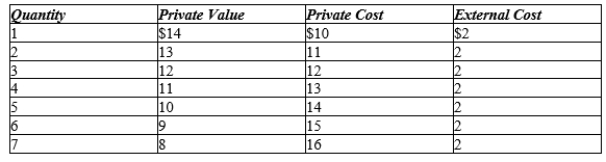 -Refer to Table 10-1. How large would a corrective tax need to be to move this market from the equilibrium outcome to the socially-optimal outcome?
 (Multiple Choice)
4.8/5 (72)
(72) Figure 10-9
-Refer to Figure 10-9, Panel (b). The market equilibrium quantity is
-Refer to Figure 10-9, Panel (b). The market equilibrium quantity is (Multiple Choice)
4.9/5 (96)
(96) When the production of a good results in a positive externality, the social value curve is
(Multiple Choice)
4.9/5 (78)
(78) Scenario 10-1
The demand curve for gasoline slopes downward and the supply curve for gasoline slopes upward. The production of the 1,000th gallon of gasoline entails the following:
• a private cost of $3.10;
• a social cost of $3.55;
• a value to consumers of $3.70.
-Refer to Scenario 10-1. Suppose the dollar amount of the externality, per gallon of gasoline, is constant, regardless of how much gasoline is produced. Then the externality could be internalized if producers of gasoline were
(Multiple Choice)
4.7/5 (82)
(82) Abe owns a dog; the dog's barking annoys Abe's neighbor, Jenny. Suppose that the benefit of owning the dog is worth $200 to Abe and that Jenny bears a cost of $400 from the barking. Assuming Abe has the legal right to keep the dog, a possible private solution to this problem is that
(Multiple Choice)
4.8/5 (73)
(73) Table 10-3 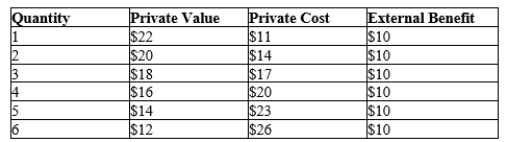 -Refer to Table 10-3. The socially optimal quantity of output is
 (Multiple Choice)
4.8/5 (72)
(72) In the case of a technology spillover, internalizing a positive externality through a government subsidy will cause the industry's supply curve to
(Multiple Choice)
4.8/5 (86)
(86) 
Filters
- Essay(0)
- Multiple Choice(0)
- Short Answer(0)
- True False(0)
- Matching(0)