



 Chat with AI
Exam 10: Externalities

Exam 1: Ten Principles of Economics455 Questions
Exam 2: Thinking Like an Economist643 Questions
Exam 3: Interdependence and the Gains From Trade547 Questions
Exam 4: The Market Forces of Supply and Demand693 Questions
Exam 5: Elasticity and Its Application626 Questions
Exam 6: Supply, Demand, and Government Policies668 Questions
Exam 7: Consumers, Producers, and the Efficiency of Markets547 Questions
Exam 8: Applications: the Costs of Taxation509 Questions
Exam 9: Application: International Trade521 Questions
Exam 10: Externalities543 Questions
Exam 11: Public Goods and Common Resources452 Questions
Exam 12: The Design of the Tax System664 Questions
Exam 13: The Costs of Production649 Questions
Exam 14: Firms in Competitive Markets604 Questions
Exam 15: Monopoly662 Questions
Exam 16: Monopolistic Competition649 Questions
Exam 17: Oligopoly522 Questions
Exam 18: The Markets for the Factors of Production592 Questions
Exam 19: Earnings and Discrimination511 Questions
Exam 20: Income Inequality and Poverty478 Questions
Exam 21: The Theory of Consumer Choice570 Questions
Exam 22: Frontiers in Microeconomics461 Questions
Exam 23: Measuring a Nation S Income547 Questions
Exam 24: Measuring the Cost of Living565 Questions
Exam 25: Production and Growth527 Questions
Exam 26: Saving, Investment, and the Financial System637 Questions
Exam 27: Tools of Finance534 Questions
Exam 28: Unemployment and Its Natural Rate701 Questions
Exam 29: The Monetary System540 Questions
Exam 30: Money Growth and Inflation504 Questions
Exam 31: Open-Economy Macroeconomics: Basic Concepts540 Questions
Exam 32: A Macroeconomic Theory of the Open Economy511 Questions
Exam 33: Aggregate Demand and Aggregate Supply572 Questions
Exam 34: The Influence of Monetary and Fiscal Policy on Aggregate Demand523 Questions
Exam 35: The Short-Run Tradeoff Between Inflation and Unemployment536 Questions
Exam 36: Six Debates Over Macroeconomic Policy354 Questions
Select questions type


Table 10-2
The following table shows the private value, private cost, and social value for a market with a positive externality. 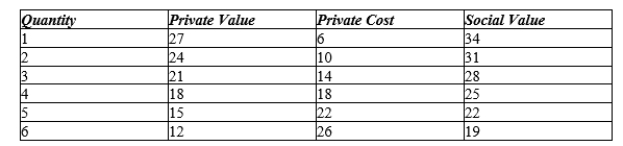 -Refer to Table 10-2. What is the equilibrium quantity of output in this market?
 (Multiple Choice)
4.8/5  (77)
(77) As a means of dealing with pollution, do economists generally prefer corrective taxes or do they prefer regulations?
(Essay)
4.8/5 (82)
(82) Table 10-3 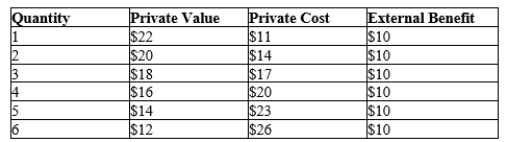 -Refer to Table 10-3. The social value of the 4th unit of output that is produced is
 (Multiple Choice)
4.8/5 (75)
(75) Figure 10-15 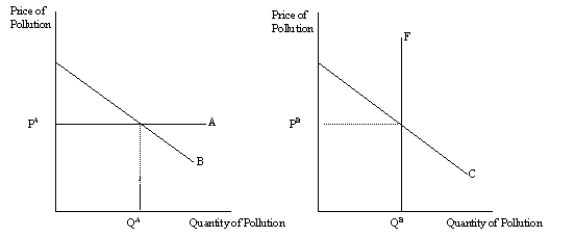 -Refer to Figure 10-15. Which of the following is not necessary in order for the corrective tax and pollution permit to have equivalent effects?
 (Multiple Choice)
4.8/5 (84)
(84) Figure 10-2. The graph depicts the market for plastic. 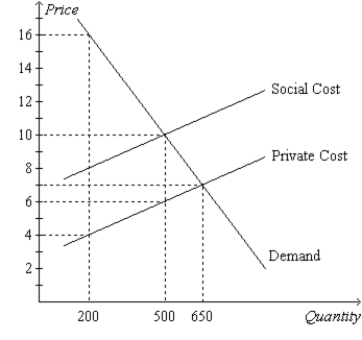 -Refer to Figure 10-2. Suppose that the production of plastic creates a social cost which is depicted in the graph above. Without any government regulation, what price will the firm charge per unit of plastic?
 (Multiple Choice)
5.0/5 (79)
(79) Suppose that electricity producers create a negative externality equal to $6 per unit. Further suppose that the government imposes a $8 per-unit tax on the producers. What is the relationship between the after-tax equilibrium quantity and the socially optimal quantity of electricity to be produced?
(Multiple Choice)
4.8/5 (89)
(89) Figure 10-11 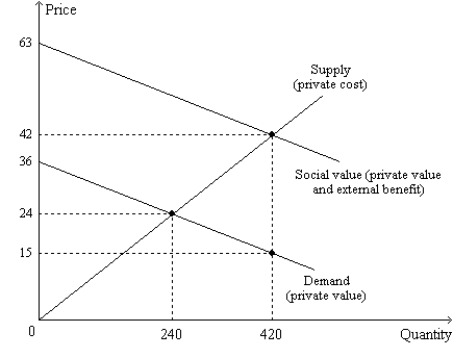 -Refer to Figure 10-11. Which of the following statements is correct?
 (Multiple Choice)
4.7/5 (84)
(84) Figure 10-18. The graph represents a corrective tax to reduce pollution. On the axes, Q denotes the quantity of pollution and P represents the price of pollution. 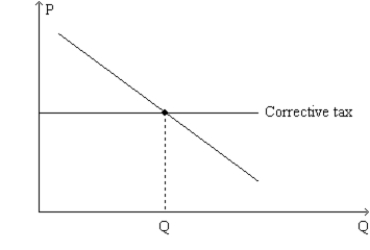 -Refer to Figure 10-18. The line labeled "Corrective tax" could accurately be re-labeled as
 (Multiple Choice)
4.9/5 (97)
(97) Figure 10-19 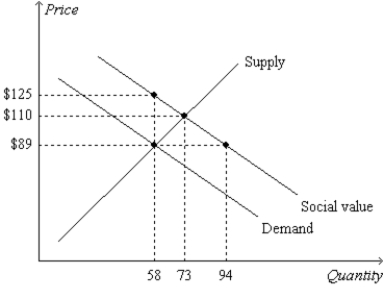 -Refer to Figure 10-19. The social optimum can be reached if
 (Multiple Choice)
4.9/5 (78)
(78) Suppose a certain good conveys either an external cost or an external benefit. If the private cost of the last unit of the good that was produced is equal to the private value of that unit, then the sum of producer and consumer surplus is maximized.
(True/False)
4.8/5 (70)
(70) The Coase theorem suggests that private markets may not be able to solve the problem of externalities
(Multiple Choice)
4.7/5 (82)
(82) Government subsidized scholarships are an example of a government policy aimed at correcting negative externalities associated with education.
(True/False)
4.8/5 (84)
(84) In the absence of externalities, the "invisible hand" leads a market to maximize
(Multiple Choice)
4.9/5 (84)
(84) In a certain city, the local government regulates the destruction of historic buildings and provides tax breaks to owners of historic buildings who restore them. These government policies
(Multiple Choice)
5.0/5 (75)
(75) If the government were to impose a fine of $4,000 for each unit of air-pollution released by a fertilizer plant, the policy would be considered
(Multiple Choice)
4.8/5 (80)
(80) This figure reflects the market for outdoor concerts in a public park surrounded by residential neighborhoods.
Figure 10-3 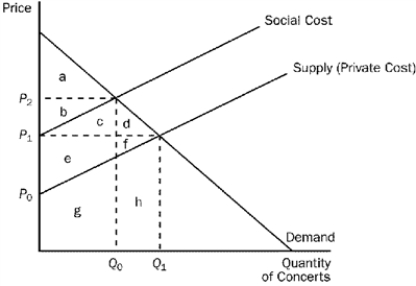 -Refer to Figure 10-3. What price and quantity combination best represents the optimum price and number of concerts that should be organized?
 (Multiple Choice)
4.8/5 (80)
(80) Ty lives in an apartment building and gets a benefit from playing his stereo. Olivia, who lives next door to Ty and often loses sleep due to the loud music coming from Ty's stereo, bears a cost from the noise. Olivia is threatening to call the police to force Ty to turn down his stereo. Under which of the following conditions would Ty be able to offer Olivia some amount of money to keep her from calling the police and to allow him to continue to play his stereo loudly?
(Multiple Choice)
4.7/5 (82)
(82) 
Filters
- Essay(0)
- Multiple Choice(0)
- Short Answer(0)
- True False(0)
- Matching(0)