



 Chat with AI
Exam 10: Externalities

Exam 1: Ten Principles of Economics455 Questions
Exam 2: Thinking Like an Economist643 Questions
Exam 3: Interdependence and the Gains From Trade547 Questions
Exam 4: The Market Forces of Supply and Demand693 Questions
Exam 5: Elasticity and Its Application626 Questions
Exam 6: Supply, Demand, and Government Policies668 Questions
Exam 7: Consumers, Producers, and the Efficiency of Markets547 Questions
Exam 8: Applications: the Costs of Taxation509 Questions
Exam 9: Application: International Trade521 Questions
Exam 10: Externalities543 Questions
Exam 11: Public Goods and Common Resources452 Questions
Exam 12: The Design of the Tax System664 Questions
Exam 13: The Costs of Production649 Questions
Exam 14: Firms in Competitive Markets604 Questions
Exam 15: Monopoly662 Questions
Exam 16: Monopolistic Competition649 Questions
Exam 17: Oligopoly522 Questions
Exam 18: The Markets for the Factors of Production592 Questions
Exam 19: Earnings and Discrimination511 Questions
Exam 20: Income Inequality and Poverty478 Questions
Exam 21: The Theory of Consumer Choice570 Questions
Exam 22: Frontiers in Microeconomics461 Questions
Exam 23: Measuring a Nation S Income547 Questions
Exam 24: Measuring the Cost of Living565 Questions
Exam 25: Production and Growth527 Questions
Exam 26: Saving, Investment, and the Financial System637 Questions
Exam 27: Tools of Finance534 Questions
Exam 28: Unemployment and Its Natural Rate701 Questions
Exam 29: The Monetary System540 Questions
Exam 30: Money Growth and Inflation504 Questions
Exam 31: Open-Economy Macroeconomics: Basic Concepts540 Questions
Exam 32: A Macroeconomic Theory of the Open Economy511 Questions
Exam 33: Aggregate Demand and Aggregate Supply572 Questions
Exam 34: The Influence of Monetary and Fiscal Policy on Aggregate Demand523 Questions
Exam 35: The Short-Run Tradeoff Between Inflation and Unemployment536 Questions
Exam 36: Six Debates Over Macroeconomic Policy354 Questions
Select questions type


Figure 10-10 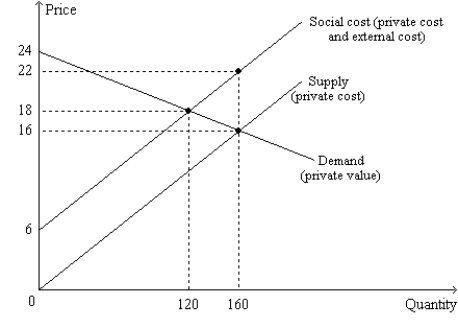 -Refer to Figure 10-10. Taking into account private and external costs, the maximum total surplus that can be achieved in this market is
 (Multiple Choice)
4.9/5  (78)
(78) Although regulation and corrective taxes are both capable of reducing pollution, regulation accomplishes this goal more efficiently.
(True/False)
4.7/5 (78)
(78) When a policy succeeds in giving buyers and sellers in a market an incentive to take into account the external effects of their actions, the policy is said to
(Multiple Choice)
4.8/5 (97)
(97) When a transaction between a buyer and seller directly affects a third party, the effect is called an externality.
(True/False)
4.8/5 (92)
(92) Suppose the socially-optimal quantity of good x is larger than the market-equilibrium quantity of good x. Does the production of good x convey a positive externality or does it convey a negative externality?
(Essay)
4.8/5 (76)
(76) The likelihood of successful private solutions to problems caused by externalities depends, in part, upon the number of interested parties. Briefly explain.
(Essay)
4.9/5 (83)
(83) Corrective taxes that are imposed upon the producer of a nasty smell can be successful in reducing that smell because the tax makes the producer
(Multiple Choice)
4.8/5 (69)
(69) Figure 10-13. On the graph, Q represents the quantity of plastics and P represents the price of plastics. 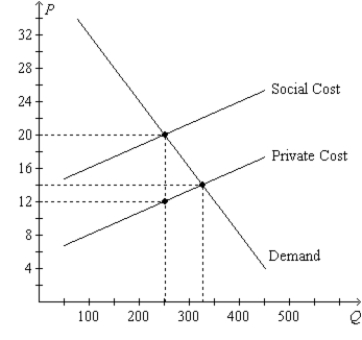 -Refer to Figure 10-13. In order to reach the social optimum, the government could
 (Multiple Choice)
4.8/5 (80)
(80) Figure 10-11 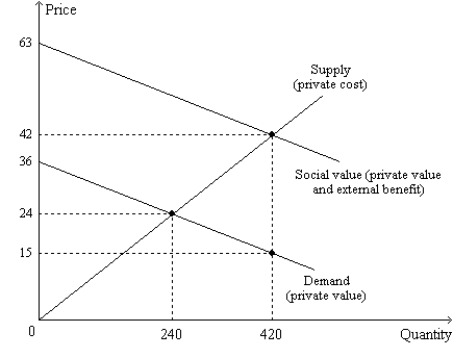 -Refer to Figure 10-11. The graph represents a market in which
 (Multiple Choice)
4.9/5 (99)
(99) Table 10-4 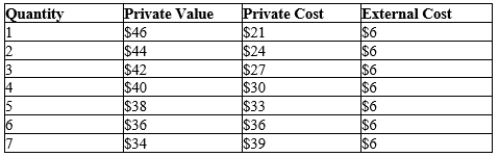 -Refer to Table 10-4. Taking into account private and external costs, total surplus in the market equilibrium amounts to
 (Multiple Choice)
4.8/5 (80)
(80) The Environmental Protection Agency (EPA) requires that firms in a certain industry adopt a particular technology to reduce the emission of pollutants. Is this requirement a command- and-control policy or is it a market-based policy?
(Essay)
4.7/5 (79)
(79) Figure 10-12 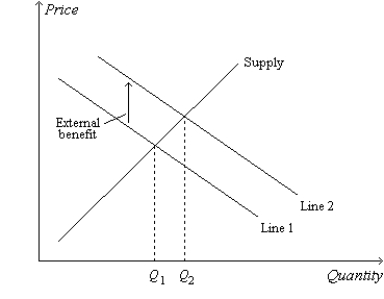 -Refer to Figure 10-12. Which of the following is an appropriate label for Line 2?
 (Multiple Choice)
4.9/5 (76)
(76) Suppose that smoking creates a negative externality. If the government imposes a per-cigarette tax equal to the per-cigarette externality, then
(Multiple Choice)
4.9/5 (71)
(71) Firms that can reduce pollution easily would be willing to sell their pollution permits.
(True/False)
4.8/5 (77)
(77) Negative externalities lead markets to produce a smaller quantity of a good than is socially desirable, while positive externalities lead markets to produce a larger quantity of a good than is socially desirable.
(True/False)
4.8/5 (80)
(80) Dog owners do not bear the full cost of the noise their barking dogs create and often take too few precautions to prevent their dogs from barking. Local governments address this problem by
(Multiple Choice)
4.9/5 (74)
(74) Scenario 10-3
Suppose the equation for the demand curve in a market is  , where
 is the quantity demanded and
 is the price. Also, suppose the equation for the supply curve in the same market is
 , where
 is the quantity supplied.
-Refer to Scenario 10-3. Suppose there is an external cost of $12 associated with the production of each unit of the good. What are the socially optimal quantity and price?
, where is the quantity demanded and is the price. Also, suppose the equation for the supply curve in the same market is , where is the quantity supplied.
-Refer to Scenario 10-3. Suppose there is an external cost of $12 associated with the production of each unit of the good. What are the socially optimal quantity and price? (Essay)
4.8/5 (66)
(66) Wally owns a dog whose barking annoys Wally's neighbor, Corrine. Suppose that the benefit of owning the dog is worth $700 to Wally and that Corrine bears a cost of $500 from the barking. Assuming Wally has the legal right to keep the dog, a possible private solution to this problem is that
(Multiple Choice)
5.0/5 (84)
(84) Gretchen is a writer who works from her home. Gretchen lives next door to Randall, the trumpet player for a local band. Randall needs lots of practice to earn his share of the band's profit, which will amount to $350. Gretchen gets distracted by Randall's trumpet playing but she needs to get her writing done to earn $570 for her current article. If Randall owns the right to play his music and Gretchen needs to hire a lawyer to help her reach an agreement with Randall, then what price is Gretchen willing to pay the lawyer?
(Multiple Choice)
5.0/5 (79)
(79) 
Filters
- Essay(0)
- Multiple Choice(0)
- Short Answer(0)
- True False(0)
- Matching(0)