



 Chat with AI
Exam 10: Externalities

Exam 1: Ten Principles of Economics455 Questions
Exam 2: Thinking Like an Economist643 Questions
Exam 3: Interdependence and the Gains From Trade547 Questions
Exam 4: The Market Forces of Supply and Demand693 Questions
Exam 5: Elasticity and Its Application626 Questions
Exam 6: Supply, Demand, and Government Policies668 Questions
Exam 7: Consumers, Producers, and the Efficiency of Markets547 Questions
Exam 8: Applications: the Costs of Taxation509 Questions
Exam 9: Application: International Trade521 Questions
Exam 10: Externalities543 Questions
Exam 11: Public Goods and Common Resources452 Questions
Exam 12: The Design of the Tax System664 Questions
Exam 13: The Costs of Production649 Questions
Exam 14: Firms in Competitive Markets604 Questions
Exam 15: Monopoly662 Questions
Exam 16: Monopolistic Competition649 Questions
Exam 17: Oligopoly522 Questions
Exam 18: The Markets for the Factors of Production592 Questions
Exam 19: Earnings and Discrimination511 Questions
Exam 20: Income Inequality and Poverty478 Questions
Exam 21: The Theory of Consumer Choice570 Questions
Exam 22: Frontiers in Microeconomics461 Questions
Exam 23: Measuring a Nation S Income547 Questions
Exam 24: Measuring the Cost of Living565 Questions
Exam 25: Production and Growth527 Questions
Exam 26: Saving, Investment, and the Financial System637 Questions
Exam 27: Tools of Finance534 Questions
Exam 28: Unemployment and Its Natural Rate701 Questions
Exam 29: The Monetary System540 Questions
Exam 30: Money Growth and Inflation504 Questions
Exam 31: Open-Economy Macroeconomics: Basic Concepts540 Questions
Exam 32: A Macroeconomic Theory of the Open Economy511 Questions
Exam 33: Aggregate Demand and Aggregate Supply572 Questions
Exam 34: The Influence of Monetary and Fiscal Policy on Aggregate Demand523 Questions
Exam 35: The Short-Run Tradeoff Between Inflation and Unemployment536 Questions
Exam 36: Six Debates Over Macroeconomic Policy354 Questions
Select questions type


A dentist shares an office building with a radio station. The electrical current from the dentist's drill causes static in the radio broadcast, causing the radio station to lose $10,000 in profits. The radio station could put up a shield at a cost of $30,000; the dentist could buy a new drill that causes less interference for $6,000. Either would restore the radio station's lost profits. What is the economically efficient outcome?
(Multiple Choice)
4.8/5  (93)
(93) Suppose a subsidy is offered to consumers of education as a means of internalizing the externalities associated with education. If the subsidy accurately reflects the external benefits of education, then the new demand curve for education coincides with which other curve?
(Essay)
4.9/5 (92)
(92) Which of the following statements is true of both pollution permits and corrective taxes?
(Multiple Choice)
5.0/5 (86)
(86) Suppose a new market for tradable pollution permits is created. As long as there is a free market for the pollution rights, the final allocation will be __________ , regardless of the initial allocation of permits.
(Short Answer)
4.8/5 (75)
(75) Figure 10-2. The graph depicts the market for plastic. 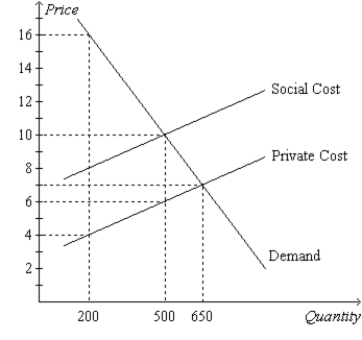 -Refer to Figure 10-2. Suppose that the production of plastic creates a social cost which is depicted in the graph above. Without any government regulation, how much plastic will be produced?
 (Multiple Choice)
5.0/5 (78)
(78) Figure 10-16 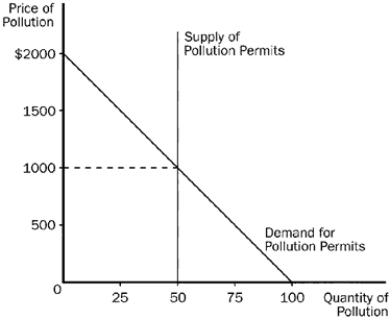 -Refer to Figure 10-16. This graph shows the market for pollution when permits are issued to firms and traded in the marketplace. In the absence of a pollution permit system, the quantity of pollution would be
 (Multiple Choice)
4.8/5 (59)
(59) Table 10-1
The following table shows the private value, private cost, and external cost for various quantities of output in a market. 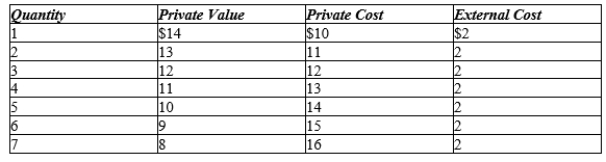 -Refer to Table 10-1. What is the equilibrium quantity of output in the market?
 (Multiple Choice)
4.8/5 (83)
(83) At any given quantity, the cost of the marginal seller is the height of the __________.
(Short Answer)
4.8/5 (89)
(89) Figure 10-12 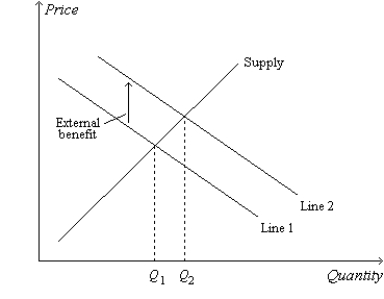 -Refer to Figure 10-12. An alternative label for the quantity
 would be
-Refer to Figure 10-12. An alternative label for the quantity would be (Multiple Choice)
5.0/5 (84)
(84) In some cases, selling pollution permits is a better method for reducing pollution than imposing a corrective tax because
(Multiple Choice)
4.8/5 (84)
(84) Figure 10-13. On the graph, Q represents the quantity of plastics and P represents the price of plastics. 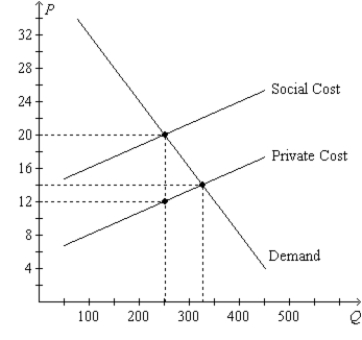 -Refer to Figure 10-13. If 250 units of plastics are produced and consumed, then the
 (Multiple Choice)
5.0/5 (79)
(79) Suppose that candy producers create a positive externality equal to $1 per pound of candy. Further suppose that the government offers a $1-per-pound subsidy to the producers. What is the relationship between the equilibrium quantity and the socially optimal quantity of candy?
(Multiple Choice)
4.9/5 (73)
(73) Which theorem asserts that private economic actors can often solve the problem of externalities among themselves?
(Short Answer)
4.9/5 (78)
(78) Suppose that flu shots create a positive externality equal to $8 per shot. Further suppose that the government offers a $6-per-shot subsidy to producers. What is the relationship between the equilibrium quantity and the socially optimal quantity of flu shots produced?
(Multiple Choice)
4.9/5 (75)
(75) Government can be used to solve externality problems that are too costly for private parties to solve.
(True/False)
4.9/5 (79)
(79) Figure 10-20.  -Refer to Figure 10-20. The graph depicts the market for fertilizer. Without any government regulation, what is the equilibrium price of fertilizer?
 (Multiple Choice)
4.9/5 (70)
(70) 
Filters
- Essay(0)
- Multiple Choice(0)
- Short Answer(0)
- True False(0)
- Matching(0)