



 Chat with AI
Exam 10: Externalities

Exam 1: Ten Principles of Economics455 Questions
Exam 2: Thinking Like an Economist643 Questions
Exam 3: Interdependence and the Gains From Trade547 Questions
Exam 4: The Market Forces of Supply and Demand693 Questions
Exam 5: Elasticity and Its Application626 Questions
Exam 6: Supply, Demand, and Government Policies668 Questions
Exam 7: Consumers, Producers, and the Efficiency of Markets547 Questions
Exam 8: Applications: the Costs of Taxation509 Questions
Exam 9: Application: International Trade521 Questions
Exam 10: Externalities543 Questions
Exam 11: Public Goods and Common Resources452 Questions
Exam 12: The Design of the Tax System664 Questions
Exam 13: The Costs of Production649 Questions
Exam 14: Firms in Competitive Markets604 Questions
Exam 15: Monopoly662 Questions
Exam 16: Monopolistic Competition649 Questions
Exam 17: Oligopoly522 Questions
Exam 18: The Markets for the Factors of Production592 Questions
Exam 19: Earnings and Discrimination511 Questions
Exam 20: Income Inequality and Poverty478 Questions
Exam 21: The Theory of Consumer Choice570 Questions
Exam 22: Frontiers in Microeconomics461 Questions
Exam 23: Measuring a Nation S Income547 Questions
Exam 24: Measuring the Cost of Living565 Questions
Exam 25: Production and Growth527 Questions
Exam 26: Saving, Investment, and the Financial System637 Questions
Exam 27: Tools of Finance534 Questions
Exam 28: Unemployment and Its Natural Rate701 Questions
Exam 29: The Monetary System540 Questions
Exam 30: Money Growth and Inflation504 Questions
Exam 31: Open-Economy Macroeconomics: Basic Concepts540 Questions
Exam 32: A Macroeconomic Theory of the Open Economy511 Questions
Exam 33: Aggregate Demand and Aggregate Supply572 Questions
Exam 34: The Influence of Monetary and Fiscal Policy on Aggregate Demand523 Questions
Exam 35: The Short-Run Tradeoff Between Inflation and Unemployment536 Questions
Exam 36: Six Debates Over Macroeconomic Policy354 Questions
Select questions type


If the social value of producing a good is always higher than the private value of producing it, then there is a
(Multiple Choice)
4.8/5  (79)
(79) Some environmentalists argue that we should protect the environment as much as possible, regardless of cost. Which of the following is not a likely outcome of pursuing such a course of action?
(Multiple Choice)
4.9/5 (83)
(83) In some parts of the United States, sugar beets are grown and harvested. The process of producing usable sugar from the beets generates foul-smelling smoke. A government policy that limits the emission of smoke by sugar-beet-processing firms is an example of
(Multiple Choice)
4.8/5 (83)
(83) According to recent research, the gas tax in the United States is lower than the optimal level.
(True/False)
4.9/5 (89)
(89) Figure 10-19 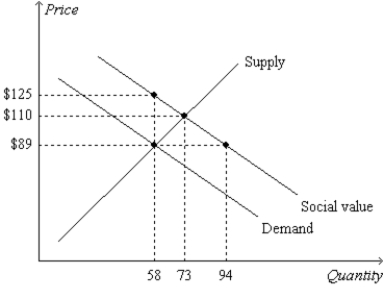 -Refer to Figure 10-19. Each additional unit of the good that is produced yields an external
 (Multiple Choice)
4.9/5 (92)
(92) Taxes that are enacted to mitigate the effects of negative externalities are sometimes called
(Multiple Choice)
4.8/5 (89)
(89) Suppose the market-equilibrium quantity of good x is 5,000 units and the socially-optimal quantity of good x is 4,000 units. Then
(Multiple Choice)
4.8/5 (76)
(76) Which of the following is an advantage of tradable pollution permits?
(Multiple Choice)
4.8/5 (80)
(80) In which of the following cases is the Coase theorem most likely to solve the externality?
(Multiple Choice)
5.0/5 (78)
(78) Some policies toward externalities provide incentives so that private decision makers will choose to solve the problem on their own. What name do we use for these types of policies?
(Essay)
4.7/5 (75)
(75) Figure 10-12 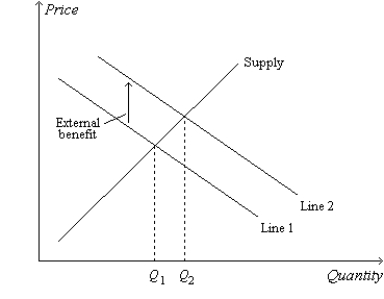 -Refer to Figure 10-12. An alternative label for the line labeled "Supply" would be
 (Multiple Choice)
4.9/5 (78)
(78) Figure 10-1 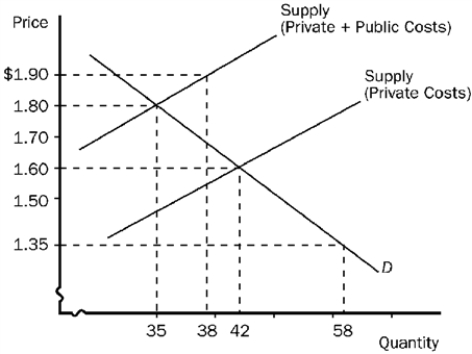 -Refer to Figure 10-1. This graph represents the tobacco industry. The industry creates
 (Multiple Choice)
4.7/5 (80)
(80) Figure 10-12
-Refer to Figure 10-12. Which of the following is an appropriate label for Line 1?
-Refer to Figure 10-12. Which of the following is an appropriate label for Line 1? (Multiple Choice)
4.8/5 (73)
(73) In class action lawsuits, interested parties to the lawsuit are not required to pay attorney fees directly. This is an example of an attempt to
(Multiple Choice)
4.8/5 (74)
(74) Scenario 10-2
The demand curve for restored historic buildings slopes downward and the supply curve for restored historic buildings slopes upward. The production of the 50th restored historic building entails the following:
• a private cost of $800,000;
• a private value of $650,000;
• a social value of $800,000.
-Refer to Scenario 10-2. Is the socially optimal quantity of restored historic buildings less than, equal to, or greater than 50?
(Essay)
4.8/5 (71)
(71) Dee loves to landscape her yard, but her neighbor Marvin places a low value on his landscaping. When Marvin's grass is neglected and gets long, Dee will mow it for Marvin. This is an example of
(Multiple Choice)
4.9/5 (78)
(78) Suppose that smoking creates a negative externality. If the government does not interfere in the cigarette market, then
(Multiple Choice)
4.9/5 (81)
(81) Scenario 10-2
The demand curve for restored historic buildings slopes downward and the supply curve for restored historic buildings slopes upward. The production of the 50th restored historic building entails the following:
• a private cost of $800,000;
• a private value of $650,000;
• a social value of $800,000.
-Refer to Scenario 10-2. Is the market equilibrium quantity of restored historic buildings less than, equal to, or greater than 50?
(Essay)
4.8/5 (82)
(82) In some cases, tradable pollution permits may be better than a corrective tax because
(Multiple Choice)
4.7/5 (62)
(62) 
Filters
- Essay(0)
- Multiple Choice(0)
- Short Answer(0)
- True False(0)
- Matching(0)