



 Chat with AI
Exam 10: Externalities

Exam 1: Ten Principles of Economics455 Questions
Exam 2: Thinking Like an Economist643 Questions
Exam 3: Interdependence and the Gains From Trade547 Questions
Exam 4: The Market Forces of Supply and Demand693 Questions
Exam 5: Elasticity and Its Application626 Questions
Exam 6: Supply, Demand, and Government Policies668 Questions
Exam 7: Consumers, Producers, and the Efficiency of Markets547 Questions
Exam 8: Applications: the Costs of Taxation509 Questions
Exam 9: Application: International Trade521 Questions
Exam 10: Externalities543 Questions
Exam 11: Public Goods and Common Resources452 Questions
Exam 12: The Design of the Tax System664 Questions
Exam 13: The Costs of Production649 Questions
Exam 14: Firms in Competitive Markets604 Questions
Exam 15: Monopoly662 Questions
Exam 16: Monopolistic Competition649 Questions
Exam 17: Oligopoly522 Questions
Exam 18: The Markets for the Factors of Production592 Questions
Exam 19: Earnings and Discrimination511 Questions
Exam 20: Income Inequality and Poverty478 Questions
Exam 21: The Theory of Consumer Choice570 Questions
Exam 22: Frontiers in Microeconomics461 Questions
Exam 23: Measuring a Nation S Income547 Questions
Exam 24: Measuring the Cost of Living565 Questions
Exam 25: Production and Growth527 Questions
Exam 26: Saving, Investment, and the Financial System637 Questions
Exam 27: Tools of Finance534 Questions
Exam 28: Unemployment and Its Natural Rate701 Questions
Exam 29: The Monetary System540 Questions
Exam 30: Money Growth and Inflation504 Questions
Exam 31: Open-Economy Macroeconomics: Basic Concepts540 Questions
Exam 32: A Macroeconomic Theory of the Open Economy511 Questions
Exam 33: Aggregate Demand and Aggregate Supply572 Questions
Exam 34: The Influence of Monetary and Fiscal Policy on Aggregate Demand523 Questions
Exam 35: The Short-Run Tradeoff Between Inflation and Unemployment536 Questions
Exam 36: Six Debates Over Macroeconomic Policy354 Questions
Select questions type


Table 10-5
The following table shows the marginal costs for each of four firms (A, B, C, and D) to eliminate units of pollution from their production processes. For example, for Firm A to eliminate one unit of pollution, it would cost $54, and for Firm A to eliminate a second unit of pollution it would cost an additional $67.  -Refer to Table 10-5. Suppose the government wants to reduce pollution from 16 units to 8 units and auctions off 8 pollution permits to achieve this goal. Which of the following is a likely auction price of the permits?
 (Multiple Choice)
4.9/5  (85)
(85) One reason that private solutions to externalities do not always work is that
(Multiple Choice)
4.9/5 (82)
(82) Figure 10-2. The graph depicts the market for plastic. 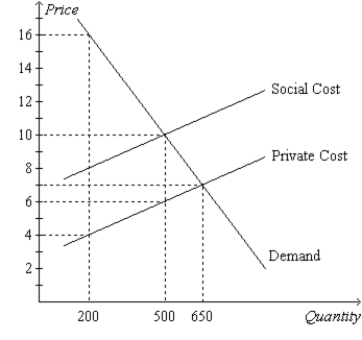 -Refer to Figure 10-2. Suppose that the production of plastic creates a social cost which is depicted in the graph above. What is the socially optimal quantity of plastic?
 (Multiple Choice)
4.8/5 (78)
(78) Private solutions may not be possible due to the costs of negotiating and enforcing these solutions. Such costs are called
(Multiple Choice)
4.9/5 (100)
(100) Table 10-4 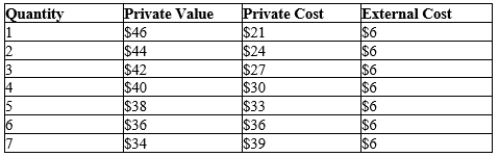 -Refer to Table 10-4. The social cost of the 2nd unit of output that is produced is
 (Multiple Choice)
5.0/5 (97)
(97) Figure 10-20.  -Refer to Figure 10-20. The socially optimal price and quantity are $250 and 250 units, respectively.
 (True/False)
4.8/5 (86)
(86) Suppose that coal producers create a negative externality equal to $5 per ton of coal. What is the relationship between the equilibrium quantity of coal and the socially optimal quantity of coal?
(Multiple Choice)
4.9/5 (80)
(80) An optimal tax on pollution would result in which of the following?
(Multiple Choice)
5.0/5 (79)
(79) Figure 10-9 

 -Refer to Figure 10-9. The installation of a scrubber in a smokestack reduces the emission of harmful chemicals from the smokestack. Therefore, the market for smokestack scrubbers is shown in
 (Multiple Choice)
4.8/5 (76)
(76) Using a supply and demand diagram, demonstrate how a negative externality leads to market inefficiency. How might the government help to eliminate this inefficiency?
(Essay)
4.8/5 (74)
(74) Suppose that elementary education creates a positive externality. If the government subsidizes education by an amount equal to the per-unit externality it creates, then
(Multiple Choice)
5.0/5 (82)
(82) Private parties may choose not to solve an externality problem if the transaction costs are large enough.
(True/False)
4.9/5 (72)
(72) The Environmental Protection Agency (EPA) cannot reach a target level of pollution through the use of pollution permits.
(True/False)
4.9/5 (71)
(71) Table 10-6
The following table shows the total costs for each of four firms (A, B, C, and D) to eliminate units of pollution from their production processes. For example, for Firm A to eliminate one unit of pollution, it would cost $46, and for Firm A to eliminate two units of pollution, it would cost a total of $103.  -Refer to Table 10-6. If the government charged a fee of $93 per unit of pollution, how many units of pollution would the firms eliminate altogether?
 (Multiple Choice)
4.8/5 (88)
(88) In Singapore, littering fines are strictly enforced. This is an example of a policy that
(Multiple Choice)
4.7/5 (67)
(67) That some firms are engaged in more than one type of business is explained, in some cases, by
(Multiple Choice)
4.9/5 (90)
(90) Scenario 10-4
The demand curve for fire extinguishers slopes downward and the supply curve for fire extinguishers slopes upward. The production of the 500th fire extinguisher entails the following:
• a private cost of $10;
• an external cost of $0;
• a private value of $9;
• an external benefit of $3.
-Refer to Scenario 10-4. Is the socially-optimal quantity of fire extinguishers less than, equal to, or greater than 500? Explain.
(Essay)
4.8/5 (71)
(71) Which of the following is not a negative externality associated with driving cars?
(Multiple Choice)
5.0/5 (80)
(80) Because there are positive externalities from higher education,
(Multiple Choice)
4.8/5 (82)
(82) Sheryl sits on her patio and plays her guitar while her neighbors are outside. Sheryl neither pays nor receives any compensation for playing her guitar. Under what condition does her guitar-playing give rise to a positive externality?
(Essay)
4.9/5 (75)
(75) 
Filters
- Essay(0)
- Multiple Choice(0)
- Short Answer(0)
- True False(0)
- Matching(0)