



 Chat with AI
Exam 10: Externalities

Exam 1: Ten Principles of Economics455 Questions
Exam 2: Thinking Like an Economist643 Questions
Exam 3: Interdependence and the Gains From Trade547 Questions
Exam 4: The Market Forces of Supply and Demand693 Questions
Exam 5: Elasticity and Its Application626 Questions
Exam 6: Supply, Demand, and Government Policies668 Questions
Exam 7: Consumers, Producers, and the Efficiency of Markets547 Questions
Exam 8: Applications: the Costs of Taxation509 Questions
Exam 9: Application: International Trade521 Questions
Exam 10: Externalities543 Questions
Exam 11: Public Goods and Common Resources452 Questions
Exam 12: The Design of the Tax System664 Questions
Exam 13: The Costs of Production649 Questions
Exam 14: Firms in Competitive Markets604 Questions
Exam 15: Monopoly662 Questions
Exam 16: Monopolistic Competition649 Questions
Exam 17: Oligopoly522 Questions
Exam 18: The Markets for the Factors of Production592 Questions
Exam 19: Earnings and Discrimination511 Questions
Exam 20: Income Inequality and Poverty478 Questions
Exam 21: The Theory of Consumer Choice570 Questions
Exam 22: Frontiers in Microeconomics461 Questions
Exam 23: Measuring a Nation S Income547 Questions
Exam 24: Measuring the Cost of Living565 Questions
Exam 25: Production and Growth527 Questions
Exam 26: Saving, Investment, and the Financial System637 Questions
Exam 27: Tools of Finance534 Questions
Exam 28: Unemployment and Its Natural Rate701 Questions
Exam 29: The Monetary System540 Questions
Exam 30: Money Growth and Inflation504 Questions
Exam 31: Open-Economy Macroeconomics: Basic Concepts540 Questions
Exam 32: A Macroeconomic Theory of the Open Economy511 Questions
Exam 33: Aggregate Demand and Aggregate Supply572 Questions
Exam 34: The Influence of Monetary and Fiscal Policy on Aggregate Demand523 Questions
Exam 35: The Short-Run Tradeoff Between Inflation and Unemployment536 Questions
Exam 36: Six Debates Over Macroeconomic Policy354 Questions
Select questions type


Which of the following best defines the situation where one firm's research yields knowledge that is used by society as a whole?
(Multiple Choice)
4.9/5  (72)
(72) 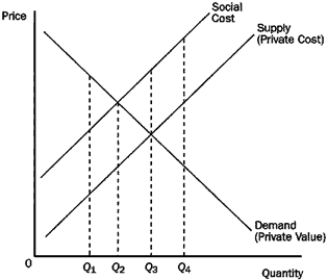 -Refer to Figure 10-4. This market
Table 10-5
The following table shows the marginal costs for each of four firms (A, B, C, and D) to eliminate units of pollution from their production processes. For example, for Firm A to eliminate one unit of pollution, it would cost $54, and for Firm A to eliminate a second unit of pollution it would cost an additional $67.  -Refer to Table 10-5. If the government charged a fee of $69 per unit of pollution, how many units of pollution would the firms eliminate altogether?
 (Multiple Choice)
4.9/5 (62)
(62) Table 10-2
The following table shows the private value, private cost, and social value for a market with a positive externality. 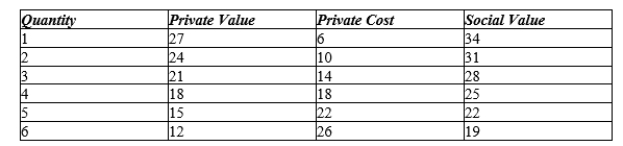 -Refer to Table 10-2. How large would a subsidy need to be in this market to move the market from the equilibrium level of output to the socially-optimal level of output?
 (Multiple Choice)
4.9/5 (78)
(78) Table 10-6
The following table shows the total costs for each of four firms (A, B, C, and D) to eliminate units of pollution from their production processes. For example, for Firm A to eliminate one unit of pollution, it would cost $46, and for Firm A to eliminate two units of pollution, it would cost a total of $103.  -Refer to Table 10-6. Suppose there is presently no pollution fee, and the government wishes to eliminate exactly 8 units of pollution. Which of the following fees per unit of pollution would achieve that goal?
 (Multiple Choice)
4.8/5 (82)
(82) If education produces positive externalities and the government does not intervene in the market, we would expect
(Multiple Choice)
4.9/5 (77)
(77) Scenario 10-4
The demand curve for fire extinguishers slopes downward and the supply curve for fire extinguishers slopes upward. The production of the 500th fire extinguisher entails the following:
• a private cost of $10;
• an external cost of $0;
• a private value of $9;
• an external benefit of $3.
-Refer to Scenario 10-4. What is the social value of the 500th fire extinguisher?
(Essay)
4.8/5 (69)
(69) Figure 10-10 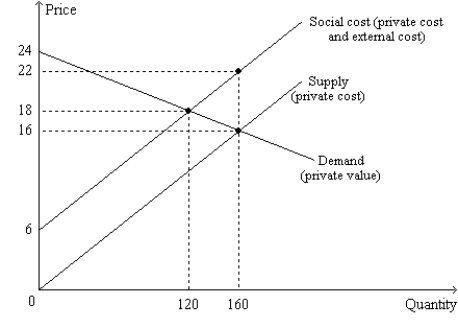 -Refer to Figure 10-10. "The social cost of the last unit produced exceeds the value to buyers of the last unit produced by $3." This statement is correct at which quantity of output?
 (Multiple Choice)
4.7/5 (73)
(73) Which of the following suggests that private markets can be effective in dealing with externalities?
(Multiple Choice)
4.8/5 (87)
(87) Why are Pigovian taxes preferred to regulatory policies as methods to remedy negative externalities?
(Essay)
4.8/5 (73)
(73) In a market with positive externalities, the market equilibrium quantity maximizes the welfare of society as a whole.
(True/False)
5.0/5 (90)
(90) Figure 10-16 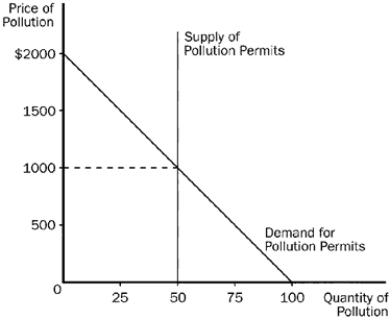 -Refer to Figure 10-16. This graph shows the market for pollution when permits are issued to firms and traded in the marketplace. The equilibrium number of permits is
 (Multiple Choice)
4.8/5 (72)
(72) Two farmers, A and B, each apply 100 tons of manure on their fields. To reduce manure runoff, the government has decided to require a permit for each ton of manure applied. The government gives each farmer 50 tradeable permits. Farmer A incurs losses of $25 for each ton of manure he does not apply, and Farmer B incurs losses of $50 for each ton of manure he does not apply. After permit trading, we would expect that
(Multiple Choice)
4.8/5 (69)
(69) When a particular negative externality affects a very large number of people, it is likely that
(Multiple Choice)
4.8/5 (83)
(83) University researchers create a positive externality because what they discover in their research labs can easily be learned by others who haven't contributed to the research costs. What could the federal government do to equate the equilibrium quantity of university research and the socially optimal quantity of university research produced?
(Multiple Choice)
4.8/5 (82)
(82) When we identify public policies toward externalities, we contrast command-and-control policies with what other type of policies?
(Essay)
4.8/5 (68)
(68) The Coase theorem asserts that, if externalities are present and if private parties can bargain over the allocation of resources at no cost, then
(Multiple Choice)
4.9/5 (77)
(77) Two firms, A and B, each currently dump 50 tons of chemicals into the local river. The government has decided to reduce the pollution and from now on will require a pollution permit for each ton of pollution dumped into the river. It costs Firm A $100 for each ton of pollution that it eliminates before it reaches the river, and it costs Firm B $50 for each ton of pollution that it eliminates before it reaches the river. The government gives each firm 20 pollution permits. Government officials are not sure whether to allow the firms to buy or sell the pollution permits to each other. What is the total cost of reducing pollution if firms are not allowed to buy and sell pollution permits from each other? What is the total cost of reducing pollution if the firms are allowed to buy and sell permits from each other?
(Multiple Choice)
4.8/5 (89)
(89) 
Filters
- Essay(0)
- Multiple Choice(0)
- Short Answer(0)
- True False(0)
- Matching(0)