



 Chat with AI
Exam 10: Externalities

Exam 1: Ten Principles of Economics455 Questions
Exam 2: Thinking Like an Economist643 Questions
Exam 3: Interdependence and the Gains From Trade547 Questions
Exam 4: The Market Forces of Supply and Demand693 Questions
Exam 5: Elasticity and Its Application626 Questions
Exam 6: Supply, Demand, and Government Policies668 Questions
Exam 7: Consumers, Producers, and the Efficiency of Markets547 Questions
Exam 8: Applications: the Costs of Taxation509 Questions
Exam 9: Application: International Trade521 Questions
Exam 10: Externalities543 Questions
Exam 11: Public Goods and Common Resources452 Questions
Exam 12: The Design of the Tax System664 Questions
Exam 13: The Costs of Production649 Questions
Exam 14: Firms in Competitive Markets604 Questions
Exam 15: Monopoly662 Questions
Exam 16: Monopolistic Competition649 Questions
Exam 17: Oligopoly522 Questions
Exam 18: The Markets for the Factors of Production592 Questions
Exam 19: Earnings and Discrimination511 Questions
Exam 20: Income Inequality and Poverty478 Questions
Exam 21: The Theory of Consumer Choice570 Questions
Exam 22: Frontiers in Microeconomics461 Questions
Exam 23: Measuring a Nation S Income547 Questions
Exam 24: Measuring the Cost of Living565 Questions
Exam 25: Production and Growth527 Questions
Exam 26: Saving, Investment, and the Financial System637 Questions
Exam 27: Tools of Finance534 Questions
Exam 28: Unemployment and Its Natural Rate701 Questions
Exam 29: The Monetary System540 Questions
Exam 30: Money Growth and Inflation504 Questions
Exam 31: Open-Economy Macroeconomics: Basic Concepts540 Questions
Exam 32: A Macroeconomic Theory of the Open Economy511 Questions
Exam 33: Aggregate Demand and Aggregate Supply572 Questions
Exam 34: The Influence of Monetary and Fiscal Policy on Aggregate Demand523 Questions
Exam 35: The Short-Run Tradeoff Between Inflation and Unemployment536 Questions
Exam 36: Six Debates Over Macroeconomic Policy354 Questions
Select questions type


Suppose that electricity producers create a negative externality equal to $5 per unit. Further suppose that the government imposes a $5 per-unit tax on the producers. What is the relationship between the after-tax equilibrium quantity and the socially optimal quantity of electricity to be produced?
(Multiple Choice)
4.9/5  (69)
(69) In the case of a technology spillover, internalizing a positive externality will cause the supply curve of an industry to
(Multiple Choice)
4.7/5 (74)
(74) Suppose that an MBA degree creates no externality because the benefits of an MBA are internalized by the student in the form of higher wages. If the government offers subsidies for MBAs, then which of the following statements is correct?
(Multiple Choice)
4.8/5 (82)
(82) Josiah installed a metal sculpture in his front yard. A positive externality arises if the sculpture
(Multiple Choice)
4.9/5 (75)
(75) Suppose a tax is imposed on producers of aluminum as a means of internalizing the externality associated with aluminum production. If the tax accurately reflects the external costs of pollutants released into the atmosphere, then the new supply curve for aluminum coincides with which other curve?
(Essay)
4.8/5 (74)
(74) Figure 10-5 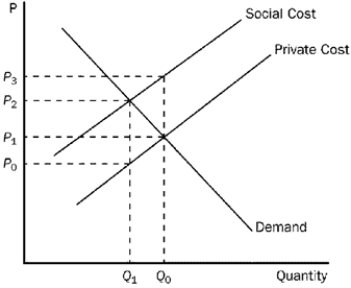 -Refer to Figure 10-5. Which price and quantity combination represents the social optimum?
 (Multiple Choice)
4.8/5 (85)
(85) Scenario 10-4
The demand curve for fire extinguishers slopes downward and the supply curve for fire extinguishers slopes upward. The production of the 500th fire extinguisher entails the following:
• a private cost of $10;
• an external cost of $0;
• a private value of $9;
• an external benefit of $3.
-Refer to Scenario 10-4. Is the market-equilibrium quantity of fire extinguishers less than, equal to, or greater than 500? Explain.
(Essay)
4.7/5 (79)
(79) Suppose that Bill wants to dine at a fancy restaurant, but the only available table is in the smoking section. Bill dislikes the smell of cigarette smoke. He notices that only one person, Peter, is smoking in the smoking section. Bill values the absence of smoke at $15. Peter values the ability to smoke in the restaurant at $10. In order for Bill to pay Peter not to smoke, he will need to tip the waiter $10 to facilitate the transaction. Which of the following represents an efficient solution?
(Multiple Choice)
4.8/5 (76)
(76) Table 10-4 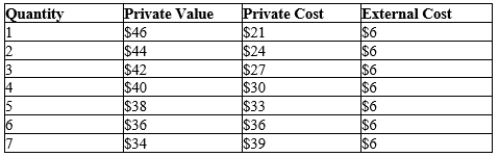 -Refer to Table 10-4. The table represents a market in which
 (Multiple Choice)
5.0/5 (86)
(86) Figure 10-18. The graph represents a corrective tax to reduce pollution. On the axes, Q denotes the quantity of pollution and P represents the price of pollution. 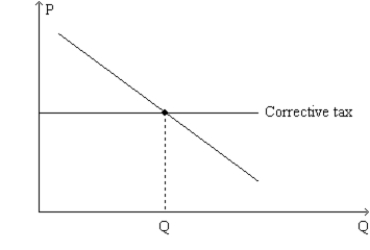 -Refer to Figure 10-18. The tax depicted on the graph
 (Multiple Choice)
4.9/5 (70)
(70) Figure 10-19 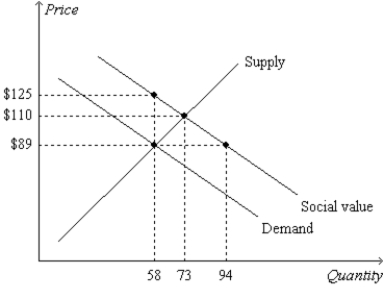 -Refer to Figure 10-19. Note that the lines labeled "Demand" and "Social Value"are parallel. Also, the slopes of the lines on the graph reflect the following facts: (1) Private value and social value decrease by $1.00 with each additional unit of the good that is consumed, and (2) private cost increases by $1.40 with each additional unit of the good that is produced. Thus, when the 74th unit of the good is produced and consumed, social well-being
 (Multiple Choice)
4.9/5 (84)
(84) Sophia sits behind Gabriel on an airplane. Gabriel owns the right to recline his seat and values this right at $10. Sophia values a non-reclined seat in front of her at $40. Assuming no transaction costs, which of the following represents an efficient solution?
(Multiple Choice)
4.8/5 (85)
(85) In some situations, private economic actors cannot solve the problem of externalities among themselves because of substantial _________ costs.
(Short Answer)
4.9/5 (84)
(84) Figure 10-12 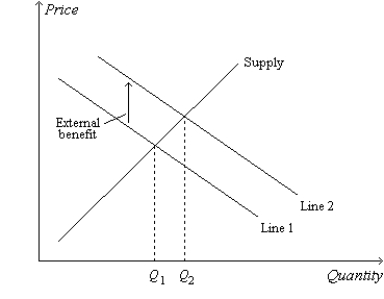 -Refer to Figure 10-12. Which of the following is an appropriate label for Line 2?
 (Multiple Choice)
4.9/5 (74)
(74) If the government wanted to ensure that the market reaches the socially optimal equilibrium in the presence of a technology spillover, it should
(Multiple Choice)
4.8/5 (81)
(81) Suppose the market-equilibrium quantity of good x is larger than the socially-optimal quantity of good x. Does the production of good x convey a positive externality or does it convey a negative externality?
(Essay)
4.7/5 (92)
(92) Does research into new technologies create a positive externality or does it create a negative externality?
(Essay)
5.0/5 (79)
(79) Assume each college degree that is granted conveys an external benefit of $3,500. The granting of the 500th college degree entails a private cost of $15,000 and a private value of $25,000. What is the social value of the 500th college degree?
(Essay)
4.9/5 (85)
(85) 
Filters
- Essay(0)
- Multiple Choice(0)
- Short Answer(0)
- True False(0)
- Matching(0)