



 Chat with AI
Exam 10: Externalities

Exam 1: Ten Principles of Economics455 Questions
Exam 2: Thinking Like an Economist643 Questions
Exam 3: Interdependence and the Gains From Trade547 Questions
Exam 4: The Market Forces of Supply and Demand693 Questions
Exam 5: Elasticity and Its Application626 Questions
Exam 6: Supply, Demand, and Government Policies668 Questions
Exam 7: Consumers, Producers, and the Efficiency of Markets547 Questions
Exam 8: Applications: the Costs of Taxation509 Questions
Exam 9: Application: International Trade521 Questions
Exam 10: Externalities543 Questions
Exam 11: Public Goods and Common Resources452 Questions
Exam 12: The Design of the Tax System664 Questions
Exam 13: The Costs of Production649 Questions
Exam 14: Firms in Competitive Markets604 Questions
Exam 15: Monopoly662 Questions
Exam 16: Monopolistic Competition649 Questions
Exam 17: Oligopoly522 Questions
Exam 18: The Markets for the Factors of Production592 Questions
Exam 19: Earnings and Discrimination511 Questions
Exam 20: Income Inequality and Poverty478 Questions
Exam 21: The Theory of Consumer Choice570 Questions
Exam 22: Frontiers in Microeconomics461 Questions
Exam 23: Measuring a Nation S Income547 Questions
Exam 24: Measuring the Cost of Living565 Questions
Exam 25: Production and Growth527 Questions
Exam 26: Saving, Investment, and the Financial System637 Questions
Exam 27: Tools of Finance534 Questions
Exam 28: Unemployment and Its Natural Rate701 Questions
Exam 29: The Monetary System540 Questions
Exam 30: Money Growth and Inflation504 Questions
Exam 31: Open-Economy Macroeconomics: Basic Concepts540 Questions
Exam 32: A Macroeconomic Theory of the Open Economy511 Questions
Exam 33: Aggregate Demand and Aggregate Supply572 Questions
Exam 34: The Influence of Monetary and Fiscal Policy on Aggregate Demand523 Questions
Exam 35: The Short-Run Tradeoff Between Inflation and Unemployment536 Questions
Exam 36: Six Debates Over Macroeconomic Policy354 Questions
Select questions type


Which of the following problems can not be alleviated by a gasoline tax?
(Multiple Choice)
4.9/5  (57)
(57) Suppose a Pigovian tax is imposed on a market that is characterized by one or more externalities. Is this a command-and-control policy or is it a market-based policy?
(Essay)
4.7/5 (72)
(72) Suppose the Environmental Protection Agency issues pollution permits in order to limit the quantity of pollution. Under this policy, is the supply of pollution rights perfectly elastic or is it perfectly inelastic?
(Short Answer)
4.9/5 (76)
(76) Two firms, A and B, each currently emit 100 tons of chemicals into the air. The government has decided to reduce the pollution and from now on will require a pollution permit for each ton of pollution emitted into the air. The government gives each firm 40 pollution permits, which it can either use or sell to the other firm. It costs Firm A $200 for each ton of pollution that it eliminates before it is emitted into the air, and it costs Firm B $100 for each ton of pollution that it eliminates before it is emitted into the air. After the two firms buy or sell pollution permits from each other, we would expect that Firm A will emit
(Multiple Choice)
4.8/5 (68)
(68) A local manufacturing plant that emitted sulfur dioxide was forced to stop production because it did not comply with local clean air standards. This decision provides an example of
(Multiple Choice)
4.8/5 (78)
(78) Figure 10-2. The graph depicts the market for plastic. 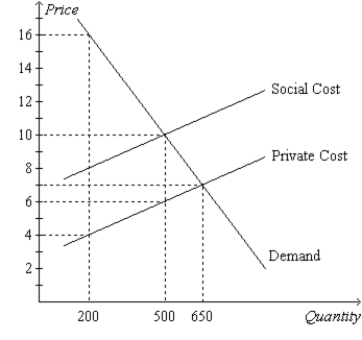 -Refer to Figure 10-2. The private value of the 200th unit of plastic exceeds the social cost of the 200th unit of plastic by
 (Multiple Choice)
4.7/5 (78)
(78) An example of a private solution to externalities is charities. The government encourages this private solution by allowing ___________ .
(Short Answer)
4.9/5 (85)
(85) Scenario 10-1
The demand curve for gasoline slopes downward and the supply curve for gasoline slopes upward. The production of the 1,000th gallon of gasoline entails the following:
• a private cost of $3.10;
• a social cost of $3.55;
• a value to consumers of $3.70.
-Refer to Scenario 10-1. Let Q represent the number of gallons of gasoline and let P represent the price of a gallon of gasoline. Which of the following statements is correct?
(Multiple Choice)
4.9/5 (74)
(74) Patent protection is one way to deal with technology spillovers.
(True/False)
4.8/5 (80)
(80) Flu shots provide a positive externality. Suppose that the market for vaccinations is perfectly competitive. Without government intervention in the vaccination market, which of the following statements is correct?
(Multiple Choice)
4.9/5 (73)
(73) Figure 10-12 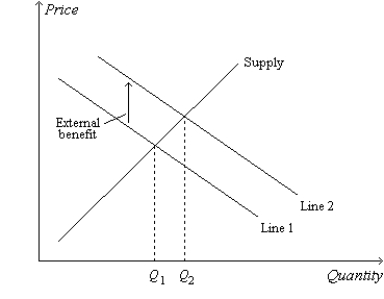 -Refer to Figure 10-12. The graph, as drawn, could apply to the market for
 (Multiple Choice)
4.9/5 (76)
(76) Most economists prefer regulation to taxation because regulation corrects market inefficiencies at a lower cost than taxation does.
(True/False)
4.7/5 (74)
(74) When a driver enters a crowded highway he increases the travel times of all other drivers on the highway. This is an example of a negative externality.
(True/False)
4.7/5 (75)
(75) Table 10-3 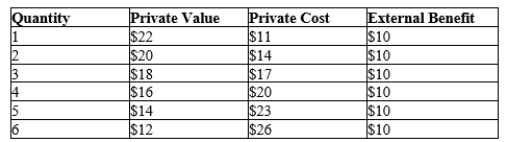 -Refer to Table 10-3. Taking into account private and external costs, the maximum total surplus that can be achieved in this market is
 (Multiple Choice)
4.9/5 (89)
(89) Laws that are passed that either require or forbid certain behaviors are examples of command-and-control policies.
(True/False)
4.8/5 (83)
(83) Suppose the government imposes a tax in a certain market in order to internalize an externality. This type of policy is based on which of the Ten Principles of Economics?
(Multiple Choice)
4.8/5 (89)
(89) If we know that the supply curve for good x fails to reflect the total cost to society of producing that good, then we know that
(Multiple Choice)
4.7/5 (78)
(78) If an externality is present in a market, economic efficiency may be enhanced by
(Multiple Choice)
4.7/5 (79)
(79) 
Filters
- Essay(0)
- Multiple Choice(0)
- Short Answer(0)
- True False(0)
- Matching(0)