



 Chat with AI
Exam 10: Externalities

Exam 1: Ten Principles of Economics455 Questions
Exam 2: Thinking Like an Economist643 Questions
Exam 3: Interdependence and the Gains From Trade547 Questions
Exam 4: The Market Forces of Supply and Demand693 Questions
Exam 5: Elasticity and Its Application626 Questions
Exam 6: Supply, Demand, and Government Policies668 Questions
Exam 7: Consumers, Producers, and the Efficiency of Markets547 Questions
Exam 8: Applications: the Costs of Taxation509 Questions
Exam 9: Application: International Trade521 Questions
Exam 10: Externalities543 Questions
Exam 11: Public Goods and Common Resources452 Questions
Exam 12: The Design of the Tax System664 Questions
Exam 13: The Costs of Production649 Questions
Exam 14: Firms in Competitive Markets604 Questions
Exam 15: Monopoly662 Questions
Exam 16: Monopolistic Competition649 Questions
Exam 17: Oligopoly522 Questions
Exam 18: The Markets for the Factors of Production592 Questions
Exam 19: Earnings and Discrimination511 Questions
Exam 20: Income Inequality and Poverty478 Questions
Exam 21: The Theory of Consumer Choice570 Questions
Exam 22: Frontiers in Microeconomics461 Questions
Exam 23: Measuring a Nation S Income547 Questions
Exam 24: Measuring the Cost of Living565 Questions
Exam 25: Production and Growth527 Questions
Exam 26: Saving, Investment, and the Financial System637 Questions
Exam 27: Tools of Finance534 Questions
Exam 28: Unemployment and Its Natural Rate701 Questions
Exam 29: The Monetary System540 Questions
Exam 30: Money Growth and Inflation504 Questions
Exam 31: Open-Economy Macroeconomics: Basic Concepts540 Questions
Exam 32: A Macroeconomic Theory of the Open Economy511 Questions
Exam 33: Aggregate Demand and Aggregate Supply572 Questions
Exam 34: The Influence of Monetary and Fiscal Policy on Aggregate Demand523 Questions
Exam 35: The Short-Run Tradeoff Between Inflation and Unemployment536 Questions
Exam 36: Six Debates Over Macroeconomic Policy354 Questions
Select questions type


The patent system gives firms greater incentive to engage in research and other activities that advance technology.
(True/False)
5.0/5  (86)
(86) An externality arises when a person engages in an activity that influences the well-being of
(Multiple Choice)
4.9/5 (83)
(83) A benevolent social planner would prefer that the output of good x be increased from its current level if, at the current level of output of good x,
(Multiple Choice)
4.9/5 (78)
(78) Figure 10-4 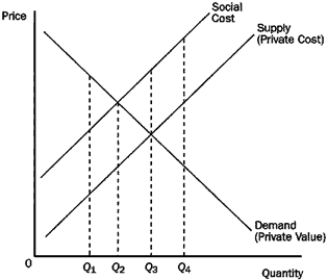 -Refer to Figure 10-4. If all external costs were internalized, then the market's equilibrium output would be
 (Multiple Choice)
4.9/5 (83)
(83) Figure 10-15 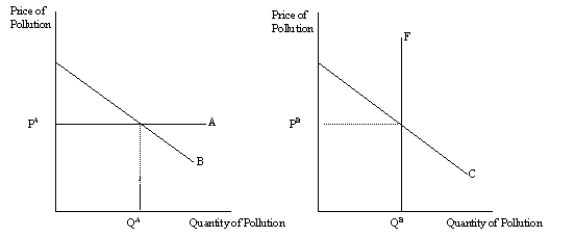 -Refer to Figure 10-15. Which graph illustrates a corrective tax?
 (Multiple Choice)
4.8/5 (80)
(80) Suppose a certain good provides an external benefit. If the private cost of the last unit of the good that was produced is equal to the social value of that unit, then the sum of producer and consumer surplus is maximized.
(True/False)
5.0/5 (87)
(87) What are the three externalities that are associated with driving cars and trucks?
(Essay)
4.9/5 (85)
(85) A rain barrel is a container that captures and stores rainwater for landscape and garden use during dry periods. Rain barrels provide an external benefit to the community through water conservation. What can the government do to equate the equilibrium quantity of rain barrels and the socially optimal quantity of rain barrels?
(Multiple Choice)
5.0/5 (69)
(69) Figure 10-9 

 -Refer to Figure 10-9. Which graph represents a market with no externality?
 (Multiple Choice)
4.8/5 (71)
(71) Which of the following policies is the government most inclined to use when faced with a positive externality?
(Multiple Choice)
4.9/5 (72)
(72) Figure 10-8  -Refer to Figure 10-8. What is the socially-optimal quantity of output in this market?
 (Multiple Choice)
4.8/5 (95)
(95) Scenario 10-1
The demand curve for gasoline slopes downward and the supply curve for gasoline slopes upward. The production of the 1,000th gallon of gasoline entails the following:
• a private cost of $3.10;
• a social cost of $3.55;
• a value to consumers of $3.70.
-Refer to Scenario 10-1. Suppose the equilibrium quantity of gasoline is 1,150 gallons; that is, QMARKET = 1,150. Then the equilibrium price of a gallon could be
(Multiple Choice)
4.8/5 (82)
(82) Which of the following is the most effective way to internalize a technology spillover?
(Multiple Choice)
4.9/5 (84)
(84) Figure 10-9
-Refer to Figure 10-9, Panel (c). The market equilibrium price is
-Refer to Figure 10-9, Panel (c). The market equilibrium price is (Multiple Choice)
4.8/5 (78)
(78) Altering incentives so that people take account of the external effects of their actions
(Multiple Choice)
4.9/5 (79)
(79) Figure 10-11 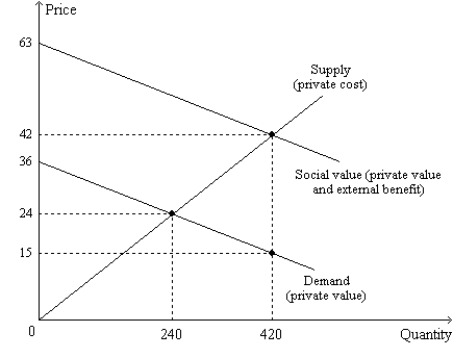 -Refer to Figure 10-11. Which of the following statements is correct?
 (Multiple Choice)
4.7/5 (81)
(81) 
Filters
- Essay(0)
- Multiple Choice(0)
- Short Answer(0)
- True False(0)
- Matching(0)