



 Chat with AI
Exam 10: Externalities

Exam 1: Ten Principles of Economics455 Questions
Exam 2: Thinking Like an Economist645 Questions
Exam 3: Interdependence and the Gains From Trade550 Questions
Exam 4: The Market Forces of Supply and Demand693 Questions
Exam 5: Elasticity and Its Application625 Questions
Exam 6: Supply, Demand, and Government Policies671 Questions
Exam 7: Consumers, Producers, and the Efficiency of Markets547 Questions
Exam 8: Application: The Costs of Taxation507 Questions
Exam 9: Application: International Trade521 Questions
Exam 10: Externalities543 Questions
Exam 11: Public Goods and Common Resources453 Questions
Exam 12: The Design of the Tax System563 Questions
Exam 13: The Costs of Production649 Questions
Exam 14: Firms in Competitive Markets608 Questions
Exam 15: Monopoly662 Questions
Exam 16: Monopolistic Competition649 Questions
Exam 17: Oligopoly522 Questions
Exam 18: The Markets for the Factors of Production592 Questions
Exam 19: Earnings and Discrimination511 Questions
Exam 20: Income Inequality and Poverty478 Questions
Exam 21: The Theory of Consumer Choice568 Questions
Exam 22: Frontiers in Microeconomics461 Questions
Select questions type


Education is heavily subsidized through public schools and government scholarships. This subsidization of education reflects the fact that
(Multiple Choice)
4.8/5  (70)
(70) University researchers create a positive externality because what they discover in their research labs can easily be learned by others who haven't contributed to the research costs. If there are no subsidies, what is the relationship between the equilibrium quantity of university research and the optimal quantity of university research produced?
(Multiple Choice)
4.9/5 (80)
(80) Mary and Cathy are roommates. Mary assigns a $30 value to smoking cigarettes. Cathy values smoke-free air at $15. Which of the following scenarios is a successful example of the Coase theorem?
(Multiple Choice)
4.9/5 (85)
(85) Table 10-1
The following table shows the private value, private cost, and external cost for various quantities of output in a market. 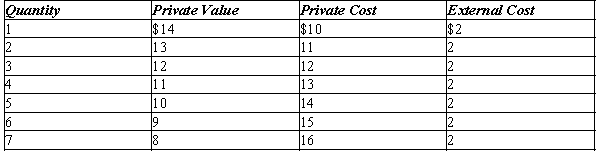 -Refer to Table 10-1. What is the socially-optimal quantity of output in this market?
 (Multiple Choice)
4.7/5 (82)
(82) Suppose that Bill wants to dine at a fancy restaurant, but the only available table is in the smoking section. Bill dislikes the smell of cigarette smoke. He notices that only one person, Peter, is smoking in the smoking section. Bill values the absence of smoke at $15. Peter values the ability to smoke in the restaurant at $10. In order for Bill to pay Peter not to smoke, he will need to tip the waiter $10 to facilitate the transaction. Which of the following represents an efficient solution?
(Multiple Choice)
4.8/5 (63)
(63) Tyler owns a dog and receives a $300 benefit from owning it. Tyler's neighbor, Liz, incurs a cost of $450 from the dog's barking. Suggest a deal between Tyler and Liz that would result in both individuals becoming better off.
(Essay)
4.8/5 (77)
(77) University researchers create a positive externality because what they discover in their research labs can easily be learned by others who haven't contributed to the research costs. What could the federal government do to equate the equilibrium quantity of university research and the socially optimal quantity of university research produced?
(Multiple Choice)
4.8/5 (70)
(70) According to the Coase theorem, if private parties can bargain without cost, then the private market will solve the problem of externalities.
(True/False)
4.9/5 (82)
(82) When a negative externality exists in a market, the cost to producers
(Multiple Choice)
4.7/5 (93)
(93) When a particular negative externality affects a very large number of people, it is likely that
(Multiple Choice)
4.7/5 (72)
(72) In many cases the Coase theorem does not work well because
(Multiple Choice)
5.0/5 (87)
(87) Before the flu season begins, Jeremy gets a flu shot. As a result, Jeremy and several of his friends and relatives avoid the flu for the entire flu season. It would make sense to argue that
(Multiple Choice)
4.8/5 (83)
(83) Figure 10-9 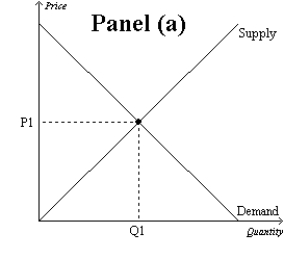
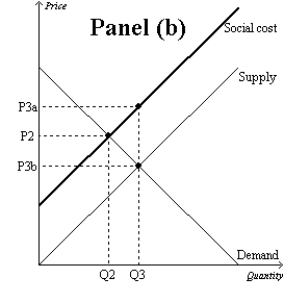
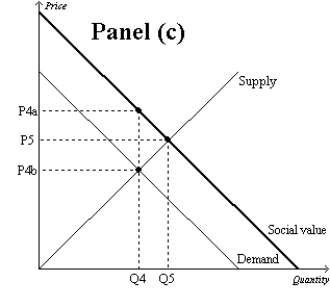 -Refer to Figure 10-9, Panel (b) and Panel (c). The overuse of antibiotics leads to the development of antibiotic-resistant diseases. Therefore, a government policy that internalized the externality would move the quantity of antibiotics used from point
 (Multiple Choice)
4.8/5 (89)
(89) Table 10-4 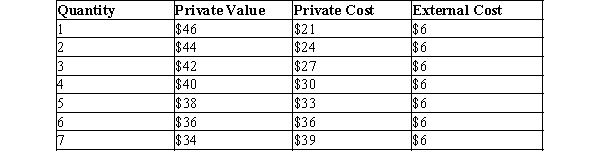 -Refer to Table 10-4. Taking into account private and external costs, total surplus in the market equilibrium amounts to
 (Multiple Choice)
4.8/5 (68)
(68) Figure 10-12  -Refer to Figure 10-12. Which of the following is an appropriate label for Line 2?
 (Multiple Choice)
4.9/5 (85)
(85) Organizers of an outdoor concert in a park surrounded by residential neighborhoods are likely to consider the noise and traffic cost to residential neighborhoods when they assess the financial viability of the concert venture.
(True/False)
4.8/5 (87)
(87) Figure 10-6 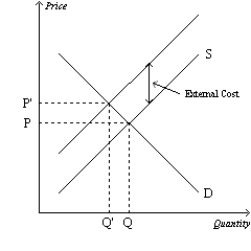 -Refer to Figure 10-6. Which price represents the equilibrium price of the product in this market?
 (Multiple Choice)
5.0/5 (75)
(75) 
Filters
- Essay(0)
- Multiple Choice(0)
- Short Answer(0)
- True False(0)
- Matching(0)