



 Chat with AI
Exam 10: Externalities

Exam 1: Ten Principles of Economics455 Questions
Exam 2: Thinking Like an Economist645 Questions
Exam 3: Interdependence and the Gains From Trade550 Questions
Exam 4: The Market Forces of Supply and Demand693 Questions
Exam 5: Elasticity and Its Application625 Questions
Exam 6: Supply, Demand, and Government Policies671 Questions
Exam 7: Consumers, Producers, and the Efficiency of Markets547 Questions
Exam 8: Application: The Costs of Taxation507 Questions
Exam 9: Application: International Trade521 Questions
Exam 10: Externalities543 Questions
Exam 11: Public Goods and Common Resources453 Questions
Exam 12: The Design of the Tax System563 Questions
Exam 13: The Costs of Production649 Questions
Exam 14: Firms in Competitive Markets608 Questions
Exam 15: Monopoly662 Questions
Exam 16: Monopolistic Competition649 Questions
Exam 17: Oligopoly522 Questions
Exam 18: The Markets for the Factors of Production592 Questions
Exam 19: Earnings and Discrimination511 Questions
Exam 20: Income Inequality and Poverty478 Questions
Exam 21: The Theory of Consumer Choice568 Questions
Exam 22: Frontiers in Microeconomics461 Questions
Select questions type


Scenario 10-1
The demand curve for gasoline slopes downward and the supply curve for gasoline slopes upward. The production of the 1,000th gallon of gasoline entails the following:
• a private cost of $3.10;
• a social cost of $3.55;
• a value to consumers of $3.70.
-Refer to Scenario 10-1. Suppose the dollar amount of the externality, per gallon of gasoline, is constant, regardless of how much gasoline is produced. Then the externality could be internalized if producers of gasoline were
(Multiple Choice)
4.8/5  (87)
(87) Table 10-6
The following table shows the total costs for each of four firms (A, B, C, and D) to eliminate units of pollution from their production processes. For example, for Firm A to eliminate one unit of pollution, it would cost $46, and for Firm A to eliminate two units of pollution, it would cost a total of $103. 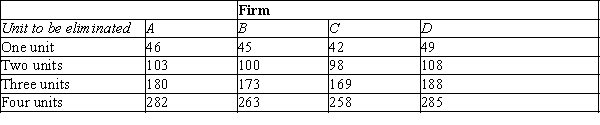 -Refer to Table 10-6. If the government charged a fee of $85 per unit of pollution, how many units of pollution would the firms eliminate altogether?
 (Multiple Choice)
4.9/5 (76)
(76) A market for pollution permits can efficiently allocate the right to pollute by using the forces of supply and demand.
(True/False)
4.8/5 (85)
(85) The Environmental Protection Agency (EPA) requires that firms in a certain industry adopt a particular technology to reduce the emission of pollutants. Is this requirement a command- and-control policy or is it a market-based policy?
(Essay)
4.9/5 (83)
(83) Which of the following is a difference between corrective taxes and tradable pollution permits?
(Multiple Choice)
4.9/5 (87)
(87) Assume that your roommate is very messy. Suppose she gets a $25 benefit from being messy but imposes a $50 cost on you. The Coase theorem would suggest that an efficient solution would be for you to
(Multiple Choice)
4.8/5 (85)
(85) What is the difference between command-and-control policies and market-based policies toward externalities?
(Multiple Choice)
4.8/5 (71)
(71) Table 10-1
The following table shows the private value, private cost, and external cost for various quantities of output in a market. 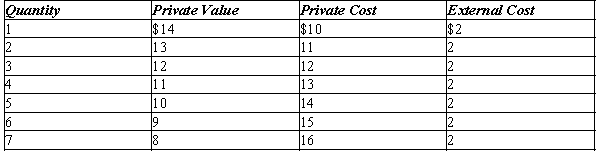 -Refer to Table 10-1. Which of the following statements is correct?
 (Multiple Choice)
5.0/5 (69)
(69) Figure 10-7 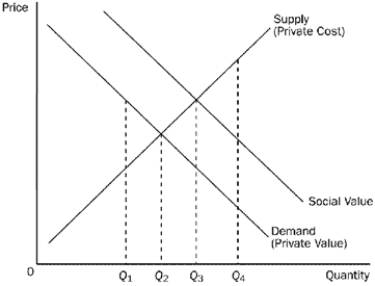 -Refer to Figure 10-7. Which quantity represents the social optimum for this market?
 (Multiple Choice)
4.8/5 (87)
(87) Suppose that flu shots create a positive externality equal to $8 per shot. Further suppose that the government offers a $6-per-shot subsidy to producers. What is the relationship between the equilibrium quantity and the socially optimal quantity of flu shots produced?
(Multiple Choice)
4.8/5 (84)
(84) According to recent research, the gas tax in the United States is lower than the optimal level.
(True/False)
4.8/5 (81)
(81) Corrective taxes are typically advocated to correct for the effects of
(Multiple Choice)
4.8/5 (80)
(80) Government subsidized scholarships are an example of a government policy aimed at correcting negative externalities associated with education.
(True/False)
5.0/5 (70)
(70) Figure 10-4 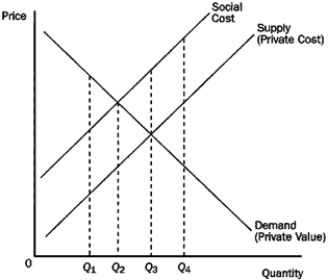 -Refer to Figure 10-4. Without government intervention, the equilibrium quantity would be
 (Multiple Choice)
4.9/5 (94)
(94) Since almost all forms of transportation produce some type of pollution,
(Multiple Choice)
4.9/5 (90)
(90) Scenario 10-4
The demand curve for fire extinguishers slopes downward and the supply curve for fire extinguishers slopes upward. The production of the 500th fire extinguisher entails the following:
• a private cost of $10;
• an external cost of $0;
• a private value of $9;
• an external benefit of $3.
-Refer to Scenario 10-4. In order to maximize the total benefit of fire extinguishers to society as a whole, should the number of fire extinguishers produced be less than, equal to, or greater than 500? Explain.
(Essay)
4.9/5 (89)
(89) Table 10-4 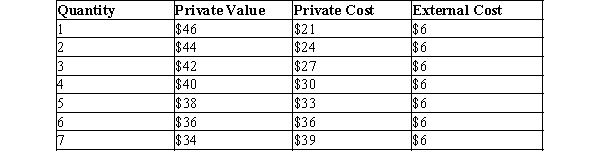 -Refer to Table 10-4. The market equilibrium quantity of output is
 (Multiple Choice)
4.8/5 (80)
(80) 
Filters
- Essay(0)
- Multiple Choice(0)
- Short Answer(0)
- True False(0)
- Matching(0)