



 Chat with AI
Exam 10: Externalities

Exam 1: Ten Principles of Economics455 Questions
Exam 2: Thinking Like an Economist645 Questions
Exam 3: Interdependence and the Gains From Trade550 Questions
Exam 4: The Market Forces of Supply and Demand693 Questions
Exam 5: Elasticity and Its Application625 Questions
Exam 6: Supply, Demand, and Government Policies671 Questions
Exam 7: Consumers, Producers, and the Efficiency of Markets547 Questions
Exam 8: Application: The Costs of Taxation507 Questions
Exam 9: Application: International Trade521 Questions
Exam 10: Externalities543 Questions
Exam 11: Public Goods and Common Resources453 Questions
Exam 12: The Design of the Tax System563 Questions
Exam 13: The Costs of Production649 Questions
Exam 14: Firms in Competitive Markets608 Questions
Exam 15: Monopoly662 Questions
Exam 16: Monopolistic Competition649 Questions
Exam 17: Oligopoly522 Questions
Exam 18: The Markets for the Factors of Production592 Questions
Exam 19: Earnings and Discrimination511 Questions
Exam 20: Income Inequality and Poverty478 Questions
Exam 21: The Theory of Consumer Choice568 Questions
Exam 22: Frontiers in Microeconomics461 Questions
Select questions type


In a market characterized by externalities, the market equilibrium fails to maximize the total benefit to society as a whole.
(True/False)
4.8/5  (89)
(89) Figure 10-15  -Refer to Figure 10-15. Which of the following is not necessary in order for the corrective tax and pollution permit to have equivalent effects?
 (Multiple Choice)
5.0/5 (82)
(82) If education produces positive externalities, we would expect
(Multiple Choice)
4.9/5 (82)
(82) Two firms, A and B, each currently dump 20 tons of chemicals into the local river. The government has decided to reduce the pollution and from now on will require a pollution permit for each ton of pollution dumped into the river. The government gives each firm 10 pollution permits, which it can either use or sell to the other firm. It costs Firm A $100 for each ton of pollution that it eliminates before it reaches the river, and it costs Firm B $50 for each ton of pollution that it eliminates before it reaches the river. After the two firms buy or sell pollution permits from each other, we would expect that
(Multiple Choice)
4.9/5 (68)
(68) Figure 10-11  -Refer to Figure 10-11. Taking only private value and private cost into account, total surplus at the market equilibrium amounts to
 (Multiple Choice)
4.8/5 (96)
(96) Since restored historic buildings convey a positive externality, local governments may choose to
(Multiple Choice)
4.8/5 (78)
(78) To economists, good environmental policy begins by acknowledging one of the Ten Principles of Economics:
(Multiple Choice)
4.8/5 (78)
(78) Honey producers provide a positive externality to orchards because
(Multiple Choice)
4.8/5 (69)
(69) Figure 10-1 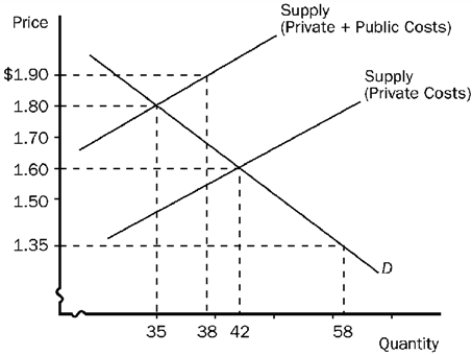 -Refer to Figure 10-1. This graph represents the tobacco industry. The industry creates
 (Multiple Choice)
4.9/5 (83)
(83) Figure 10-16 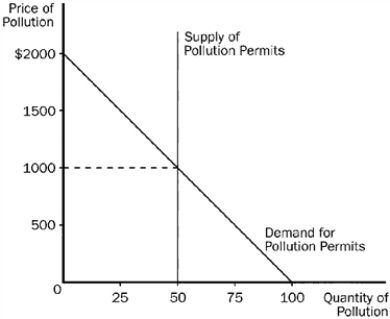 -Refer to Figure 10-16. This graph shows the market for pollution when permits are issued to firms and traded in the marketplace. The equilibrium price of pollution is
 (Multiple Choice)
4.9/5 (74)
(74) Figure 10-9 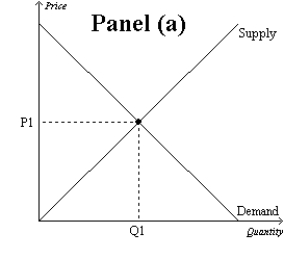
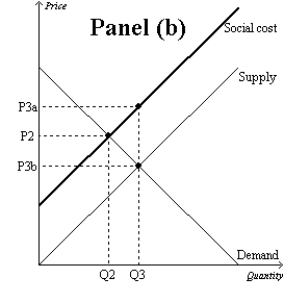
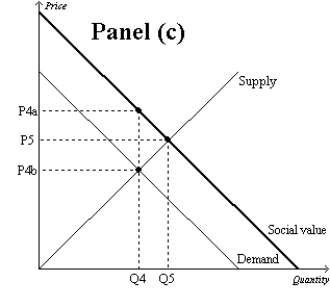 -Refer to Figure 10-9, Panel (b). The market equilibrium quantity is
 (Multiple Choice)
4.9/5 (78)
(78) Suppose that electricity producers create a negative externality equal to $5 per unit. Further suppose that the government imposes a $5 per-unit tax on the producers. What is the relationship between the after-tax equilibrium quantity and the socially optimal quantity of electricity to be produced?
(Multiple Choice)
4.7/5 (90)
(90) Figure 10-5 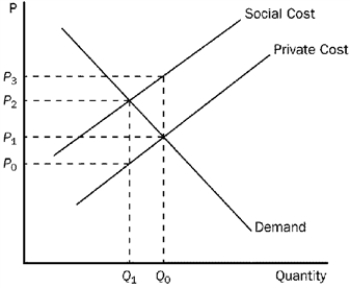 -Refer to Figure 10-5. Which of the following statements is correct?
 (Multiple Choice)
5.0/5 (77)
(77) Figure 10-2. The graph depicts the market for plastic. 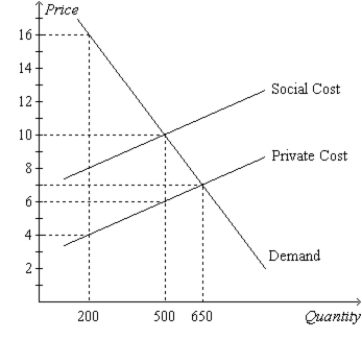 -Refer to Figure 10-2. Suppose that the production of plastic creates a social cost which is depicted in the graph above. Without any government regulation, how much plastic will be produced?
 (Multiple Choice)
4.8/5 (75)
(75) Which of the following statements about a well-maintained yard best conveys the general nature of the externality?
(Multiple Choice)
4.9/5 (72)
(72) Figure 10-4 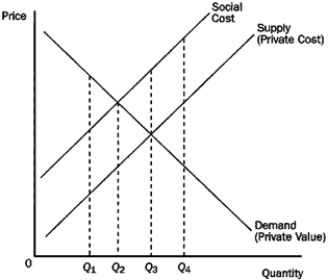 -Refer to Figure 10-4. This market is characterized by
 (Multiple Choice)
4.7/5 (88)
(88) 
Filters
- Essay(0)
- Multiple Choice(0)
- Short Answer(0)
- True False(0)
- Matching(0)