



 Chat with AI
Exam 10: Externalities

Exam 1: Ten Principles of Economics455 Questions
Exam 2: Thinking Like an Economist645 Questions
Exam 3: Interdependence and the Gains From Trade550 Questions
Exam 4: The Market Forces of Supply and Demand693 Questions
Exam 5: Elasticity and Its Application625 Questions
Exam 6: Supply, Demand, and Government Policies671 Questions
Exam 7: Consumers, Producers, and the Efficiency of Markets547 Questions
Exam 8: Application: The Costs of Taxation507 Questions
Exam 9: Application: International Trade521 Questions
Exam 10: Externalities543 Questions
Exam 11: Public Goods and Common Resources453 Questions
Exam 12: The Design of the Tax System563 Questions
Exam 13: The Costs of Production649 Questions
Exam 14: Firms in Competitive Markets608 Questions
Exam 15: Monopoly662 Questions
Exam 16: Monopolistic Competition649 Questions
Exam 17: Oligopoly522 Questions
Exam 18: The Markets for the Factors of Production592 Questions
Exam 19: Earnings and Discrimination511 Questions
Exam 20: Income Inequality and Poverty478 Questions
Exam 21: The Theory of Consumer Choice568 Questions
Exam 22: Frontiers in Microeconomics461 Questions
Select questions type


If the government were to impose a fine of $4,000 for each unit of air-pollution released by a fertilizer plant, the policy would be considered
(Multiple Choice)
4.9/5  (84)
(84) Dioxin emission that results from the production of paper is a good example of a negative externality because
(Multiple Choice)
4.9/5 (90)
(90) When a transaction between a buyer and seller directly affects a third party, the effect is called an externality.
(True/False)
4.9/5 (93)
(93) An externality arises when a person engages in an activity that influences the well-being of
(Multiple Choice)
4.8/5 (82)
(82) Two types of private solutions to the problem of externalities are
(Multiple Choice)
4.9/5 (69)
(69) Figure 10-1 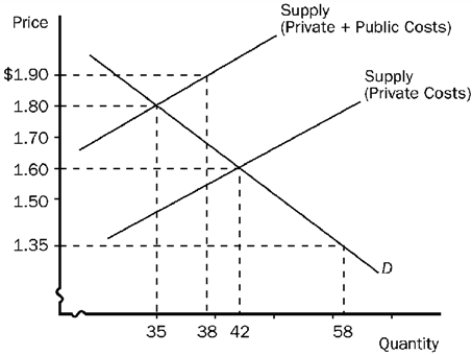 -Refer to Figure 10-1. This graph represents the tobacco industry. Without any government intervention, the equilibrium price and quantity are
 (Multiple Choice)
4.8/5 (74)
(74) A cost imposed on someone who is neither the consumer nor the producer is called a
(Multiple Choice)
4.8/5 (74)
(74) When firms internalize a negative externality, the market supply curve shifts to the left.
(True/False)
4.7/5 (76)
(76) Government intervention that aims to promote technology-enhancing industries is called
(Multiple Choice)
4.8/5 (71)
(71) Table 10-4 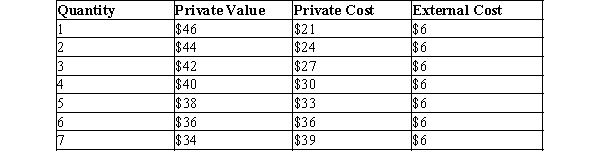 -Refer to Table 10-4. The table represents a market in which
 (Multiple Choice)
4.9/5 (85)
(85) Figure 10-20. 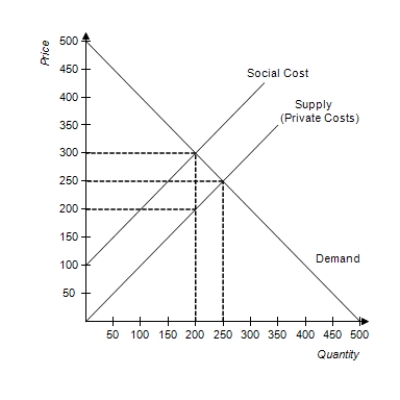 -Refer to Figure 10-20. The graph depicts the market for fertilizer. What is the socially optimal quantity of fertilizer?
 (Multiple Choice)
4.8/5 (76)
(76) The tax on gasoline causes deadweight losses, as is the case with all taxes.
(True/False)
4.9/5 (79)
(79) Laws that are passed that either require or forbid certain behaviors are examples of command-and-control policies.
(True/False)
5.0/5 (80)
(80) When the production of a good results in a positive externality, the social value curve is
(Multiple Choice)
4.9/5 (79)
(79) A negative externality will cause a private market to produce
(Multiple Choice)
4.7/5 (69)
(69) Figure 10-4 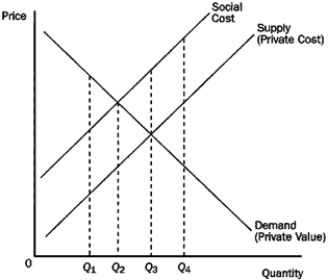 -Refer to Figure 10-4. If this market is currently producing at Q4, then total economic well-being would be maximized if output
 (Multiple Choice)
4.9/5 (89)
(89) Figure 10-2. The graph depicts the market for plastic. 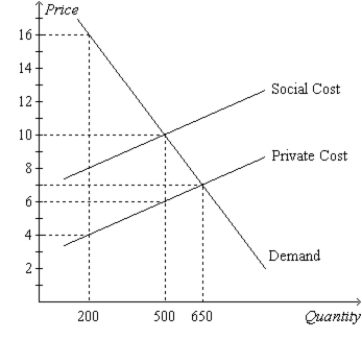 -Refer to Figure 10-2. A benevolent social planner would like to see
 (Multiple Choice)
4.9/5 (82)
(82) Scenario 10-4
The demand curve for fire extinguishers slopes downward and the supply curve for fire extinguishers slopes upward. The production of the 500th fire extinguisher entails the following:
• a private cost of $10;
• an external cost of $0;
• a private value of $9;
• an external benefit of $3.
-Refer to Scenario 10-4. Does the production of fire extinguishers convey a positive externality, a negative externality, or neither?
(Essay)
4.8/5 (74)
(74) 
Filters
- Essay(0)
- Multiple Choice(0)
- Short Answer(0)
- True False(0)
- Matching(0)