



 Chat with AI
Exam 10: Externalities

Exam 1: Ten Principles of Economics455 Questions
Exam 2: Thinking Like an Economist645 Questions
Exam 3: Interdependence and the Gains From Trade550 Questions
Exam 4: The Market Forces of Supply and Demand693 Questions
Exam 5: Elasticity and Its Application625 Questions
Exam 6: Supply, Demand, and Government Policies671 Questions
Exam 7: Consumers, Producers, and the Efficiency of Markets547 Questions
Exam 8: Application: The Costs of Taxation507 Questions
Exam 9: Application: International Trade521 Questions
Exam 10: Externalities543 Questions
Exam 11: Public Goods and Common Resources453 Questions
Exam 12: The Design of the Tax System563 Questions
Exam 13: The Costs of Production649 Questions
Exam 14: Firms in Competitive Markets608 Questions
Exam 15: Monopoly662 Questions
Exam 16: Monopolistic Competition649 Questions
Exam 17: Oligopoly522 Questions
Exam 18: The Markets for the Factors of Production592 Questions
Exam 19: Earnings and Discrimination511 Questions
Exam 20: Income Inequality and Poverty478 Questions
Exam 21: The Theory of Consumer Choice568 Questions
Exam 22: Frontiers in Microeconomics461 Questions
Select questions type


Figure 10-16 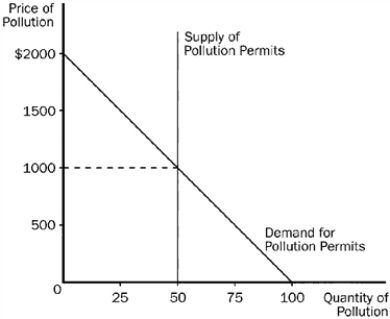 -Refer to Figure 10-16. This graph shows the market for pollution when permits are issued to firms and traded in the marketplace. The equilibrium number of permits is
 (Multiple Choice)
4.8/5  (59)
(59) Suppose planting flowering shrubs creates a positive externality equal to $7 per shrub. Further suppose that the local government offers a $7 per-shrub subsidy to planters. The number of shrubs that are planted is then
(Multiple Choice)
4.9/5 (73)
(73) Figure 10-15  -Refer to Figure 10-15. The supply of pollution permits is
 (Multiple Choice)
4.9/5 (81)
(81) Does research into new technologies create a positive externality or does it create a negative externality?
(Essay)
4.7/5 (82)
(82) Figure 10-15
-Refer to Figure 10-15. Which graph illustrates a pollution permit program?
-Refer to Figure 10-15. Which graph illustrates a pollution permit program? (Multiple Choice)
4.8/5 (88)
(88) Figure 10-12  -Refer to Figure 10-12. The graph, as drawn, could apply to the market for
 (Multiple Choice)
4.9/5 (82)
(82) Markets are often inefficient when negative externalities are present because
(Multiple Choice)
4.9/5 (86)
(86) Which of the following illustrates the concept of a negative externality?
(Multiple Choice)
4.8/5 (79)
(79) Scenario 10-2
The demand curve for restored historic buildings slopes downward and the supply curve for restored historic buildings slopes upward. The production of the 50th restored historic building entails the following:
• a private cost of $800,000;
• a private value of $650,000;
• a social value of $800,000.
-Refer to Scenario 10-2. Is the market equilibrium quantity of restored historic buildings less than, equal to, or greater than 50?
(Essay)
5.0/5 (79)
(79) Suppose that Company A's railroad cars pass through Farmer B's corn fields. The railroad causes an externality to the farmer because the railroad cars emit sparks that cause $1,500 in damage to the farmer's crops. There is a special soy-based grease that the railroad could purchase that would eliminate the damaging sparks. The grease costs $1,200. Suppose that the farmer has the right to compensation for any damage that his crops suffer. Assume that there are no transaction costs. Which of the following characterizes the efficient outcome?
(Multiple Choice)
4.8/5 (87)
(87) Figure 10-19 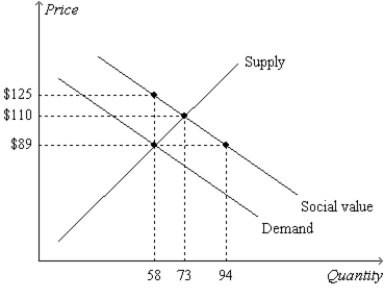 -Refer to Figure 10-19. The social optimum can be reached if
 (Multiple Choice)
4.9/5 (83)
(83) According to the Coase theorem, the private market will need government intervention in order to reach an efficient outcome.
(True/False)
4.8/5 (81)
(81) Figure 10-13. On the graph, Q represents the quantity of plastics and P represents the price of plastics.  -Refer to Figure 10-13. If the government imposed a corrective tax that successfully moved the market from the market equilibrium to the social optimum, then tax revenue for the government would amount to
 (Multiple Choice)
4.9/5 (76)
(76) This figure reflects the market for outdoor concerts in a public park surrounded by residential neighborhoods.
Figure 10-3 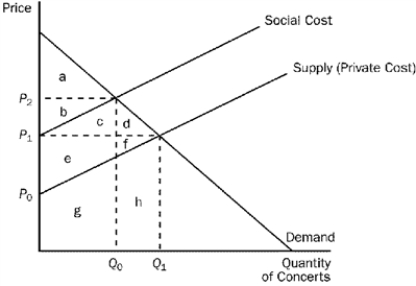 -Refer to Figure 10-3. The social cost curve is above the supply curve because
 (Multiple Choice)
5.0/5 (79)
(79) Many charities like the Sierra Club are established to deal with externalities.
(True/False)
4.7/5 (85)
(85) An example of a private solution to externalities is charities. The government encourages this private solution by allowing ___________ .
(Short Answer)
4.8/5 (83)
(83) Figure 10-20.  -Refer to Figure 10-20. This market would benefit from a tax equal to $50 per unit.
 (True/False)
4.9/5 (78)
(78) 
Filters
- Essay(0)
- Multiple Choice(0)
- Short Answer(0)
- True False(0)
- Matching(0)