



 Chat with AI
Exam 10: Externalities

Exam 1: Ten Principles of Economics455 Questions
Exam 2: Thinking Like an Economist645 Questions
Exam 3: Interdependence and the Gains From Trade550 Questions
Exam 4: The Market Forces of Supply and Demand693 Questions
Exam 5: Elasticity and Its Application625 Questions
Exam 6: Supply, Demand, and Government Policies671 Questions
Exam 7: Consumers, Producers, and the Efficiency of Markets547 Questions
Exam 8: Application: The Costs of Taxation507 Questions
Exam 9: Application: International Trade521 Questions
Exam 10: Externalities543 Questions
Exam 11: Public Goods and Common Resources453 Questions
Exam 12: The Design of the Tax System563 Questions
Exam 13: The Costs of Production649 Questions
Exam 14: Firms in Competitive Markets608 Questions
Exam 15: Monopoly662 Questions
Exam 16: Monopolistic Competition649 Questions
Exam 17: Oligopoly522 Questions
Exam 18: The Markets for the Factors of Production592 Questions
Exam 19: Earnings and Discrimination511 Questions
Exam 20: Income Inequality and Poverty478 Questions
Exam 21: The Theory of Consumer Choice568 Questions
Exam 22: Frontiers in Microeconomics461 Questions
Select questions type


Some environmentalists argue that we should protect the environment as much as possible, regardless of cost. Which of the following is not a likely outcome of pursuing such a course of action?
(Multiple Choice)
4.9/5  (84)
(84) A dentist shares an office building with a radio station. The electrical current from the dentist's drill causes static in the radio broadcast, causing the radio station to lose $10,000 in profits. The radio station could put up a shield at a cost of $30,000; the dentist could buy a new drill that causes less interference for $6,000. Either would restore the radio station's lost profits. What is the economically efficient outcome?
(Multiple Choice)
4.7/5 (76)
(76) What are the three externalities that are associated with driving cars and trucks?
(Essay)
4.8/5 (95)
(95) Education yields positive externalities. For example, a more educated population
(Multiple Choice)
4.9/5 (81)
(81) Figure 10-11  -Refer to Figure 10-11. Taking into account private value and external benefits, the maximum total surplus that can be achieved in this market is
 (Multiple Choice)
4.8/5 (84)
(84) Gretchen is a writer who works from her home. Gretchen lives next door to Randall, the trumpet player for a local band. Randall needs lots of practice to earn his share of the band's profit, which will amount to $350. Gretchen gets distracted by Randall's trumpet playing but she needs to get her writing done to earn $570 for her current article. If Randall owns the right to play his music and Gretchen needs to hire a lawyer to help her reach an agreement with Randall, then what price is Gretchen willing to pay the lawyer?
(Multiple Choice)
4.8/5 (81)
(81) Which of the following problems can not be alleviated by a gasoline tax?
(Multiple Choice)
4.9/5 (91)
(91) Suppose that Company A's railroad cars pass through Farmer B's corn fields. The railroad causes an externality to the farmer because the railroad cars emit sparks that cause $1,500 in damage to the farmer's crops. There is a special soy-based grease that the railroad could purchase that would eliminate the damaging sparks. The grease costs $1,200. Suppose that the railroad is not liable for any damage caused to the crops. Assume that there are no transaction costs. Which of the following characterizes an efficient outcome?
(Multiple Choice)
4.9/5 (84)
(84) Does the phenomenon of externalities strengthen the argument that we should rely upon the "invisible hand" of the marketplace, or does it weaken that argument?
(Essay)
4.9/5 (78)
(78) The Coase theorem suggests that private markets may not be able to solve the problem of externalities
(Multiple Choice)
5.0/5 (90)
(90) Table 10-2
The following table shows the private value, private cost, and social value for a market with a positive externality. 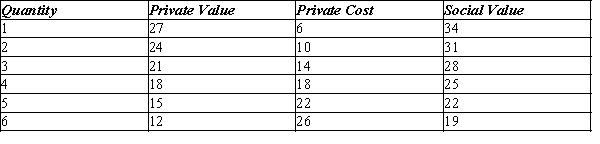 -Refer to Table 10-2. How large would a subsidy need to be in this market to move the market from the equilibrium level of output to the socially-optimal level of output?
 (Multiple Choice)
4.9/5 (85)
(85) Which of the following policies is an example of a command-and-control policy?
(Multiple Choice)
4.9/5 (78)
(78) Which of the following is not an advantage of corrective taxes?
(Multiple Choice)
5.0/5 (83)
(83) A rain barrel is a container that captures and stores rainwater for landscape and garden use during dry periods. Rain barrels provide an external benefit to the community through water conservation. If the government offers a per unit subsidy on rain barrels equal to the per-unit externality, then
(Multiple Choice)
4.8/5 (76)
(76) Suppose that candy producers create a positive externality equal to $1 per pound of candy. Further suppose that the government offers a $1-per-pound subsidy to the producers. What is the relationship between the equilibrium quantity and the socially optimal quantity of candy?
(Multiple Choice)
4.8/5 (72)
(72) 
Filters
- Essay(0)
- Multiple Choice(0)
- Short Answer(0)
- True False(0)
- Matching(0)