



 Chat with AI
Exam 10: Externalities

Exam 1: Ten Principles of Economics455 Questions
Exam 2: Thinking Like an Economist645 Questions
Exam 3: Interdependence and the Gains From Trade550 Questions
Exam 4: The Market Forces of Supply and Demand693 Questions
Exam 5: Elasticity and Its Application625 Questions
Exam 6: Supply, Demand, and Government Policies671 Questions
Exam 7: Consumers, Producers, and the Efficiency of Markets547 Questions
Exam 8: Application: The Costs of Taxation507 Questions
Exam 9: Application: International Trade521 Questions
Exam 10: Externalities543 Questions
Exam 11: Public Goods and Common Resources453 Questions
Exam 12: The Design of the Tax System563 Questions
Exam 13: The Costs of Production649 Questions
Exam 14: Firms in Competitive Markets608 Questions
Exam 15: Monopoly662 Questions
Exam 16: Monopolistic Competition649 Questions
Exam 17: Oligopoly522 Questions
Exam 18: The Markets for the Factors of Production592 Questions
Exam 19: Earnings and Discrimination511 Questions
Exam 20: Income Inequality and Poverty478 Questions
Exam 21: The Theory of Consumer Choice568 Questions
Exam 22: Frontiers in Microeconomics461 Questions
Select questions type


Figure 10-9 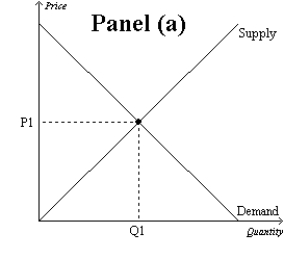
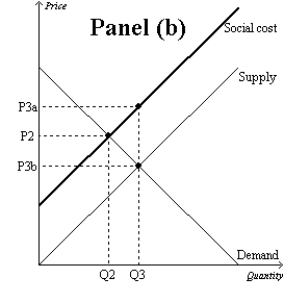
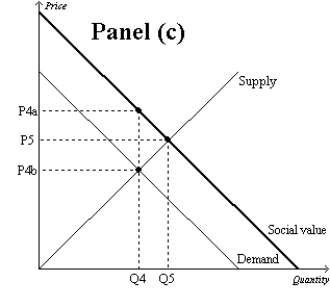 -Refer to Figure 10-9. The installation of a scrubber in a smokestack reduces the emission of harmful chemicals from the smokestack. Therefore, the market for smokestack scrubbers is shown in
 (Multiple Choice)
4.8/5  (85)
(85) Scenario 10-1
The demand curve for gasoline slopes downward and the supply curve for gasoline slopes upward. The production of the 1,000th gallon of gasoline entails the following:
• a private cost of $3.10;
• a social cost of $3.55;
• a value to consumers of $3.70.
-Refer to Scenario 10-1. Let QMARKET represent the equilibrium quantity of gasoline, and let QOPTIMUM represent the socially optimal quantity of gasoline. Which of the following inequalities is correct?
(Multiple Choice)
4.8/5 (83)
(83) According to the Coase Theorem, individuals can always work out a mutually beneficial agreement to solve the problems of externalities even when high transaction costs are involved.
(True/False)
4.8/5 (82)
(82) Figure 10-13. On the graph, Q represents the quantity of plastics and P represents the price of plastics.  -Refer to Figure 10-13. If 325 units of plastics are produced and consumed, then the
 (Multiple Choice)
4.8/5 (83)
(83) Which of the following policies is not an example of a command-and-control policy?
(Multiple Choice)
4.9/5 (87)
(87) This figure reflects the market for outdoor concerts in a public park surrounded by residential neighborhoods.
Figure 10-3 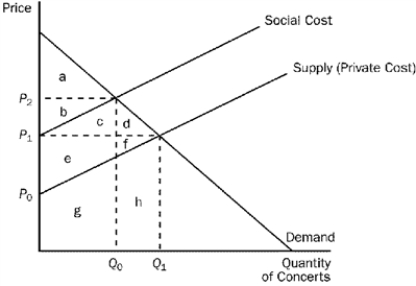 -Refer to Figure 10-3. At the private market outcome, the equilibrium price will be
 (Multiple Choice)
4.8/5 (97)
(97) Table 10-5
The following table shows the marginal costs for each of four firms (A, B, C, and D) to eliminate units of pollution from their production processes. For example, for Firm A to eliminate one unit of pollution, it would cost $54, and for Firm A to eliminate a second unit of pollution it would cost an additional $67. 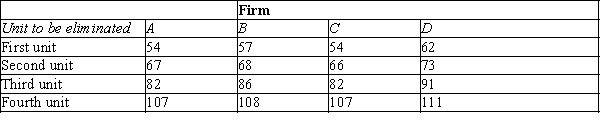 -Refer to Table 10-5. If the government charged a fee of $84 per unit of pollution, how many units of pollution would the firms eliminate altogether?
 (Multiple Choice)
4.9/5 (64)
(64) If an externality is present in a market, economic efficiency may be enhanced by
(Multiple Choice)
4.9/5 (89)
(89) Which of the following is true of markets characterized by positive externalities?
(Multiple Choice)
4.8/5 (70)
(70) Suppose the government imposes a tax in a certain market in order to internalize an externality. This type of policy is based on which of the Ten Principles of Economics?
(Multiple Choice)
4.8/5 (73)
(73) Suppose that an MBA degree creates no externality because the benefits of an MBA are internalized by the student in the form of higher wages. If the government offers subsidies for MBAs, then which of the following statements is correct?
(Multiple Choice)
4.8/5 (83)
(83) Which of the following is the most effective way to internalize a technology spillover?
(Multiple Choice)
4.9/5 (73)
(73) Figure 10-9
-Refer to Figure 10-9, Panel (b) and Panel (c). The installation of a scrubber in a smokestack reduces the emission of harmful chemicals from the smokestack. Therefore, the socially optimal quantity of smokestack scrubbers is represented by point
-Refer to Figure 10-9, Panel (b) and Panel (c). The installation of a scrubber in a smokestack reduces the emission of harmful chemicals from the smokestack. Therefore, the socially optimal quantity of smokestack scrubbers is represented by point (Multiple Choice)
4.8/5 (86)
(86) Barking dogs cannot be considered an externality because externalities must be associated with some form of market exchange.
(True/False)
4.7/5 (61)
(61) When a driver enters a crowded highway he increases the travel times of all other drivers on the highway. This is an example of a negative externality.
(True/False)
4.9/5 (83)
(83) Scenario 10-1
The demand curve for gasoline slopes downward and the supply curve for gasoline slopes upward. The production of the 1,000th gallon of gasoline entails the following:
• a private cost of $3.10;
• a social cost of $3.55;
• a value to consumers of $3.70.
-Refer to Scenario 10-1. Suppose the equilibrium quantity of gasoline is 1,150 gallons; that is, QMARKET = 1,150. Then the equilibrium price of a gallon could be
(Multiple Choice)
4.7/5 (78)
(78) Figure 10-19 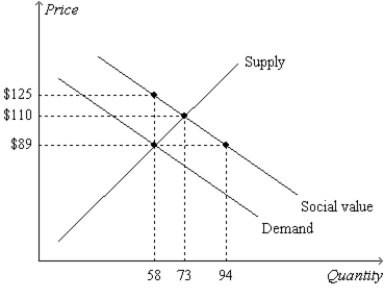 -Refer to Figure 10-19. The socially optimal quantity of output is
 (Multiple Choice)
4.8/5 (83)
(83) Table 10-6
The following table shows the total costs for each of four firms (A, B, C, and D) to eliminate units of pollution from their production processes. For example, for Firm A to eliminate one unit of pollution, it would cost $46, and for Firm A to eliminate two units of pollution, it would cost a total of $103. 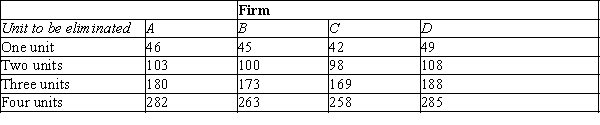 -Refer to Table 10-6. Suppose the government wanted to reduce pollution from 16 units to exactly 6 units. Which one of the following fees per unit of pollution would achieve that goal?
 (Multiple Choice)
4.9/5 (80)
(80) 
Filters
- Essay(0)
- Multiple Choice(0)
- Short Answer(0)
- True False(0)
- Matching(0)