



 Chat with AI
Exam 10: Externalities

Exam 1: Ten Principles of Economics455 Questions
Exam 2: Thinking Like an Economist645 Questions
Exam 3: Interdependence and the Gains From Trade550 Questions
Exam 4: The Market Forces of Supply and Demand693 Questions
Exam 5: Elasticity and Its Application625 Questions
Exam 6: Supply, Demand, and Government Policies671 Questions
Exam 7: Consumers, Producers, and the Efficiency of Markets547 Questions
Exam 8: Application: The Costs of Taxation507 Questions
Exam 9: Application: International Trade521 Questions
Exam 10: Externalities543 Questions
Exam 11: Public Goods and Common Resources453 Questions
Exam 12: The Design of the Tax System563 Questions
Exam 13: The Costs of Production649 Questions
Exam 14: Firms in Competitive Markets608 Questions
Exam 15: Monopoly662 Questions
Exam 16: Monopolistic Competition649 Questions
Exam 17: Oligopoly522 Questions
Exam 18: The Markets for the Factors of Production592 Questions
Exam 19: Earnings and Discrimination511 Questions
Exam 20: Income Inequality and Poverty478 Questions
Exam 21: The Theory of Consumer Choice568 Questions
Exam 22: Frontiers in Microeconomics461 Questions
Select questions type


Scenario 10-2
The demand curve for restored historic buildings slopes downward and the supply curve for restored historic buildings slopes upward. The production of the 50th restored historic building entails the following:
• a private cost of $800,000;
• a private value of $650,000;
• a social value of $800,000.
-Refer to Scenario 10-2. Is the socially optimal quantity of restored historic buildings less than, equal to, or greater than 50?
(Essay)
4.9/5  (73)
(73) In a certain city, the local government regulates the destruction of historic buildings and provides tax breaks to owners of historic buildings who restore them. These government policies
(Multiple Choice)
4.9/5 (74)
(74) Private parties may choose not to solve an externality problem if the transaction costs are large enough.
(True/False)
4.8/5 (95)
(95) Figure 10-19 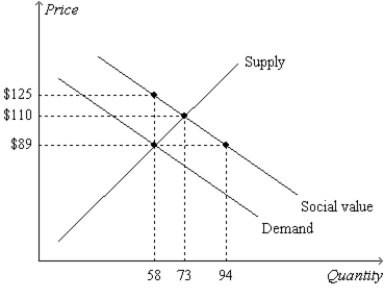 -Refer to Figure 10-19. Note that the lines labeled "Demand" and "Social Value"are parallel. Also, the slopes of the lines on the graph reflect the following facts: (1) Private value and social value decrease by $1.00 with each additional unit of the good that is consumed, and (2) private cost increases by $1.40 with each additional unit of the good that is produced. Thus, when the 74th unit of the good is produced and consumed, social well-being
 (Multiple Choice)
4.8/5 (80)
(80) Sophia sits behind Gabriel on an airplane. Gabriel owns the right to recline his seat and values this right at $10. Sophia values a non-reclined seat in front of her at $20. Assuming no transaction costs, an efficient solution would be for Sophia to pay Gabriel $15 to not recline his seat.
(True/False)
4.8/5 (79)
(79) Assuming education results in a positive externality, which of the following statements is correct?
(Multiple Choice)
4.9/5 (78)
(78) Suppose the market-equilibrium quantity of good x is 5,000 units and the socially-optimal quantity of good x is 4,000 units. Then
(Multiple Choice)
5.0/5 (75)
(75) Karen's cat causes Danny to sneeze. Karen values her cat's companionship at $300 per year. The cost to Danny of tissues and her allergy medication is $350 per year. Based on the Coase theorem,
(Multiple Choice)
4.8/5 (75)
(75) If only a few people are affected by an externality, then it is likely that
(Multiple Choice)
5.0/5 (81)
(81) Which of the following helped reduce sulfur dioxide emissions, a leading cause of acid rain? (i)
Corrective taxes
(ii)
Tradable pollution permits
(iii)
Amendments to the Clean Air Act
(Multiple Choice)
4.9/5 (85)
(85) In Singapore, littering fines are strictly enforced. This is an example of a policy that
(Multiple Choice)
4.8/5 (74)
(74) Which of the following is not a characteristic of pollution permits?
(Multiple Choice)
4.8/5 (88)
(88) For the purpose of protecting the environment, upon which of the following approaches do we rely more and more as time goes by?
(Multiple Choice)
4.7/5 (96)
(96) 
Filters
- Essay(0)
- Multiple Choice(0)
- Short Answer(0)
- True False(0)
- Matching(0)