



 Chat with AI
Exam 10: Externalities

Exam 1: Ten Principles of Economics455 Questions
Exam 2: Thinking Like an Economist645 Questions
Exam 3: Interdependence and the Gains From Trade550 Questions
Exam 4: The Market Forces of Supply and Demand693 Questions
Exam 5: Elasticity and Its Application625 Questions
Exam 6: Supply, Demand, and Government Policies671 Questions
Exam 7: Consumers, Producers, and the Efficiency of Markets547 Questions
Exam 8: Application: The Costs of Taxation507 Questions
Exam 9: Application: International Trade521 Questions
Exam 10: Externalities543 Questions
Exam 11: Public Goods and Common Resources453 Questions
Exam 12: The Design of the Tax System563 Questions
Exam 13: The Costs of Production649 Questions
Exam 14: Firms in Competitive Markets608 Questions
Exam 15: Monopoly662 Questions
Exam 16: Monopolistic Competition649 Questions
Exam 17: Oligopoly522 Questions
Exam 18: The Markets for the Factors of Production592 Questions
Exam 19: Earnings and Discrimination511 Questions
Exam 20: Income Inequality and Poverty478 Questions
Exam 21: The Theory of Consumer Choice568 Questions
Exam 22: Frontiers in Microeconomics461 Questions
Select questions type


The patent system gives firms greater incentive to engage in research and other activities that advance technology.
(True/False)
4.8/5  (69)
(69) 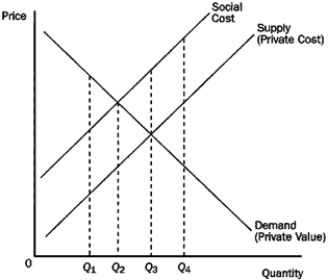 -Refer to Figure 10-4. At Q3
Figure 10-13. On the graph, Q represents the quantity of plastics and P represents the price of plastics.  -Refer to Figure 10-13. Each unit of plastics that is produced results in an external
 (Multiple Choice)
4.7/5 (85)
(85) Figure 10-12  -Refer to Figure 10-12. Suppose, on the figure, Q represents the quantity of education and P represents the price of education. Then the quantity
 represents
-Refer to Figure 10-12. Suppose, on the figure, Q represents the quantity of education and P represents the price of education. Then the quantity represents (Multiple Choice)
4.9/5 (92)
(92) Research into new technologies conveys neither negative externalities nor positive externalities.
(True/False)
4.7/5 (73)
(73) By allowing an income-tax deduction for charitable contributions, the government
(Multiple Choice)
4.9/5 (82)
(82) Assuming transaction costs are small, the Coase theorem would predict that private parties could arrive at an efficient solution for which of the following problems?
(Multiple Choice)
4.9/5 (93)
(93) When externalities are present in a market, the well-being of market participants
(Multiple Choice)
4.9/5 (92)
(92) Two firms, A and B, each currently dump 50 tons of chemicals into the local river. The government has decided to reduce the pollution and from now on will require a pollution permit for each ton of pollution dumped into the river. The government will sell 40 pollution permits for $75 each. It costs Firm A $100 for each ton of pollution that it eliminates before it reaches the river, and it costs Firm B $50 for each ton of pollution that it eliminates before it reaches the river. Neither firm produces any less output, but they both conform to the law. It is likely that between the cost of permits and the cost of additional pollution abatement,
(Multiple Choice)
4.8/5 (78)
(78) University researchers create a positive externality because what they discover in their research labs can easily be learned by others who haven't contributed to the research costs. Suppose that the federal government gives grants to these researchers equal to the their per-unit production externality. What is the relationship between the equilibrium quantity of university research and the socially optimal quantity of university research produced?
(Multiple Choice)
4.8/5 (55)
(55) Two firms, A and B, each currently emit 100 tons of chemicals into the air. The government has decided to reduce the pollution and from now on will require a pollution permit for each ton of pollution emitted into the air. The government gives each firm 40 pollution permits, which it can either use or sell to the other firm. It costs Firm A $200 for each ton of pollution that it eliminates before it is emitted into the air, and it costs Firm B $100 for each ton of pollution that it eliminates before it is emitted into the air. After the two firms buy or sell pollution permits from each other, we would expect that Firm A will emit
(Multiple Choice)
4.8/5 (68)
(68) A congestion toll imposed on a highway driver to force the driver to take into account the increase in travel time she imposes on all other drivers is an example of internalizing the externality.
(True/False)
4.7/5 (62)
(62) Table 10-3  -Refer to Table 10-3. The table represents a market in which
 (Multiple Choice)
4.8/5 (88)
(88) Suppose that an MBA degree creates no externality because the benefits of an MBA are internalized by the student in the form of higher wages. If there are no government subsidies for MBAs, then which of the following statements is correct?
(Multiple Choice)
4.8/5 (67)
(67) The business activities of Firm A confer positive externalities on Firm B, and the business activities of Firm B confer positive externalities on Firm A. If the two firms merged, then
(Multiple Choice)
4.9/5 (87)
(87) Suppose that coal producers create a negative externality equal to $5 per ton of coal. What is the relationship between the equilibrium quantity of coal and the socially optimal quantity of coal?
(Multiple Choice)
4.9/5 (71)
(71) Government can be used to solve externality problems that are too costly for private parties to solve.
(True/False)
4.8/5 (83)
(83) 
Filters
- Essay(0)
- Multiple Choice(0)
- Short Answer(0)
- True False(0)
- Matching(0)