



 Chat with AI
Exam 10: Externalities

Exam 1: Ten Principles of Economics455 Questions
Exam 2: Thinking Like an Economist645 Questions
Exam 3: Interdependence and the Gains From Trade550 Questions
Exam 4: The Market Forces of Supply and Demand693 Questions
Exam 5: Elasticity and Its Application625 Questions
Exam 6: Supply, Demand, and Government Policies671 Questions
Exam 7: Consumers, Producers, and the Efficiency of Markets547 Questions
Exam 8: Application: The Costs of Taxation507 Questions
Exam 9: Application: International Trade521 Questions
Exam 10: Externalities543 Questions
Exam 11: Public Goods and Common Resources453 Questions
Exam 12: The Design of the Tax System563 Questions
Exam 13: The Costs of Production649 Questions
Exam 14: Firms in Competitive Markets608 Questions
Exam 15: Monopoly662 Questions
Exam 16: Monopolistic Competition649 Questions
Exam 17: Oligopoly522 Questions
Exam 18: The Markets for the Factors of Production592 Questions
Exam 19: Earnings and Discrimination511 Questions
Exam 20: Income Inequality and Poverty478 Questions
Exam 21: The Theory of Consumer Choice568 Questions
Exam 22: Frontiers in Microeconomics461 Questions
Select questions type


With pollution permits, the supply curve for pollution rights is
(Multiple Choice)
4.9/5  (86)
(86) Figure 10-10  -Refer to Figure 10-10. The socially optimal quantity of output is
 (Multiple Choice)
4.9/5 (89)
(89) Figure 10-18. The graph represents a corrective tax to reduce pollution. On the axes, Q denotes the quantity of pollution and P represents the price of pollution. 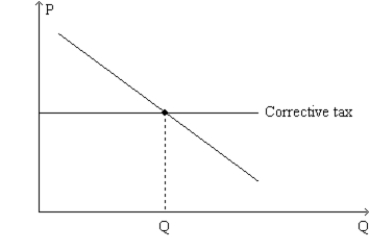 -Refer to Figure 10-18. The tax depicted on the graph
 (Multiple Choice)
4.8/5 (79)
(79) Internalizing a positive externality will cause the demand curve to
(Multiple Choice)
4.9/5 (77)
(77) Figure 10-10
-Refer to Figure 10-10. Taking into account private and external costs, the maximum total surplus that can be achieved in this market is
-Refer to Figure 10-10. Taking into account private and external costs, the maximum total surplus that can be achieved in this market is (Multiple Choice)
4.9/5 (83)
(83) Because there are positive externalities from higher education,
(Multiple Choice)
4.8/5 (90)
(90) Table 10-5
The following table shows the marginal costs for each of four firms (A, B, C, and D) to eliminate units of pollution from their production processes. For example, for Firm A to eliminate one unit of pollution, it would cost $54, and for Firm A to eliminate a second unit of pollution it would cost an additional $67. 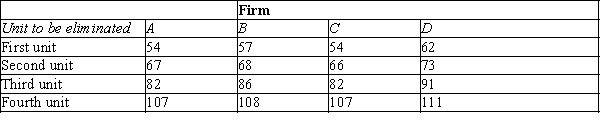 -Refer to Table 10-5. If the government charged a fee of $69 per unit of pollution, how many units of pollution would the firms eliminate altogether?
 (Multiple Choice)
4.9/5 (80)
(80) At any given quantity, the willingness to pay in the market for gasoline is reflected in the
(Multiple Choice)
4.8/5 (92)
(92) Most economists prefer corrective taxes to regulation as a way to correct the problem of pollution because
(Multiple Choice)
4.7/5 (72)
(72) The least expensive way to clean up the environment is for all firms to reduce pollution by an equal percentage.
(True/False)
4.8/5 (84)
(84) According to the Coase theorem, whatever the initial distribution of rights, the interested parties can bargain to an efficient outcome.
(True/False)
4.8/5 (79)
(79) If a market is characterized by a positive externality that is not the result of a technology spillover,
(Multiple Choice)
4.9/5 (81)
(81) Table 10-4 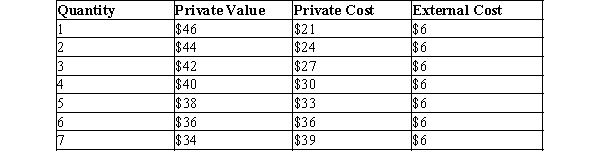 -Refer to Table 10-4. The last unit of output for which private value exceeds social cost is the
 (Multiple Choice)
4.9/5 (88)
(88) Suppose that elementary education creates a positive externality. If the government subsidizes education by an amount equal to the per-unit externality it creates, then
(Multiple Choice)
4.8/5 (88)
(88) Externalities can be corrected by each of the following except
(Multiple Choice)
4.7/5 (74)
(74) 
Filters
- Essay(0)
- Multiple Choice(0)
- Short Answer(0)
- True False(0)
- Matching(0)