



 Chat with AI
Exam 10: Externalities

Exam 1: Ten Principles of Economics455 Questions
Exam 2: Thinking Like an Economist645 Questions
Exam 3: Interdependence and the Gains From Trade550 Questions
Exam 4: The Market Forces of Supply and Demand693 Questions
Exam 5: Elasticity and Its Application625 Questions
Exam 6: Supply, Demand, and Government Policies671 Questions
Exam 7: Consumers, Producers, and the Efficiency of Markets547 Questions
Exam 8: Application: The Costs of Taxation507 Questions
Exam 9: Application: International Trade521 Questions
Exam 10: Externalities543 Questions
Exam 11: Public Goods and Common Resources453 Questions
Exam 12: The Design of the Tax System563 Questions
Exam 13: The Costs of Production649 Questions
Exam 14: Firms in Competitive Markets608 Questions
Exam 15: Monopoly662 Questions
Exam 16: Monopolistic Competition649 Questions
Exam 17: Oligopoly522 Questions
Exam 18: The Markets for the Factors of Production592 Questions
Exam 19: Earnings and Discrimination511 Questions
Exam 20: Income Inequality and Poverty478 Questions
Exam 21: The Theory of Consumer Choice568 Questions
Exam 22: Frontiers in Microeconomics461 Questions
Select questions type


When a policy succeeds in giving buyers and sellers in a market an incentive to take into account the external effects of their actions, the policy is said to
(Multiple Choice)
4.9/5  (78)
(78) In some cases, tradable pollution permits may be better than a corrective tax because
(Multiple Choice)
5.0/5 (94)
(94) Two farmers, A and B, each apply 100 tons of manure on their fields. To reduce manure runoff, the government has decided to require a permit for each ton of manure applied. The government gives each farmer 50 permits. Farmer A incurs losses of $25 for each ton of manure he does not apply, and Farmer B incurs losses of $50 for each ton of manure he does not apply. What is the total cost of reducing runoff if firms are not allowed to buy and sell permits from each other? What is the total cost of reducing runoff if the firms are allowed to buy and sell permits from each other?
(Multiple Choice)
4.8/5 (72)
(72) Suppose that Charles wants to dine at a fancy restaurant, but the only available table is in the smoking section. Charles dislikes the smell of cigarette smoke. He notices that only one person, Sam, is smoking in the smoking section. Charles values the absence of smoke at $40. Sam values the ability to smoke in the restaurant at $15. Which of the following represents an efficient solution in the absence of transaction costs?
(Multiple Choice)
4.9/5 (85)
(85) Table 10-6
The following table shows the total costs for each of four firms (A, B, C, and D) to eliminate units of pollution from their production processes. For example, for Firm A to eliminate one unit of pollution, it would cost $46, and for Firm A to eliminate two units of pollution, it would cost a total of $103. 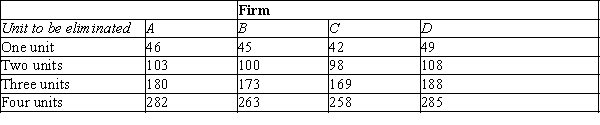 -Refer to Table 10-6. If the government charged a fee of $93 per unit of pollution, how many units of pollution would the firms eliminate altogether?
 (Multiple Choice)
5.0/5 (76)
(76) Firms that can reduce pollution easily would be willing to sell their pollution permits.
(True/False)
4.9/5 (89)
(89) The Coase theorem asserts that the private market will always solve the problem of externalities and allocate resources efficiently
(Multiple Choice)
4.7/5 (94)
(94) Suppose that flu shots create a positive externality equal to $12 per shot. What is the relationship between the equilibrium quantity and the socially optimal quantity of flu shots produced?
(Multiple Choice)
4.8/5 (84)
(84) Sheryl sits on her patio and plays her guitar while her neighbors are outside. Sheryl neither pays nor receives any compensation for playing her guitar. Under what condition does her guitar-playing give rise to a positive externality?
(Essay)
4.8/5 (85)
(85) To determine the optimal level of output in a market with negative externalities, a benevolent social planner would look for the level of output at which private cost equals private value.
(True/False)
4.7/5 (94)
(94) Which of the following best defines the situation where one firm's research yields knowledge that is used by society as a whole?
(Multiple Choice)
4.8/5 (97)
(97) Figure 10-1 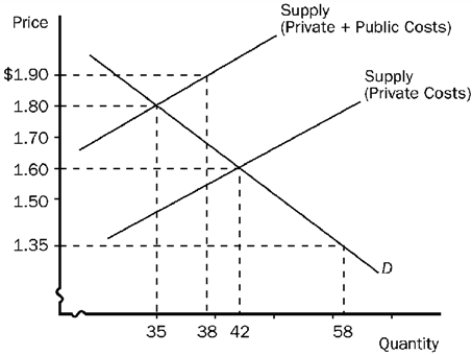 -Refer to Figure 10-1. This graph represents the tobacco industry. The socially optimal price and quantity are
 (Multiple Choice)
4.8/5 (79)
(79) Suppose the socially-optimal quantity of good x is 2,500 units and the market-equilibrium quantity of good x is 3,000 units. When 2,500 units of good x are produced, the
(Multiple Choice)
4.8/5 (68)
(68) Which of the following require firms to pay to pollute? (i)
Corrective taxes
(ii)
Tradable pollution permits
(iii)
Pollution regulations
(Multiple Choice)
4.9/5 (69)
(69) Assume each gallon of gasoline that is produced gives rise to an external cost of $1.25. On any given day, the production of the 10,000th gallon of gasoline entails a private value of $4.00 and a social cost of $3.50. What is the private cost of the 10,000th gallon?
(Essay)
5.0/5 (93)
(93) Flu shots provide a positive externality. Suppose that the market for vaccinations is perfectly competitive. Without government intervention in the vaccination market, which of the following statements is correct?
(Multiple Choice)
4.9/5 (61)
(61) Which of the following is an advantage of tradable pollution permits?
(Multiple Choice)
4.7/5 (73)
(73) Figure 10-9 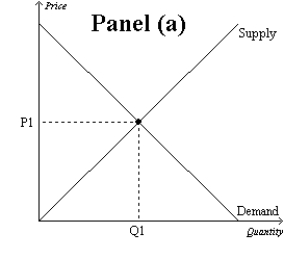
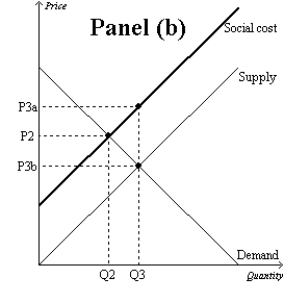
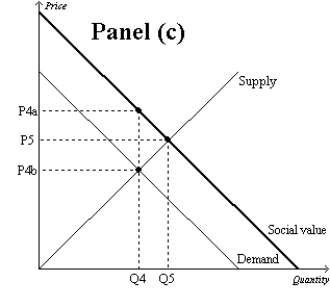 -Refer to Figure 10-9, Panel (c). The market equilibrium price is
 (Multiple Choice)
4.8/5 (84)
(84) Dee loves to landscape her yard, but her neighbor Marvin places a low value on his landscaping. When Marvin's grass is neglected and gets long, Dee will mow it for Marvin. This is an example of
(Multiple Choice)
4.9/5 (86)
(86) 
Filters
- Essay(0)
- Multiple Choice(0)
- Short Answer(0)
- True False(0)
- Matching(0)