



 Chat with AI
Exam 10: Externalities

Exam 1: Ten Principles of Economics455 Questions
Exam 2: Thinking Like an Economist645 Questions
Exam 3: Interdependence and the Gains From Trade550 Questions
Exam 4: The Market Forces of Supply and Demand693 Questions
Exam 5: Elasticity and Its Application625 Questions
Exam 6: Supply, Demand, and Government Policies671 Questions
Exam 7: Consumers, Producers, and the Efficiency of Markets547 Questions
Exam 8: Application: The Costs of Taxation507 Questions
Exam 9: Application: International Trade521 Questions
Exam 10: Externalities543 Questions
Exam 11: Public Goods and Common Resources453 Questions
Exam 12: The Design of the Tax System563 Questions
Exam 13: The Costs of Production649 Questions
Exam 14: Firms in Competitive Markets608 Questions
Exam 15: Monopoly662 Questions
Exam 16: Monopolistic Competition649 Questions
Exam 17: Oligopoly522 Questions
Exam 18: The Markets for the Factors of Production592 Questions
Exam 19: Earnings and Discrimination511 Questions
Exam 20: Income Inequality and Poverty478 Questions
Exam 21: The Theory of Consumer Choice568 Questions
Exam 22: Frontiers in Microeconomics461 Questions
Select questions type


When Monique drives to work every morning, she drives on a congested highway. What Monique does not realize is that when she enters the highway each morning she increases the travel time of all other drivers on the highway. In this case, the external cost of Monique's highway trip
(Multiple Choice)
4.9/5  (78)
(78) Suppose the Environmental Protection Agency uses a corrective tax to set a price for pollution. Under this policy, is the supply curve for pollution rights vertical or is it horizontal?
(Short Answer)
4.7/5 (82)
(82) Suppose that elementary education creates a positive externality. If the government does not subsidize education, then
(Multiple Choice)
4.7/5 (96)
(96) Suppose that cookie producers create a positive externality equal to $2 per dozen. What is the relationship between the equilibrium quantity and the socially optimal quantity of cookies to be produced?
(Multiple Choice)
4.8/5 (89)
(89) The Environmental Protection Agency (EPA) cannot reach a target level of pollution through the use of pollution permits.
(True/False)
5.0/5 (73)
(73) Corrective taxes cause deadweight losses, reducing economic efficiency.
(True/False)
4.8/5 (71)
(71) Figure 10-10  -Refer to Figure 10-10. A decrease in output from 160 units to 120 units would
 (Multiple Choice)
4.7/5 (75)
(75) Scenario 10-2
The demand curve for restored historic buildings slopes downward and the supply curve for restored historic buildings slopes upward. The production of the 50th restored historic building entails the following:
• a private cost of $800,000;
• a private value of $650,000;
• a social value of $800,000.
-Refer to Scenario 10-2. Could the government impose a tax or provide a subsidy to move the market to the social optimum? If your answer is "Yes," should it be a tax or should it be a subsidy?
(Essay)
4.8/5 (84)
(84) Table 10-2
The following table shows the private value, private cost, and social value for a market with a positive externality. 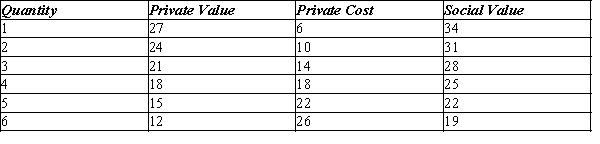 -Refer to Table 10-2. What is the equilibrium quantity of output in this market?
 (Multiple Choice)
4.9/5 (79)
(79) Table 10-5
The following table shows the marginal costs for each of four firms (A, B, C, and D) to eliminate units of pollution from their production processes. For example, for Firm A to eliminate one unit of pollution, it would cost $54, and for Firm A to eliminate a second unit of pollution it would cost an additional $67. 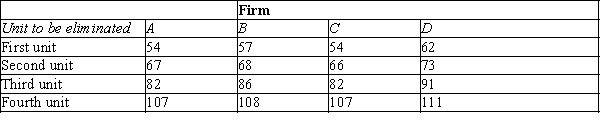 -Refer to Table 10-5. Suppose the government wants to reduce pollution from 16 units to 8 units and auctions off 8 pollution permits to achieve this goal. Which of the following is a likely auction price of the permits?
 (Multiple Choice)
4.7/5 (76)
(76) A local manufacturing plant that emitted sulfur dioxide was forced to stop production because it did not comply with local clean air standards. This decision provides an example of
(Multiple Choice)
4.7/5 (67)
(67) Which of the following is a way to address an externality problem?
(Multiple Choice)
4.9/5 (82)
(82) Scenario 10-2
The demand curve for restored historic buildings slopes downward and the supply curve for restored historic buildings slopes upward. The production of the 50th restored historic building entails the following:
• a private cost of $800,000;
• a private value of $650,000;
• a social value of $800,000.
-Refer to Scenario 10-2. Is there an externality associated with this market? If your answer is "Yes," is the externality positive or negative?
(Essay)
4.7/5 (76)
(76) Suppose the Environmental Protection Agency issues pollution permits in order to limit the quantity of pollution. Under this policy, is the supply of pollution rights perfectly elastic or is it perfectly inelastic?
(Short Answer)
4.8/5 (90)
(90) A paper plant produces water pollution during the production process. If the government forces the plant to internalize the negative externality, then the
(Multiple Choice)
4.9/5 (81)
(81) The Coase theorem suggests that efficient solutions to externalities can be determined through bargaining. Under what circumstances will private bargaining fail to produce a solution?
(Essay)
4.9/5 (62)
(62) Government intervention in the economy with the goal of promoting technology-producing industries is known as patent policy.
(True/False)
4.8/5 (77)
(77) Table 10-3  -Refer to Table 10-3. The social value of the 4th unit of output that is produced is
 (Multiple Choice)
4.7/5 (96)
(96) Figure 10-12  -Refer to Figure 10-12. An alternative label for the line labeled "Supply" would be
 (Multiple Choice)
4.8/5 (90)
(90) 
Filters
- Essay(0)
- Multiple Choice(0)
- Short Answer(0)
- True False(0)
- Matching(0)