



 Chat with AI
Exam 10: Externalities

Exam 1: Ten Principles of Economics455 Questions
Exam 2: Thinking Like an Economist645 Questions
Exam 3: Interdependence and the Gains From Trade550 Questions
Exam 4: The Market Forces of Supply and Demand693 Questions
Exam 5: Elasticity and Its Application625 Questions
Exam 6: Supply, Demand, and Government Policies671 Questions
Exam 7: Consumers, Producers, and the Efficiency of Markets547 Questions
Exam 8: Application: The Costs of Taxation507 Questions
Exam 9: Application: International Trade521 Questions
Exam 10: Externalities543 Questions
Exam 11: Public Goods and Common Resources453 Questions
Exam 12: The Design of the Tax System563 Questions
Exam 13: The Costs of Production649 Questions
Exam 14: Firms in Competitive Markets608 Questions
Exam 15: Monopoly662 Questions
Exam 16: Monopolistic Competition649 Questions
Exam 17: Oligopoly522 Questions
Exam 18: The Markets for the Factors of Production592 Questions
Exam 19: Earnings and Discrimination511 Questions
Exam 20: Income Inequality and Poverty478 Questions
Exam 21: The Theory of Consumer Choice568 Questions
Exam 22: Frontiers in Microeconomics461 Questions
Select questions type


Scenario 10-4
The demand curve for fire extinguishers slopes downward and the supply curve for fire extinguishers slopes upward. The production of the 500th fire extinguisher entails the following:
• a private cost of $10;
• an external cost of $0;
• a private value of $9;
• an external benefit of $3.
-Refer to Scenario 10-4. Is the socially-optimal quantity of fire extinguishers less than, equal to, or greater than 500? Explain.
(Essay)
4.9/5  (75)
(75) Figure 10-10  -Refer to Figure 10-10. Which of the following statements is correct?
 (Multiple Choice)
4.8/5 (70)
(70) Thurman is a writer who works from his home. Thurman lives next door to Phil, the drummer for a local band. Phil needs a lot of practice to earn $250, which is his share of the band's profit. Thurman gets distracted by Phil's drumming but he needs to get his writing done to earn $500 for his current article. Which of the following is an efficient solution?
(Multiple Choice)
4.9/5 (87)
(87) Which of the following statements is true of both pollution permits and corrective taxes?
(Multiple Choice)
4.8/5 (73)
(73) Figure 10-9 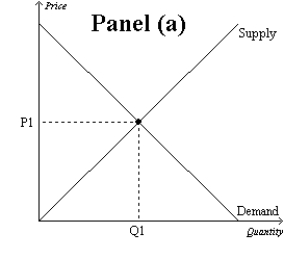
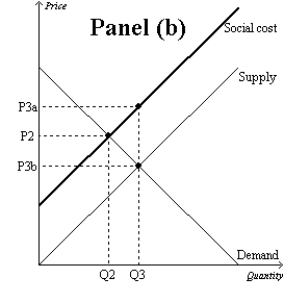
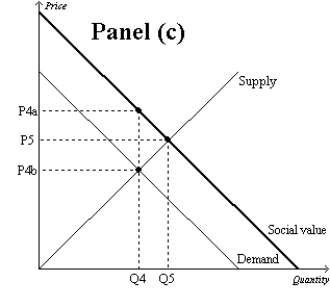 -Refer to Figure 10-9, Panel (b) and Panel (c). The overuse of antibiotics leads to the development of antibiotic-resistant diseases. Therefore, the external cost of antibiotic overuse is represented by
 (Multiple Choice)
4.8/5 (92)
(92) The Coase theorem asserts that, in the presence of externalities,
(Multiple Choice)
4.8/5 (89)
(89) If we know that the supply curve for good x fails to reflect the total cost to society of producing that good, then we know that
(Multiple Choice)
4.7/5 (68)
(68) Figure 10-11  -Refer to Figure 10-11. Which of the following statements is correct?
 (Multiple Choice)
4.8/5 (74)
(74) Suppose that smoking creates a negative externality. If the government does not interfere in the cigarette market, then
(Multiple Choice)
4.8/5 (82)
(82) If the production of computer chips yields greater technology spillovers than the production of potato chips, the government should
(Multiple Choice)
5.0/5 (79)
(79) If an objective of public policy is to allocate pollution to those factories that face the highest cost of reducing it, then that objective could be achieved by
(Multiple Choice)
4.8/5 (88)
(88) Figure 10-14 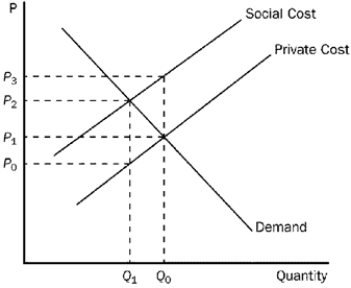 -Refer to Figure 10-14. Which of the following statements is correct?
 (Multiple Choice)
4.8/5 (91)
(91) Figure 10-12  -Refer to Figure 10-12. The graph, as drawn, could apply to the market for
 (Multiple Choice)
4.8/5 (76)
(76) Which theorem asserts that private economic actors can often solve the problem of externalities among themselves?
(Short Answer)
4.9/5 (76)
(76) Figure 10-16 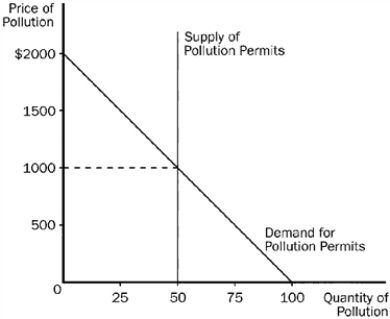 -Refer to Figure 10-16. This graph shows the market for pollution when permits are issued to firms and traded in the marketplace. In the absence of a pollution permit system, the quantity of pollution would be
 (Multiple Choice)
4.9/5 (72)
(72) Table 10-4 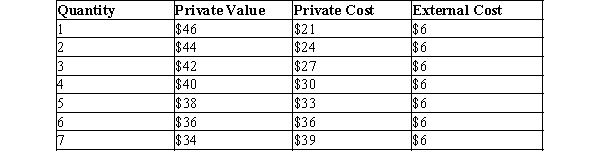 -Refer to Table 10-4. Take into account private and external costs and assume the quantity of output is always a whole number (that is, fractional units of output are not possible). The maximum total surplus that can be achieved in this market is
 (Multiple Choice)
4.8/5 (94)
(94) Which of the following would not be considered a negative externality?
(Multiple Choice)
4.9/5 (73)
(73) Scenario 10-4
The demand curve for fire extinguishers slopes downward and the supply curve for fire extinguishers slopes upward. The production of the 500th fire extinguisher entails the following:
• a private cost of $10;
• an external cost of $0;
• a private value of $9;
• an external benefit of $3.
-Refer to Scenario 10-4. What is the social value of the 500th fire extinguisher?
(Essay)
4.8/5 (88)
(88) According to the Coase theorem, private markets will solve externality problems and allocate resources efficiently as long as
(Multiple Choice)
4.8/5 (75)
(75) 
Filters
- Essay(0)
- Multiple Choice(0)
- Short Answer(0)
- True False(0)
- Matching(0)